Introduction.
The Empty Quarter is considered to be the largest uninterrupted sand desert on the planet, situated in the southern region of Saudi Arabia and spilling into the north west of Oman and eastern Yemen. An area of desolate landscapes of great beauty. It has a unique set of ecosystems that allow a remarkable flora and fauna to exist in one of the most inhospitable regions in the world. Human settlements are found at its edges with traditional Boswellia or frankincense routes that start and end at these locations that lead around and across the sand seas.
In conversation the other day the area of the Empty Quarter and water supply came up. I stated that beneath many parts of the region there were good aquifers: in a desert it might be expected to be dry beneath the parched surface, but in reality this may not be so. Clean Rivers Trust has taken an interest in the water issues in Yemen for many years and researched the resources in many parts of the country including the Empty Quarter.
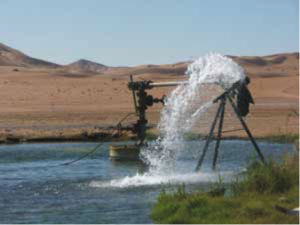
The water resources change both in volume and quality quite markedly but there are plentiful reserves that might be utilised across much of the country


The location of the Empty Quarter and its relationship within the region geographically.
The purpose of this short paper is to demonstrate the availability and possible qualities of the resource, though it should be emphasised that such waters may or may not need some human intervention to bring it to a standard for human or agricultural use.
Deserts have been around for millennia, their sizes have varied as have their climactic severity, the notion that the Sahara could be the source of water for the majority of the coastal dwelling people of Libya was a dream that was made a reality by Muammar Gaddafi before his downfall in 2011. The water came from the southern area of the country from a section of the Nubian Aquifer, a resource that could have significance for other North African, Saharan and Near/Middle Eastern populations, such as Chad, Egypt, South West Sudan, possibly Palestine and the Sinai Peninsula.
This aquifer being based on sandstones interspersed with marls and other strata which hold prehistoric water of meteoric origin: that is ancient rainfall which has percolated through the surface cover when the desert was a lush wet savannah. Historically the last vestiges of this green fertile region are recorded in Pharaonic wall paintings and papyri showing hunting over rich grass lands to the south of Egypt in the land known as Nubia. This ancient title is now given to the whole aquifer. The lower stretches of the White Nile, the Sudd wetlands are an approximate border and a possible last vestige of this green paradise. This Nubian aquifer, in a more fractured form, has been found to underlie areas as far east as parts of Saudi Arabia and northern Yemen. These aquifer sections are older as they have lost much of their geological continuity due to the fracturing of the Red Sea and continental drift.
Yemen Water Resources.
Before highlighting the Empty Quarter specifically it is worth taking an over view of the general water situation across the whole of the country.
History at our Service.
Historically Yemen has been a rich and fertile country, often admired from afar but seldom subjugated, most foreign empires rather trading in partnership with, rather than trying to conquering the country. The country was the home of the first coffee plantations in the 15th Century CE, and long before that the domain of the almost mythical Queen of Sheba and the centre of water engineering in the known world several hundreds of years BCE and initiated by the Sabine peoples hundreds of years earlier still. In that time it is recognised in ancient texts that the Queen was amongst the most farsighted in that of structuring the water needs of her peoples (which may have stretched beyond Yemen’s shores into Ethiopia)
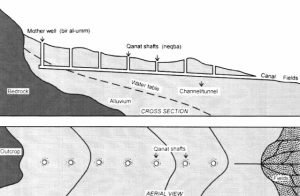
The development of Qanats (see below) and the terracing of land were developed in those times: many of the remarkable terraced landscapes of today are the resultant legacy of those times, the use of slaves being a common engineering device as was also likely in the digging of the qanats 9the knowledge of their digging coming from the area of modern day Iran) which have all but disappeared across much of the region due to shifting sands and changes in population distribution. More recent structures are operational in the south and west of Yemen.
The use of terracing that allowed the capture of rainfall from the annual monsoons that pass across the country in most years allows for large areas of rugged land to be turned over to profitable agricultural use.

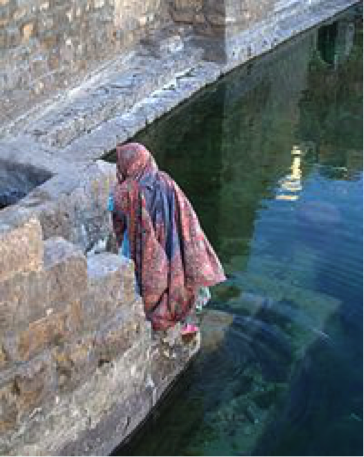
Fresh water wells, many of which are reminiscent of those found on the Indian sub-continent are attributable to these periods and acted as both well and conduit for the recharge of the aquifers.
The act of damming valleys was not an easy feat to accomplish in a desert region but at Marib an ancient and modern version have both in their times proved their worth although the present dam is far from useable due to the security issues of the present time.
The medieval Arab geographer Yāqūt al-Ḥamawī described the Marib Dam: ‘It is between three mountains, and the flood waters all flow to the one location, and because of that the water only discharges in one direction; and the ancients blocked that place with hard rocks and lead. The water from springs gathers there as well as floodwater, collecting behind the dam like a sea. Whenever they wanted to they could irrigate their crops from it, by just letting out however much water they needed from sluice gates; once they had used enough they would close the gates again as they pleased.’ (The dam was severely damaged by a Saudi airstrike in the night of May 31, 2015.
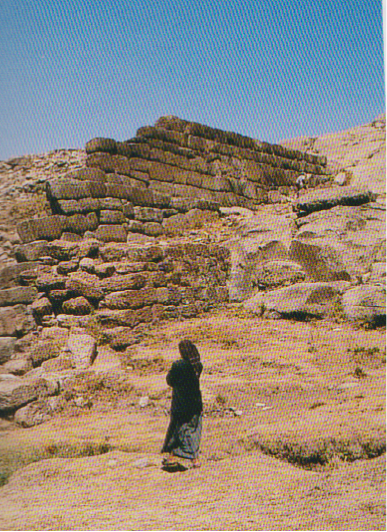
The old dam from around 740 BCE.
Ground Water in the Empty Quarter.
The southern edge of the Empty Quarter has a groundwater table fed by the waters brought by the monsoons that fall on the mountains to the south of the region. These water resources are quite shallow and in some area are over used and the resource depleted. The aquifers are also liable to be polluted by both human waste and grazing animals. The deeper aquifers the area are much better known to the north in Saudi and east in Oman. The development of some of the largest oil and gas fields on earth facilitating this knowledge. Boreholes at depths of one kilometre and deeper being commonly used to access unexpectedly high volumes. Ancient qanats exist and are not difficult to bring back into use.
The Saudi Geological Survey demonstrated the resources in 2010 and 2013 to invited groups of geologists, hydrogeologists and historians for the purpose of gaining support for future development of tourism, there being a wide variety of archaeological sites of interest as well as an abundance of sand and blue sky. The Empty Quarter is proving to be far richer in hydrocarbon deposits, both oil and natural gas.
In Oman the state owned Oman Gas Company has installed the world’s largest treatment wetland (nearly 800 hectares in size) in the Empty Quarter to treat waste water from their new facility at Nimr, which is now turning this part of the Empty Quarter green through its over 380 hectare reed beds and the reuse of some of the water for agricultural crop development. It has also turned into an oasis for bird life, giving refuge to both a new indigenous community and many avian species on migration.
The use of drone prospecting techniques are finding new water bearing rock formations beneath the sands in the region. Such activity has not been based in Yemen though Saudi survey teams have located sites of water resource.
The use of flora indicator research alongside archaeological study can be productive in locating water at manageable depths.
Emergency Water and Long Term Resource.
The most remarkable aspect of the Yemeni Climate in times of drought or other water shortage are the mountainous regions that closely border the Arabian Sea: there is little infrastructure to collect water precipitated during the monsoon periods and ecologically the collection in high volume might have damaging consequences for the natural flora and fauna. The water available has never been accessed. The mists that come in on a daily basis from the sea are thick and carry a high water content. Such mist is easily captured and delivered to a water network. (CRT/Anglo American Atacama Desert mining town supplies 1997).
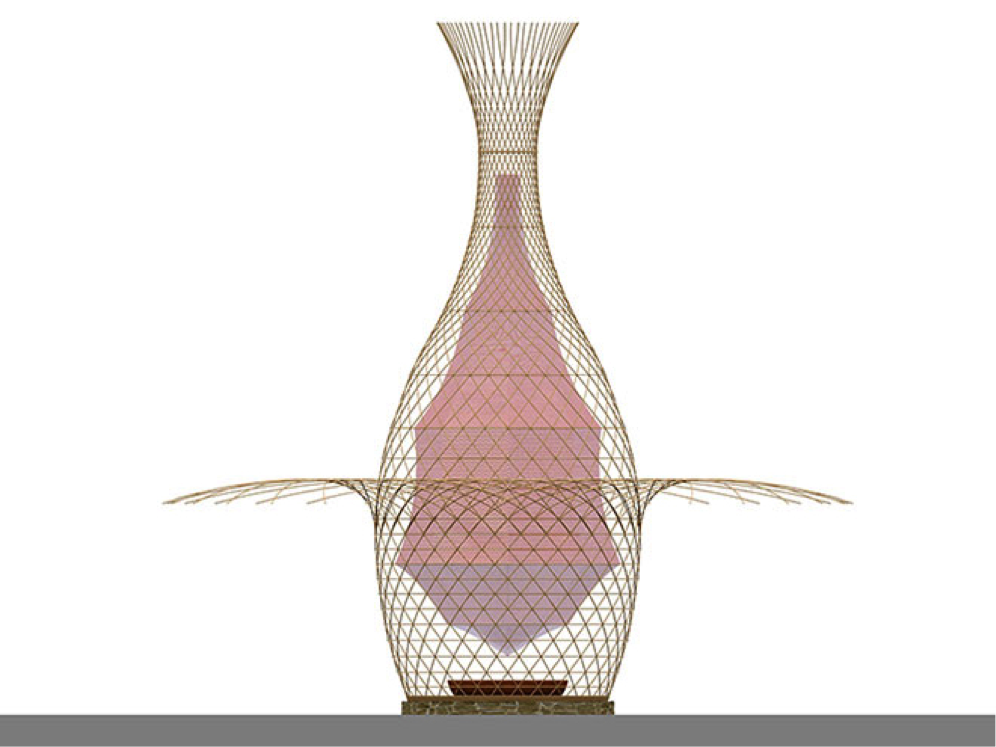
A design originating from Italy but constructed in Ethiopia to supply villages with mist derived water.
The Largest Treat to Yemen’s Water Supply.
The dependence on cash crops to sustain the high agricultural rents or fees due to tribal land owners ensures the levels of Qat production is constantly growing. The desire of many farmers to produce food rather than sustain the national recreational habit are great but due to the geography and the economic conditions such changes are hard to make. The two other, both internationally traded crops produced in Yemen being dates and coffee. Dates are sold under an agreement with Saudi Arabia and often marketed as Arabian Peninsula produce whilst the coffee plantations have become rudderless with the last 15 years of inactive marketing by the government backed trade organisation (Fortnum and Mason, London 2016). This has led to the berry tree orchards being cut down and replaced by qat.
The issue with qat is the volumes of water needed to grow the young leaves. Of all the water available to the Yemen 45% of it is used for its production, this is unsustainable and is using huge volumes that otherwise might be available to go some way to negate the water scarcity around the capital Sana’a and other cities.
Attempts by the government and Imams to declare it either illegal or haram have failed to break the hold this plant has on the national psyche. The damage to families, children and female malnourishment, poverty and relationship breakdown being widely acknowledged.
CRT have carried out 7 years of trials on methods of irrigation that cut water usage and have put forward papers on trickle irrigation and other methods to both the ministries of Agriculture and Water and Environment.