Introduction.
Across the Indian Sub-continent millions of people have plentiful water supplies that are poisoning them. Others are short of water supply and what they can access is also killing them. Arsenic is a killer when it is ingested over time. It has a history as long as time itself of its lethal effects. The famous as well as the poor have lost their lives to it. Napoleon died in exile from its effects, he knew he was suffering from its toxicity but that did not change the outcome for him as it will not for millions of Indian families. Further arsenic is being ingested via rice that is being grown using arsenic rich irrigation water.
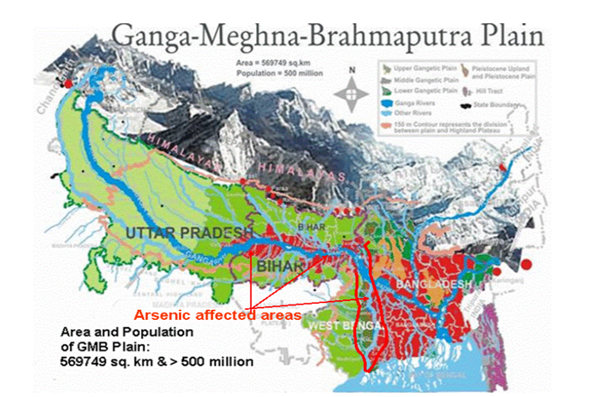
Across much of India and Bangladesh the arsenic pollution of groundwater is caused by high concentrations of the metal in the source rocks in which the groundwater is found, though in some parts, as in some of West Bengal the source is the solute form of arseno-pyrites that have migrated through the parent strata to the aquifers.
The vast increases in the need for potable supply across much of India is due to increases, both in life expectancy and general potable water use has in many instances destroyed the traditional well supply system, these now being dry. The most reliable ‘quick fix’ being tube wells accessing deeper and deeper aquifers as each level reached dries up through over exploitation. The water consumption rise is further exacerbated by the need to maximise potential cropping of land. The desire for increased rice yields and its biannual cropping is allowing the wider contamination of food stuffs. Rice is a great bioaccumulator of arsenic and other metals.
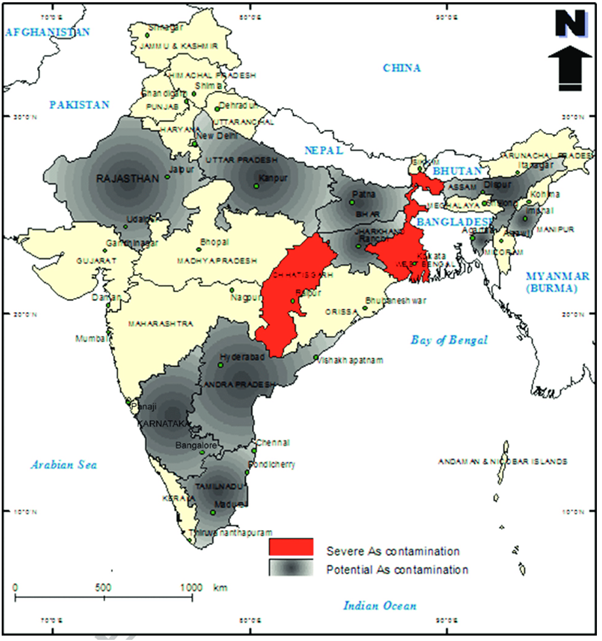
In the above plan, the areas marked as having potential arsenic contamination, are already demonstrating this potential across the whole of the country. As increased pumping progresses this problem will become worse.
Irrigation of Crops.
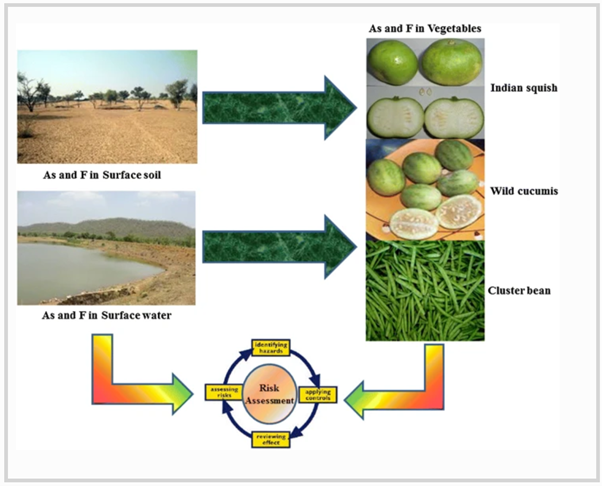
Alongside the problems of rice, which has already been raised in the previous section many other crops that are watered across the country are susceptible to bioaccumulation of pollutants, particularly metals such as arsenic (As). Another, common problem associated with wells and being natural fluoride (F), which can cause dental issues and lead to other illnesses.
Solutions.
- i) In-situ remediation of arsenic from aquifer system:
This is possible and ideally could solve the long-term problem. The cost though of pumping polluted water to waste would be prohibitive and lead to issues such as contamination of land in the vicinity of wells.
- ii) Ex-situ remediation of arsenic from tapped groundwater by arsenic removal technologies:
This is the short to mid term option that is the most attractive and can be highly cost effective. There are several proprietary and other cheaper methods. Methods can be put in place on the community or family level to supply potable supply. The issues of decontamination of irrigation water are more complex and need to be considered on a broader basis, though it is achievable.
iii) Use of surface water source as an alternative to the contaminated groundwater source:
In certain areas the use of reservoirs and sand dams would allow total cessation of well water use.
- iv) Tapping alternate safe aquifers for supply of arsenic free groundwater:
The accessing water from different aquifers is not an easy option as much research needs to be carried out to ensure the resources long term sustainability.