USAID’s IWRM Program in Morocco
THE purpose of this case study series is to familiarize Missions and Regional Bureaus with practical approaches to integrated water resources management (IWRM) that have proven to be successful in USAID field programs.
Acknowledgments
This report was produced by the USAID Water Team with information provided by Michele Zador, John Thomas, and Alan Hurdus of USAID. Photographs were taken by R. Choukr- Allah and F. Rachidi.
Keywords
Integrated water resources manage- ment; Morocco; river basin authorities; “Water” Strategic Objective
Introduction
One of the major development challenges facing Morocco is the sustainable management of its water resources. Already classified as water- poor, Morocco’s rapid population growth, combined with increased urbanization and industrialization, will make water an ever-more contentious issue in the future unless a fundamen- tally new way of managing water is adopted. The lack of water is already a major development challenge for most rural communities. The UN estimates that 58 percent of the rural population lacked access to adequate sanitation in 2000, and 42 percent lacked access to potable drinking water. Experts warn that water pollution from agriculture, industry, and households is worsening, while strategies to combat the problem are only beginning to be developed. Overlaying the waterscape is the fact that two-thirds of the country’s agricultural exports, a major economic sector, are produced by irrigated agriculture, which uses 92 percent of
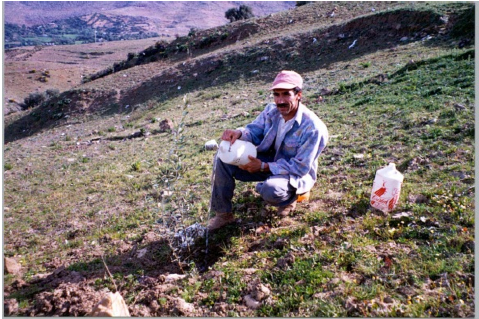
Erosion in the Nakhla watershed was significantly reduced by planting olive tree seedlings on steep hillsides, such as those pictured above.
the nation’s dwindling freshwater resources. Farmers, however, have been slow to adopt new techniques and equipment that economize on irrigation water. In the meantime, the country is getting drier, with the frequency and severity of droughts increasing dramatically since the 1980s. With current projections indicating a doubling in population over the next 30 years, massive decreases in per capita water availability are expected.
To prevent a water crisis that threatens the country’s well-being, sweeping changes in the way water is managed are essential. Fortunately, the Government of Morocco has taken several steps to improve water manage- ment in recent years, including a major water reform program that decentral- izes financial and planning authority for water resources to nine river basin agencies (RBAs), to be created incrementally.