1 Introduction.
Farley Moor is a small part of a piece of forestry set above Matlock in Derbyshire. Below the moor is the small village of Farle, a community that relies on its own water supplies of wells and a gathering ground with underground storage. The company Forest Holidays has proposed to build a development above the village of wooden cabins, shop, and café within the forest. The community are concerned for their water supply.
The Forestry Commission (Forest England) have along with Forest Holidays put forward plans to change the nature of the nature of Farley Moor that stands above the tourist centre of Matlock in Derbyshire. The plan is designed to profit from the local attractions that bring in tourists and others in large numbers to the area. The proposed plan does not mention tourism but emphasizes nature conservation and planning net gain (the new buzz words for putting a plan in place in an unsuitable location.
2 Comment.
2.1 The Plan is remarkable in that it is written so that one would not know that Forest Holidays was not part of the Forestry Commission and that it is owned by an international investment company (see Appendix 1).
2.2 A highlighted benefit to the local area will be that the local forestry will benefit from planning net gain, which is specified as planting native trees in areas already earmarked for replanting after clear felling some years ago. The term for this is double dipping or being paid twice for the same thing. The4 Forestry Commission (Forest England) have already budgeted for the scheduled replanting.
2.3 The outline of the plan suggests nightjar and other birds will be encouraged to inhabit the area due to planning net gain. The nightjar is already present in the area and an increase in human activity in the area will make it a less favourable site for threatened species.
2.4 Two concerns regarding drainage.
Surface/storm water drainage is to be stored on site and any chance of flooding would be avoided by releasing surface water to ground or surface. This would impact properties below Farly Moor and other properties who gain their water supply from wells and gathering grounds below the moor.
Sewage generated on the site would not go to a sewer but to an onsite treatment works. The plan states that the public sewer could manage the volume of effluent generated and might be considered disingenuous as no properties in the area have access to a public sewer. The volume of water needing to be treated (appendix 2). The fowl water drainage would need to be treated within the site and the use of a soakaway. This would lead to damage the water quality of the properties below the development permanently. Even if the site were linked to a main sewer the normal leakage from the sewage pipework would lead the local authority environmental health department to condemn the water supply from wells and gathering ground to houses below the site.
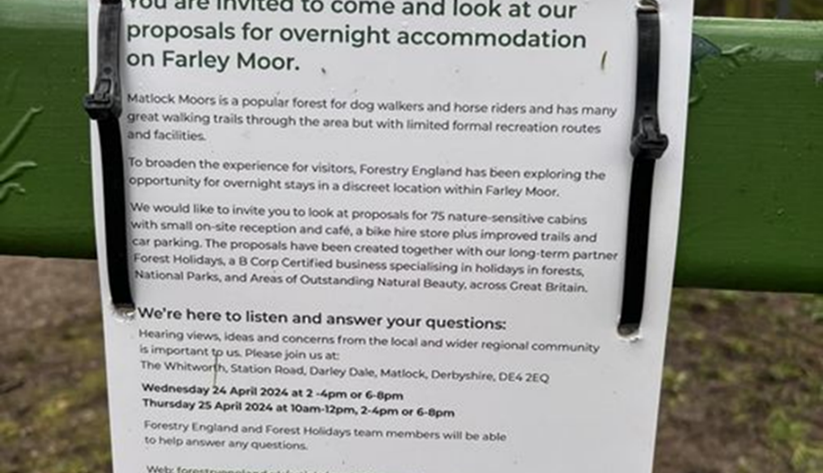
The public invitation from Forest England and Forest Holidays to the Public Exhibition made no differentiation between them and gives the impression that they are both part of the same entity, the Forestry Commission.
The area stated as being taken up by the development is greater than 2.5% of Farley Moor. The land taken amounts to more than 80%.
The employment of ‘Forest Rangers’ who at other sites function as security guards to stop outdoor cooking and noise. On some sites quad bike problems have led to incidents where the police and ambulances have had to attend.
The plan puts forward the spurious untruth that nature benefits from increasing visitor numbers. This is also true for humans with low paid jobs being offered in shop, cleaning, and gardening/maintenance. No opportunities for careers or apprenticeships.
The plan states that the Minister at the Department for the Environment, Food and Rural Affairs has signed the project off. This is not true. The Forestry Commission had to get permission to offer a lease to Forest Holidays. This is an untruth that makes one realise that this is purely a money-making venture for venture capital companies who do little for where their businesses are located with the majority of profits leaving the country.
3 Conclusion.
The best option for Derbyshire Dales District Council would be to refuse this planning application on the above ground and also the inferior quality of public relations and consultation. The council should also question the role of Forest England and the Forestry Commission regarding its somewhat underhand support for the scheme. The circumnavigation of the truth is startling.
Appendix 1.
1.1 Forest Holidays.
Bath Yard, Bath Lane, Moira, Swadlincote, Derbyshire, DE12 6BA
The company first was formed by Forest Enterprise, a department of the Forestry Commission. Since devolution, Forest England, Forest Scotland, and Natural Resources Wales (the Environment Agency in Wales) manage the ownership of each country’s forests.
In 2017 the Forestry Commission were tasked to raise revenues from their estates beyond their camping grounds. The Forestry Commission raise investment capital by creating Forest Holidays as a stand-alone company and selling a controlling stake of 51%(?) to Phoenix Equity Partnership. In 2022 low point of holidaying in the UK after the Covid pandemic saw the company in need of investment and the three-government owned entities sold their interest in Forest Holidays alongside a proportion of Phoenix’s holding to Sykes Holiday Cottages (wholly owned by Vitruvian Partners International Investment).
Since this decoupling from state part ownership the Forestry Commission have functioned as agents to help Forest Holidays gain new sites for developments of up to 76 timber cabins or lodges on Forestry Commission owned sies across England, Wales, and Scotland.
1.2 Phoenix Equity Partnership.
10th Floor, 123 Victoria Street, London, England, SW1E 6DE
Phoenix is a company that capitalises investment in a business and looks to maximise growth to encourage market value growth of its assets and attract takeover bids from other companies. Founded 2003.
1.3 Sykes Holiday Cottages.
One City Place, Queens Road, Chester, Cheshire, United Kingdom, CH1 3BQ
Founded in 1991. Ownes or controls 22,000+ holiday cottages across the UK and Ireland.
Owned by Vitruvian Partners.
1.4 Vitruvian Partners International Investment. (Private Company)
105 Wigmore Street, London, United Kingdom, W1U 1QY
Offices also in Munich, Germany / Stockholm, Sweden / Luxembourg / Madrid, Spain / Shanghai, China / San Francisco, United States / Mumbai, India/ Singapore,
Invested in Sykes Holiday Cottages in 2019. Stating it was a ‘consumer technology and internet company,’ strange heading for a holiday cottage company. Investments seem light weight as published but other companies may hold more substantial assets or other holdings such as data.
Capitalised to £30 billion.
The company appears to specialise in sales of European assets to Asian/Chinese investment companies.