Canada’s Smoking Hills.
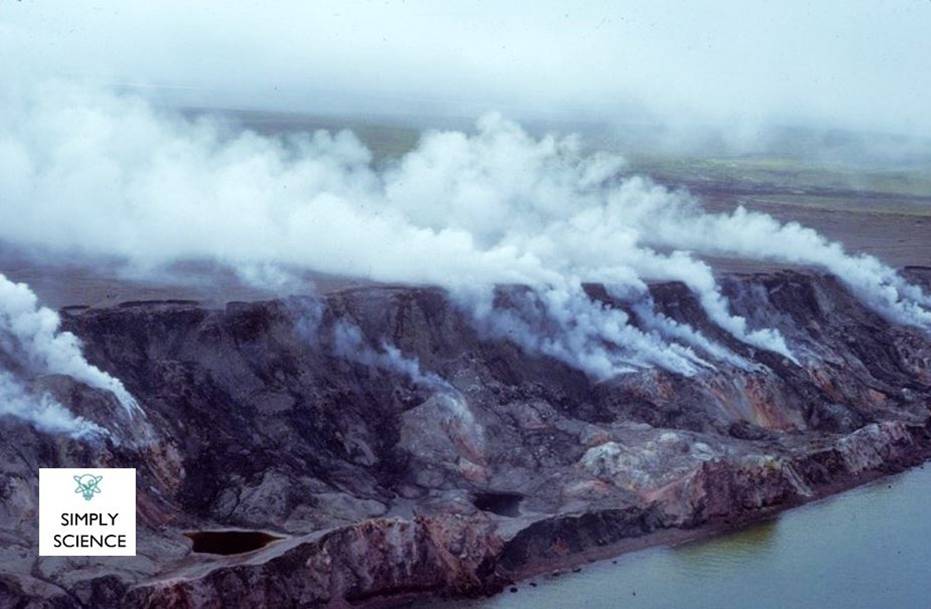
The remarkable problems of global warming in the Arctic regions of North American are exacerbated by the geology of part of the region.
The Smoking Hills (Inuvialuktun: Ingniryuat) are a unique geological phenomenon located on the eastern coast of Cape Bathurst in Canada’s Northwest Territories. These cliffs have been continuously smouldering for centuries—potentially up to 10,000 years—creating a landscape often described as “Hell on Earth”.
Geological Origin
The “smoke” is not caused by volcanic activity or forest fires, but by a process of spontaneous auto-combustion:
- The Reaction: The hills are composed of oil shales rich in sulphur and lignite (brown coal).
- Exposure: When coastal erosion or permafrost slumping exposes these minerals to the air, the pyrite (fool’s gold) reacts with oxygen, generating enough heat to ignite the surrounding hydrocarbons.
- The Result: Plumes of thick, toxic sulphuric acid gas rise from the vents, staining the cliffs in vibrant shades of red, orange, and yellow (known as “clinker”).
Environmental Impact
The area is one of the most toxic and acidic natural environments on the planet:
- Extreme Acidity: Nearby ponds have recorded negative pH levels (as low as -1.44), making them more acidic than battery acid.
- Toxic Fumes: The air reeks of rotting eggs (hydrogen sulphide) and contains high concentrations of sulphur dioxide, making it deadly to breathe without a respirator near the vents.
- Scientific Interest: NASA and other researchers study the site as a Mars analogue to understand how life might survive in extreme, acidic conditions on other planets.
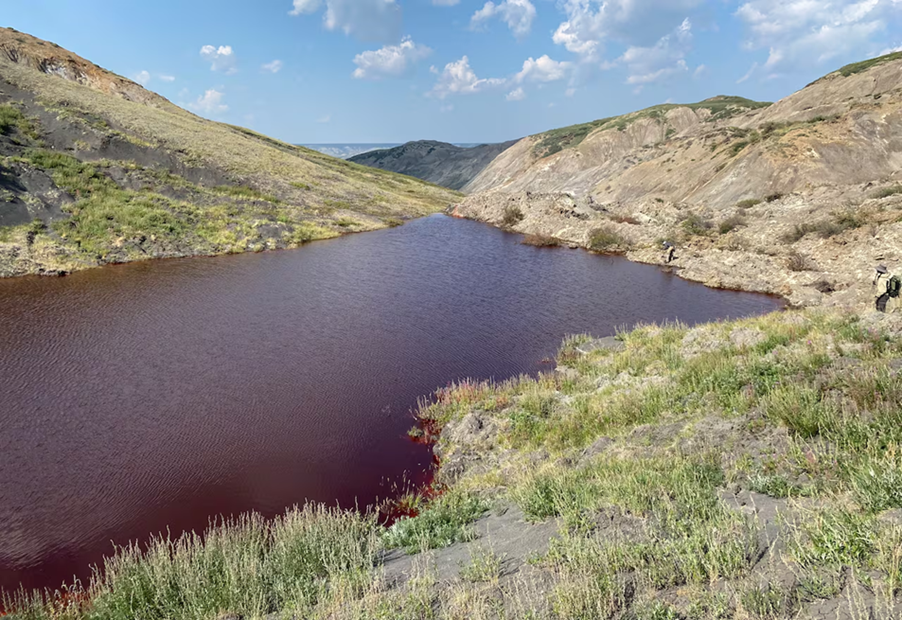
An acid pond rich in iron.