Utilities.
The utilities are basic need providers of fundamental services to domestic and commercial premises. The general rule is that a fee is charged per set unit used plus a possible standing charge or rental on the metering equipment. This, at present, is not the rule at present for water supply and sewage treatment provision for the domestic water supply which is based on rateable values of property. The metering of water supply is considered to be desirable both by the water industry and government. There is though conflict with the regard to low income high water needs families.
The eventual acceptance that water metering will become mandatory will allow the use of tripartite smart metering which will allow issues of home security and vulnerable consumers’ greater safety: the bogus meter reader will be unable to operate. The new metering will allow the customer to know exactly what volume of each utility they are using; so allowing greater freedom and informed consumption of each utility as is desired.
Water
Nottingham’s water supply is supplied and managed by Severn Trent Water Limited part of Severn Trent plc. It is the only surviving independent water and sewage undertaker in England and Wales with its head office in Birmingham. The company was formed in 1989 when the regional water authorities were privatised. The water authorities being formed in 1974 when the joint roles of water provider and sewage treatment were taken away from the local urban, rural and borough councils by the reorganisation of local authorities in that year.
Severn Trent Water supply around 130,000 households, about 270,000 individuals (approximately 9,000 living in communal establishments) and thousands of companies, employees of whom use the water and waste water facilities infrastructure for at least 8 hours per day. The population of the city swells to over 1/2 million during the working day.
Potable Supply
The original water supplies for Nottingham were the rivers Trent and Lean, by Viking times and throughout the Middle Ages, up to 1830 wells and other ad-hoc arrangements met the demands. The sandstones under the city were an abundant and pure supply of water at that time. The 1840s saw the development of the wells at Zion Hill (close to Canning Circus) which piped supplies to households that could afford connection. The company; The Nottingham Water and Marble Company, also employed water sellers or higglers to sell the water abroad in the streets. At the establishment of the Nottingham Water Works Company in 1852 the Zion Hill Company was bought out for £5,000.
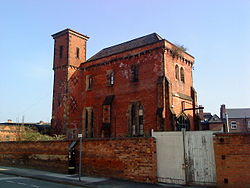
The potable water supply for the city is sourced from two major supplies; groundwater from the Sherwood sandstones to the north and east of the city and reservoir waters from the Derwent Valley in Derbyshire. A further supply is being developed; impounded water from the River Trent stored in redundant mineral workings on the county’s border with Derbyshire near Aston.
Water supplies are available to be exploited within the city as the majority of wells and boreholes are no longer used: the brewing and other large water abstractions have ceased. Local water tables are rising as can be witnessed by the pumping of the groundwater from beneath the Broadmarsh shopping centre.
Waste Water
The majority of Nottingham’s sewage and other waste waters, including precipitation are collected in combined sewage mains and transported to the large waste water treatment works at Stoke Bardolph to the east of the city on the northern bank of the River Trent. This works was originally designed by Marriott Ogle Tarbutton in 1886/7 before which most of the city disposed of its liquid wastes to streams, ditches and soakaways in the sandstones that were the source of the drinking water supply.
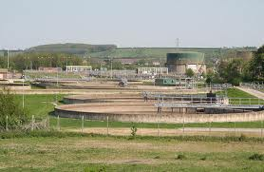
Other small scale waste water treatment works discharge to the River Lean.
All sewage from private homes is treated by either septic tank / cesspit (3.5%) or by sewage treatment works (96.5). there are no reported operational earth closets in the city; the last night soil collection was in 2001. The Grantham Canal ferried much of Nottingham’s night soil in the years of its operation, particularly from 1800 to 1846 when it was used in Lincolnshire as a ‘fertiliser’ when mixed with horse and other animal waste; it was then dried and powdered ready for application.
The future sewage and waste water from the city’s hospitals will have to be brought up to the standard or better than that of domestic sewage, there are concerns across the EU that unspecified diseases do not get destroyed by sewage treatment works generally and enter the environment as still infectious pathogens.
Electricity
The 1947 Electricity Act merged 625 electricity companies and authorities into 15 nationalised regional supply companies and the British Electricity Authority (later the Central Electricity Generating Board). In 1990 the industry was demutualised. At privatisation the regional company was taken over by the many power retailing companies that saw a potential in marketing a universally necessary product. The methods of such marketing have led over the period to claims of ‘sharp practise’ and misleading sales pitches. The development of fixed price fixed term contracts of one tear or eighteen months; fixed penalties for those that were tempted away from their obligations further confusing an already muddled marketplace.
Generation
There is no substantial power generating facilities within the bounds of the city today. The major power generating stations; Wilford was constructed in 1925, ceasing to generate power in the mid 1960s when Clifton Colliery (next door) closed. The site was cleared in the 1980 and redevelopment as the Riverside Retail Park began in the 1990s.

Other power generating stations were developed in Nottingham; principally by Jesse Boot and his heirs. The Canal Street Island site in 1908 was the sight of a combined heat and power generating facility and one of the first in Europe.
The River Trent that cuts the main part of the city from its district of Clifton has been the source of one third of the nation’s power supply cooling waters at its peak of generation in the 1960s and 70s. This use and that of waste water discharges locally and upstream and to its tributaries such as the River Tame and Fowlea Brook saw the river so grossly polluted that it was remarkable that any life survived in its waters. The river developed, to power station cooling waters, a distinct micro-climate of its own with river water temperatures several degrees more than any native river fish could survive in if they could cope with the lack of dissolved oxygen, surfactants and ammonia; the river was near to being an open sewer by 1970.
The large Radcliff on Soar Power Station is sited 6 miles south of the city on the River Soar just before its confluence with the River Trent. It is one of the most regulated of UK non nuclear generating stations as it has been much altered from its original standard design. It has a complex system of flue gas desulphurisation, and cleaner coal burning technologies. Its discharge consents to air and water are stringent and it meets at leat the 95 percentile required by the Environment Agency. The consent regarding chlorides discharged to the river were set at the time coal was being mined at Annesley, North of Nottingham which by way of a 17.5 kilometre pipeline discharge chloride rich minewaters upstream of the Soar confluence.
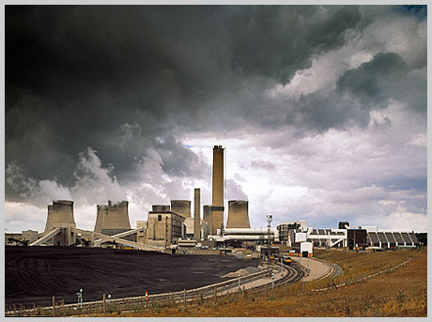
The majority of the coal used to operate the plant is imported from a variety of sources, purchased on the futures market and imported via the Humber Estuary and thence on by train through the city.
Much economic waste heat is lost by its non utilisation; the possible use of closed circuit fluid heat transfer is a strong contender for export to the city for district or industrial uses either as heat source or power generation on a bespoke level.
Supply
Gas
The Gas Act of 1948 saw the 1068 gas providing companies and local authorities brought together into 12 nationalised regional gas providers. The gas; ‘town gas’ was made from coal; between 1967 and 1977 coal gas was superseded by natural gas originating from the North Sea. The industry was privatised at the end of 1986. The industry known as British Gas plc was rebranded as Centrica after 1997. Since that date other companies have been able to retail gas in both the commercial and domestic markets, paying Centrica a fee for transporting the gas through their infrastructure networks. The gas retail marketplace is made up of an ever changing number of companies.
The original gas works that supplied much of Nottingham’s street lighting needs from 1819 was located in the Island area of Nottingham where Jesse Boot established his combined heat and power plant. After decontamination part of the site was redeveloped in the 1990s as the BBC’s regional centre for news gathering. Gas holders appeared in three locations and in the 1842 Nottingham Gas Act which extended the supplies of gas to Sneinton, Radford, and Basford and beyond. By the 1860s supplies were reaching as far as Beeston.
By 1914 7,000,000 cubic feet of gas were being produced from 700 tons of coal daily. This figure equates to the period 1913 – 14 which was the maximum tonnages of coal being mined in the UK.
A further gas works site at Basford is being developed as retail facilities, car showroom and other similar operations by MarCity Developments.
Other Energy.
Coal.
King Coal may be dead or at least on its deathbed, but the majority of the power generated in the UK is produced with the use of coal imported into the country. Once the city was a centre of mining and had its own mining college; this has all but gone. The last vestiges are parts of the streets close to the last of old colliery sites at Radford, Clifton and Wollaton; most of these though have disappeared in the great social housing development and slum clearances of the 1950s through to the 1970s.
There are though several methods of gaining energy from the redundant workings beneath the city; some of which are already being carried out elsewhere in the UK and Europe.
Methane removal from mined seams; this may require the management of waters from parts of the flooded workings, but these may be returned back into the mining levels at a distance from the abstraction point. The water thus pumped from below ground would also allow for its heat to be utilised as a heating or generating resource.
More than thirty metres of coal in the various seams was mined from beneath the area, much of it by longwall coal cutting. This brought about severe subsidence in Nottingham during the 1950s when several boulevards had their buildings massively supported by wooden buttressing. There are though coal strata that were mined, particularly at the higher horizons that were worked by the pillar and stall method lat usually left around 60% of the coal in situ as to support the roof from collapsing. There are other seams that have never been worked which could be developed as fuel to be burn in seam as has been trialled in Spain in the late 1990s and is currently carried out in Kazakhstan.
Shale Gas.
The exploration of this form of gas is in its early stages in the UK, the trial site in the northeast of England has given rise to concerns for ground stability brought about by the fracturing (fracing) the gas bearing strata. The ‘earthquakes’ which have been noted have been noted as of minor or minimal concern; they are less noticeable than the subsidence events that take place in many of the old coalfields across the country though now not working.
The geological structures beneath Nottingham have been considered by British Geological Survey as a potentially valuable area for investigation as has the surrounding country.
The potential for a gas production capability is a conundrum for future city administrations, the considerable value of such deposits need to be weighed against the several considerations of winning the gas. Public perception and ground stability are a group of issues that would need to be satisfactorily confronted.
Oil.
The geology to the east and north of the city has in the past been exploited for oil in commercial quantities. The period during the 2nd World War was the zenith of its importance.
The Nottinghamshire oilfield covered a substantial area from Kelham Hills to Eakring and geological formations allow for oil to still be exploited into North Lincolnshire.
The sandstones that underlie much of the city have been found to hold small quantities of oil and other hydrocarbons.
Imported Oil and Petroleum.
Oil has been used to generate power throughout the city for over 120 years. Today there are oil, petroleum and allied liquefied fuel tank farms at the edge of the city which are constantly recharged via the railway from the port of Immingham on the Humber Estuary.
Alternative / Renewable
The need to consider non fossil fuel obligations of the national government and their resultant requirements placed on local authorities has put the local communities at the centre of the action. Reduction in carbon emitions across all local council areas, the authorities own carbon footprint having to be reduced, which can be more expensive than leaving things as they were seems hard for communities to fathom in times of recession. Especially as services are being cut back and expenditure cut on what many think are necessities whilst large sums are spent; or invested in forward looking research and pilot projects.
District Incinerator, the Eastcroft Scheme.
This scheme which is centred on social housing and a district waste incinerator has gone in and out of favour as the decades pass. The scheme has been popular with the benefiting residents who; though not by popular belief, pay for the heat.
The operation started operations in 1972 and the most recent extension of the system will be completed in 2013. At present the Eastcroft facility serves 5,000 homes and 100 businesses through 65 kilometres of pipe relaying steam, the waste heat generated by the combined heat and power generating unit.

The Beeston weir hydro project has been realised by Hyda / Novera Energy, and generates 1.66 mega watts of output. It is the country’s largest flow of river hydro scheme. At times of salmon run a ‘fish fence’ of hydro acoustic bubbles drives salmon towards the fish ladder rather than entering the turbine outfall.
There is much being written at the present regarding fish mortality from hydro electric schemes, but the evidence on the River Trent is that there appears to be no appreciable impact.
Within the city’s boundary there are two possible sites that might be considered for development for flow of river power generation; these being at Clifton and at Colwick Sluice.
Win
One of the tourist and educational attractions of the city is Green’s Mill at Sneinton the last of at least 19 post and tower mills that operated across Nottingham from the 13th century.
Several wind generation studies have been carried out over the last twenty years with regard to generating energy. One known possibility being sited at HM Prison Nottingham which was considered a prime location for such an activity by the Justice Ministry Estates Office.
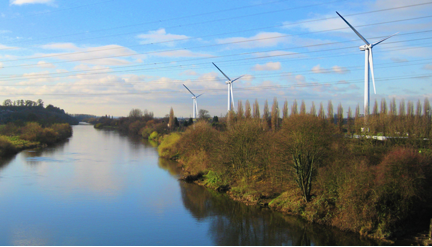
Another site planning for wind turbine development being Nottingham University; the general public dislike of such schemes which does take the gloss off such projects. There is a need to avoid the position that one knows better and local people should accept what is good for them. Notably the scheme has the support of Greenpeace.
The experience of the French nuclear generation industry who have different ways of operating where the public are encouraged to be supportive of developments rather than that of the negative views that are found this side of the Channel.
Geothermal
The geothermal resources that might be available beneath the city are uncertain at this time but the geological conditions around Leicester have been and continue to show promise. The deeper down through the strata a borehole is sunk the warmer the rocks become and the greater the potential resource becomes. Nottingham’s worked coal measures being shallow allows for ease of gaining access to the rocks below more easily than in areas where coal were operational at greater depths.
The potential for this sort of energy resource has been exploited in France (Caen district heating scheme): the Ethiopian Government with Chinese investment are commissioning a scheme not far to the southwest of the capital Addis Ababa.
Heat Pump / Exchanger – Heating and Power Generation.
The worked coal measures underlying the city are potentially suitable for the recovery of heat from the minewater that now fills the workings of the area in large volumes. Such a scheme was pioneered near Halifax, Nova Scotia where a factory provided its heating and sourced its power from flooded workings beneath its site. The concept requires water to be pumped from the flooded abandoned workings and the heat harvested. The water is then returned to the same mine system either down dip or far enough away from the abstraction point so as not to cool the subterranean heat source. The project was reported in the bulletin of CADET / ETSU in 1988. The project achieved payback for the company in 6 months.
Such projects in the UK have been discussed with the Coal Authority and have had their support, the image of minewater as a pollution source has led to negative Environment Agency responses up till a short while ago when there was a realisation that there could be environmental gain.
Waste Heat
The heat exchanger has been used for over forty years to increase heating and cooling efficiency of large spaces; the technologies are now much more fuel efficient and cost saving than was the case ten years ago and are capable of being retro fitted into most buildings.
The process simply harvests waste heat within buildings for reuse.
Waste – sewage – refuse (waste arisings) landfill tax funding of research
The district heating scheme has been discussed above, but the sewage generated in Nottingham is generating the power to run the sewage treatment operations at Stoke Bardolph. Severn Trent Water Ltd the operators and owners also grow crops to add to the feed stock for the anaerobic digestion unit. The plant was designed and built over a three year period and has been generating since 2009. It is producing 2 mega watts of generated energy. This scheme has allowed Severn Trent to be able to say they are the largest electricity generator in the UK using sewage derived fuel.
The digester produces biogas that operates two combined heat and power units and the solid waste produced at the back end of the process is an organic fertiliser which is applied to the soils of the sewage treatment works estate farmland.
The project underlines Severn Trent’s commitments to reduce its carbon footprint and at the same time maximise the fiscal value of its activities.
Other processes such as the activated sludge treatment that produce methane which is used to generate most of the onsite power needs since the 1980s.
Solar
Various central government initiatives have encouraged solar / photovoltaic panels to be placed on the roofs of houses in high density populated parts of the city. Though there visual appearance does not add any aesthetic benefits to properties the fiscal attraction of their deployment has been beneficial to the city’s carbon reduction program.
There are several locations that have an interest in such installations where large areas of roof space are available; another area that the Department of Justice amongst others is investigating.
Waste Collection / Recycling
Waste collection in the city has been at the forefront of local authority environmental best practise over many years and has been a demonstration location of such across the UK and Europe.
The need to continue this progress will allow for individual households to be aware of their role as individual units and as part of the community. The rolling out of smart metres can also allow for each householder to be aware of their waste streams and recyclability of what they are placing as refuse. Local authorities have access to the ‘spy in the bin’ technology which has had in the past an adverse, negative effect on some residents bin protocols. The ability for the smart metre to inform the household of their merit rather than the purely regulatory compliance role may reverse this poor response.
The whole recycling operation in the UK is fundamentally poorly operated by central government in that wastes that are of scarce commodities are exported out of the country for speed of finance generation rather than allowing fledgling companies to develop a home built industry. This approach also panders to the people who fear such operations in their own back yards.
Much media attention is of a negative view with regard to recycling and stories abound of recycling collections being rerouted to landfill. Some of these stories are true but many others on investigation are ill-founded.
Social Housing.
A major element of the rejuvenation of Nottingham after the Second World War was the sweeping away of many slum area; such as outlined in Ken Coates’s BBC documentary on the squalid conditions of life in parts of the city in the early 1970s; by which time
Much of the redevelopment had already been undertaken and the City Council went unrecognised for the huge work already achieved; the Clifton estate that after 11 years of development housed over 30,000 residents and much else.
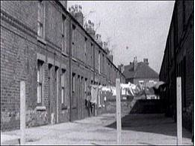
The development of housing associations to manage social housing that caters for a full cross-section of the community and assisted first purchase programs has come a long way from the early years of social responsibility. The buy to let trend in property investment has further developed concepts of mass housing has opened up a whole new private rented sector; the prospect that might lead into more innovative investment being the build to let sector that is being suggested by Whitehall.
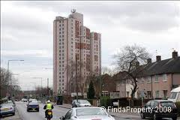
In Nottingham as elsewhere in the UK many areas of social housing were sold off during the 1980s with the introduction by central government of the tenants’ right to purchase their homes. The capital receipts from this exercise were large and originally it was believed this capital inflow would be used to further increase the social housing stock. It turned out that this was not the case and the funds were redirected via Whitehall to other things.
The boom period of slum clearance has been forgotten with again there being much inner city substandard accommodation. This decline is being found to be the cause of many social problems that the city is struggling to cope with.
The Built Environment
The utilities considered above are not separate from other environmental considerations discussed below; they are a major part as they impact on the human experience of life. The environment fundamentally effects the population as the population affects the environment.
Past projects that looked critically at environmental issues in midland cities including Nottingham attempting to offer solutions started under the acronym URGENT Program; Urban Regeneration and the Environment is a Thematic Program which was funded by the National Environment Research Council which appears to have spanned a fifteen year program finishing in 2000. Very little was published and little reportage is now available, though what is demonstrates that the built environment was then recognised as slowly failing to deliver peoples expectations.
Geology
Nottingham’s carboniferous geological situation is well understood. The economic prosperity of the area was literally built upon it. It is today potentially a future source of fiscal reward and income generation.
The pre-carboniferous strata that abut the base of the limestone is less well known as previously it had been considered as of little or no economic value.
Ground Stability, development – cave systems / subsidence
Issues of ground stability are a serious issue in Nottingham, the caves that underlie much of the city are not all known and ground investigation is vital for all planned development ventures in the sandstone areas. Marsh and made ground are attended by risk of flooding or ground subsidence.
Economic Factors / Industrial Minerals – coal bed methane, in-situ coal burn.
The basic succession of strata is that Sherwood sandstones overlie the Carboniferous, including many coal seams; the outcrop of the coal levels begins in the west of the city reaching close to surface further to West sequentially into the Erewash Valley. To the east the sandstones dip in that direction under the Permian marls. Underlying all these strata across the area in question are Carboniferous limestones; below which the pre carboniferous strata include shales that have the potential for being gas generating.
Water
Nottingham is a city blessed with plentiful water supplies, much of which is at present under utilised.
Groundwater and the surface waters of the city are important reasons for its location. The well supplies are historically of significance and St Anne’s Well being of symbolic and religious importance even prior to the Christian era.
The River Trent was the major communications and trade route for more than two millennia. It was also the physical and administrative divide between the north and south of England. It still divides the regulation of the College of Arms;
Fluvial
The two rivers that flow through the city are the Trent and Lean. There are several important streams such as the Fairham Brook which rises beyond Keyworth and passes through Clifton where the Nottinghamshire Wildlife Trust have a 10.8 hectare nature reserve which is leased from the City Council. Much of this water has lost its natural value due to partial canalisation by the local land drainage authority. Other streams within the city boundaries are Robin Hood Dyke, Day Brook and Tinker Lean.
The River Trent is one of the four Royal Rivers of England (the others being the Yorkshire Ouse, Severn and Thames) created by Edward the Confessor. It bestowed rights of fishing, power generation and navigation. These privileges also bore with them responsibilities one to another and to the rights of citizens along the banks and to travellers wishing to pass over the river.
Groundwater
The Sherwood sandstones of Nottinghamshire supply not just the county but parts of South and West Yorkshire and Lincolnshire including Lincoln itself. The aquifer to the north and east of the City are over exploited though the stratum beneath the urban area is suffering from rising water tables.
Such a development in the upper sandstones is a concern for land stability and the safety of many building across the city due to the weak cementation of the cave sandstone complex. The weak cementation binding the sandstones together is due to the poor cohesiveness of the clays that bind the sandstones together. The sandstones whilst dry are remarkably sound for such a poor material due to the lack of bedding planes or faulting in the area: when inundated will soon loose its strength and shift or slump downwards.
Much work has been undertaken to ascertain the viability of supply in the area by external water companies who wish to supply users of high volumes of water for industrial or institutional use. At present such schemes have had little success in Nottingham or else where in the country; the Water White Paper 2012 that goes before Parliament at the next session will make competition a more viable option and open the marketplace up.
Issues that may be encountered being variable water quality; this being more difficult to rectify than a constant quality of polluted water. There is concern that in time there may be contamination from beneath the Sherwood sandstones emanating from the now flooded abandoned mine systems below.
Rising Levels
As has already been stated rising water levels in areas such as the Broadmarsh shopping centre have to be constantly pumped to waste. This particular issue on its own has the potential to offer financial savings and embed water awareness if such waters were used in a grey water system to service the shopping mall and local public buildings such as the County and Magistrates’ Courts.
Sewage
Sewage has been an issue across the centuries, the city deposited its waste were ever it could up to the 1880s and the building of the treatment works at Stoke Bardolph. The last two major outbreaks of cholera were in the 1830s and 1850s and as in London after their final outbreak and the development of sewage system Nottingham was swift to emulate the system as well.
Fluvial Flooding
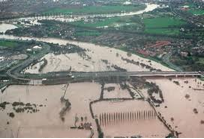
The City Council published a Preliminary Flood Risk Assessment in 2011. A strategic plan of flood management was published earlier in 2008. The Environment Agency have put in place flood remediation and limitation schemes but much of the new developments intrude onto the flood plane and are still at risk as are parts of the city bordering the River Lean.
Meteorological Considerations.
The issues of climactic change or global warming are a developing concern. There is an awareness that the climate around the world is noticeably altering inside generational timeframes rather than over centuries. There are at present several variations of weather patterns that meteorologists and climate scientists extrapolate. Nottingham City Council acting as a unitary authority is taking a strong proactive stance on limiting carbon emitions: it expects to adopt similar stringent action to limit water use supporting the water footprint initiative.

Contaminated Land
Nottingham like most cities of its type, industrialised and well populated over many centuries has a legacy of contamination to contend with. Gas works, collieries, engineering works all have been decommissioned and have reputations for polluted residues to concentrate on their sites; often spilling outside their boundaries into neighbouring lands. The principal of the polluter pays is accepted so long as that person or company or their heirs and assigns still exist. The problem if not can and often does fall onto the developer of the site to invest in expensive decontamination or the local rate payers.
Urban Flora / Fauna
Nottingham is one of the few cities to have invested in publishing a comprehensive flora of its bounds. The work is not just a guide to the wildflowers of the city, but when taken in conjunction with other plant guides such as the 1992 Guide to the Flora of Contaminated Sites is a valuable tool to address redevelopment and identifying possible contamination issues.
The council has achieved much in conjunction with the Nottinghamshire Wildlife Trust to establish wildlife corridors across the whole conurbation; these act as lungs and allow the wildlife of the countryside to percolate throughout the city.
Air Quality
The city has played many important roles in the nations history including being the catalyst for the first Clean Air Act of 1306 decided on by King Edward. His Queen; Eleanor stayed in Nottingham where she found the air fowled with coal smoke and fumes and was forced to decamp earlier than planned. The burning of coal was banned under pain of death; some executions took place but coal burning increased in popularity and no other attempts were made to stop it till the true Clean Air Act of 1956.
The main threats to air quality today are centred on the internal combustion engine; much is being trialled to curb vehicle journey with public transport and car sharing schemes. The continuing use of cars is led by the need for mobility for work and the desire to travel as families; the development of out of town shopping and the wish for country pursuits lead the reasons for vehicle journeys.
Monitoring and tracking air quality continues on a daily basis allowing an excellent understanding of the air conditions in real time.
Transport
The future is said to be for the continued development of an integrated transport system within the bounds of the city: park and ride, the tram system, bus, cycle and taxis. Commercial organisations pay a levy on car parking spaces but as yet there is no plan for a congestion charge.
Road Networks
Road networks are traditionally reactive to levels of traffic use and by the nature of the planning process and time spent in building new infrastructure lags behind the need: even when a proactive system is built the road will, by the nature of availability attract more than its designed capacity. The car still dominates the city streets.
Pedestrian Experience
Walking about the city leaves much to be desired: there are though routes shared with bicycles that allow easy progress across the centre. One such being the canal tow path from the NG2 commercial zone to the railway and bus station. From NG2 it is unsigned and is a surprise to find it behind the supermarket car park but is a haven from the complications caused by the internal combustion engine.
Bicycle
The bicycle is king in Nottingham; having rights of passage on road, pavement and apparently through shopping malls.
The cycling fraternity can avoid much of the main road mayhem by the bespoke network of cycle routes that prioritise their progress.
Tram
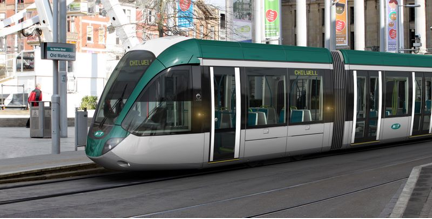
The city has successfully installed the first, northern, section of a tram system that has proved popular; the second southern route to Beeston is in the early stages of being created.
Bus
The omnibus system and network is, from practical experience, without rival in the UK out side central London. Frequencies, options of route, cleanliness and information availability make it popular and beginning to break the hold of the car on city travel habits for many residents and visitors alike.
Train
Up to the time of mass railway closure under Mr Beeching the city was served by two stations; the Central and Victoria stations.
The Central Station today is about to undergo major redevelopment, its present condition and current facilities not being acceptable for the new century. Its position of Nottingham allows the network of railway journeys to be carried out with out changing trains though remarkable. From Central Station one can travel to Cardiff, Liverpool, Newcastle, Norwich and London. This confirms the Victorian view of the city as the centre of the East Midlands and allowed easy access across the nation for the regions major export coal. The passengers’ ability to travel was secondary to the main purpose, hence the two stations and two operating companies in opposition to each other.
The passenger numbers that now use the railways has increased sharply over the last two decades and numbers using the railways to enter the city for work or leisure purposes has risen several hundred percent.
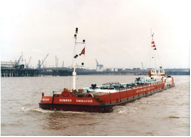
In 1993 the last Whitakers oil barge ran from the Humber to Colwick oil terminal with its cargo. Since that time all fuel oils have been transported by train. Even before that last shipment by barge the majority of fuel oils was moved by rail, including to the oil burning power stations such as Staythorpe B. other bulk freight that passed and continues to pass through are aggregates and coal, the latter imported on the whole via the Humber ports.
Air
Gamston is the city’s local airfield though its use is mainly private aviation and air taxis services. The location is outside the city boundary into Rushcliffe Borough Council tertiary.
Nottingham’s Robin Hood Airport otherwise known as East Midlands is eight miles south of the city boundary and is an extremely busy holiday and business internal and European communications hub. The consideration of developing a second runway on the site has given rise to a growing anti movement locally and further afield.
Water
In the 1970s the City Council and British Waterways put forward a concept paper that outlined the development of Nottingham as an inland port; somewhat on the lines of a small scale River Rhine or Danube facility. The need to remove the meanders of the River Trent were at the time considered an acceptable loss for the economic value it would have brought to the heart of the Midlands.
Tourism Hub
Nottingham as a tourist destination and centre for exploration of the surrounding district is impressive. The spending power of the tourist is equally so; the draw of outlaws, mining, spectacular, pastoral or industrial landscapes, cultural connections and galleries such as ‘Contemporary’ make the city a regional hub unparalleled in central England.
The availability of accommodation can lead to issues of affordability, but the World Wide Web allows much flexibility and rewards forward planning. The transport infrastructure and the environmental innovations and improvements are adding to the city’s attractiveness and grow with its assured development as a business centre.
Business Hub.
The development of banking, information handling and legal services for the Midland region are assured unlike larger cities such as Birmingham that struggle to assert their size which is hindered by the lack of location and identity. For Nottingham to have succeeded is in part due to the relatively defined commercial and business centre. In the 1950s development in ‘Slab Square’ by the Norwich Union Insurance Company started the process which now has spawned the likes of the NG2 business area.
There is a form of civic awareness that is both hard to define or characterise that is though apparent across the city. In part the two universities and the growing export of knowledge overseas; the far eastern connections with other economically significant cultures defuses through the city’s streets. There is also the willingness of the council to help nurture innovation and progress: this is carried outside of Nottingham by such organisations as the Chamber of Commerce and Invest in Nottingham.
In Conclusion.
The synergies of the past, present and future; together coalesce to form creative networks that are constantly reinventing the city and its environs. The awareness of the past being essential to understand how the city is to move from this, the carbon age into that of the digital future. Information technology and a data centric city; for all its immediacy and gloss cannot create the beauty of a Brimstone butterfly, it can though make it accessible to the millions who will never see one. The ability to understand the ecological issues of modern life that impact on it and the sustainable future that will ensure that such species and our own carry on into a future that will be forever changing.
Harvey Wood.
Clean Rivers Trust.
September 2012.