The flora of contamination is a poor description in several ways, there is no plant that only lives in contaminated soils, and all plants initially are descriptive of the soils and geology in which they are found naturally. Some plants are though more tolerant of or able to flourish in environments that allow them to fill niches in the landscape where other plants can not. Such colonisation may require the plant to be able to adapt fast enough to colonise ground before other species arrive to do so. The natural ecosystems of the world are constantly altering as are those which are ma made; though normally at markedly different speeds.
Plants can be indicative of human activity in an area; certain species demonstrate that certain things have occurred, such as mining or industry others will mark out where people have purely passed through. A good example being Plantago major (broadleaf or greater plantain) is a common European plant which is recognised to be one of the first introduced unwanted plant species to become endemic in North America. It is likely to have come over with the initial settles mixed in with their seed cereal and thrived in the disturbed and damaged ground surrounding European settlements. The Native Americans referred to the plants as ‘white man’s footprints’. Where ever the settlers travelled to the plantain appeared to established itself shortly afterwards.
There are many parts of the United Kingdom that have once supported industries that have now gone leaving no apparent physical remains. These sites can be surprising when discovered, the amount of information that is visibly available to those who choose to see.
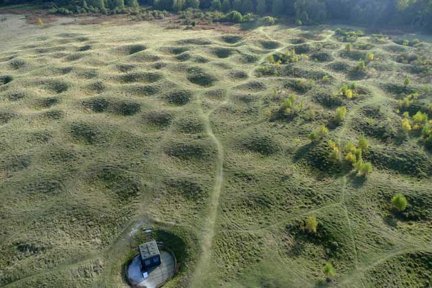
The earliest peoples left industrial sites that altered local environments for ever; Grimes Graves, a series of over 430 shallow pits, shafts and galleried mines on the border between Norfolk and Suffolk were sunk by Stone Age industrialists who wanted to gain access to the fat middle layer flints that are embedded in the chalk that is the bedrock of the area. It is a mystery still how these early peoples could know that the best quality flints that they needed to knap into tools were located twenty or more feet below the surface of the ground.
In those days of mining and the manufacture of flint tools the area was gently rolling grassland, stands of birch trees and broad vistas. Today much of the surrounding landscape is covered by the dense conifer plantations. This dark woodland hems in the views and does not allow one to see the landscape as it once was except a glimpse around the site of the mines. Today when visiting the site you will find an area of alien flora surrounded by the vestigial indigenous acid grasslands that were once the botanical makeup of the Breckland.
The mine site is made up of a rich and diverse flora that is unlike any other in the area, it is that of a sheltered chalk downland as found in the southern counties of England. The site is now protected as both a national monument and as a Site of Special Scientific Interest (SSSI). It could also be said that it is the first contaminated land site in Britain and if such an operation were to be allowed to take place today the surface of the mineral extraction would need to be restored to that that was there previously with the chalk recovered with the acidic sands ready to be recolonised by the local flora.
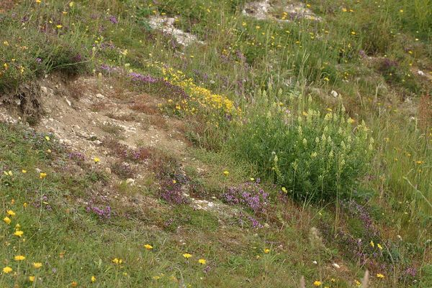
Today the plants around sites of past human endeavour, particularly mineral based activities; mining and chemical manufacture, gas works, foundries and fabrication yards all have hall mark or signature plants. There has been some work carried out over the years to develop an indicator checklist of these plants that might aid assessment of the need for further more detailed intrusive and expensive exploration of sites; these though have only been accepted half heartedly by developers, planners and consultants alike due to the lack of familiarity with botany and the concept of plants biologically typing soils and pollutants that might be present. In the instances when compared to invasive investigation the floristic approach has proved its accuracy.
Investigations into this area of reading plant contaminant signatures have been actively researched from the 1970s since then this research has developed to involve the possible uses of plant matter to bioaccumulate toxic elements of polluted land so avoiding expensive alternatives for remediating sites of their contamination. (This aspect will be reported on separately.)
Examples of plants with tolerances of contamination include grasses, rushes and reed mace:
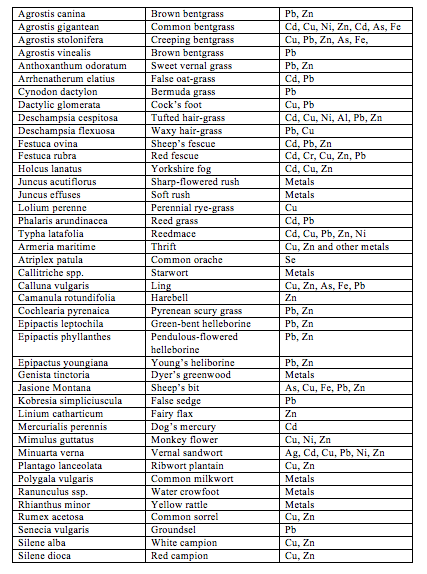
The list is extensive and is not unlike a geologist’s checklist to plant species that one needs to find in a close proximity whilst prospecting for important mineral deposits. The list above is only a small number of such indicator vascular plants that occur. Others include mosses, ferns, liverworts and alga.
Some tree species are helpful to be aware of, particularly Salix of all forms; in analysis carried out in Warwickshire and Cornwall dieback of young trees (5-7 years old) was found to contain between 17% and 22% Zn by dry weight. This metal had been taken up by the plant till the stem could not draw up any more and died. The root systems though were vigorous and sending up new stems. Other metals were also concentrated into the vegetative matter at high concentrations; Cu, As and Fe most notably.
The importance of finding a mixed community of plants that have naturally developed are able to give a complex overview of contaminants on analysis. The finding of one or two members of a species is not a truly accurate number to work by.
Further pieces will be added to the site with regard to this important area of research and development.