Annually the water companies send each household in England and Wales a bill that is to cover the costs for drinking water and the treatment of the households’ sewage and surface water that is discharged to the sewer. The same water companies also bill businesses and industry in their respective areas. Each year most householder moan that water and sewage costs have risen again and what does one see for their money?
The answer is simple, water from the tap that is safe and palatable and wildlife in and along rivers. Humans have short memories of what was the norm in the UK, rivers in many towns and cities were dead, anglers had to struggle to find fish to catch as river pollution was rife across the nation. People were not shocked at fish kills; in some instances they were interested in the event as they demonstrated that fish were present at all. Much of this pollution was from poorly treated sewage works discharges as well as industry and agriculture.
The households of England and Wales have been the source of pollution since time immemorial; the cocktail of chemicals that each home puts down its drains would be comparable to the discharges from many of the most polluting industrial sites of the past. Walk down the household cleaning aisles of any supermarket; bleaches, washing powders and liquids, polishes, antibacterial sprays and much else that ensures our cloths and homes are cleaner than ever before in the history human kind. Most of these products destroy and remove dirt, germs and other organisms deemed by society as undesirable. On the aisle dedicated to gardening you will find weed killers, lawn dressings and insecticides that need to be applied using watering cans or sprays, which are then cleaned out and the residue goes to sewer.
Even the food section of the shop has its dangers to the household discharge, oils and fats, salts, inhibiters, artificial flavours, colours and artificial preservatives; the toiletries department stocks alcohols and fragrances, waxes and oils. The pharmacy adds almost an untold plethora of additions to the drains, chemical and solids such as condoms and sanitary waste.
The householder maintains their home, car or other major investment with paints and oils, the do it your self enthusiast can be a toxic liability, most people know that engine oils should not go to drain but they do, add paints and thinners the mix can be complex and dangerous.
The above paragraphs outline only a small cross section of what each of us can send to the sewage works individually, nearly 65 million human waste streams head for sewage treatment works every day, and usually the treatments that the waste streams receive are robust enough to cope with and treat successfully all that we individuals throw at them daily.
Such is the case that sewage treatment works treat a great amount of industrial waste as well; much can be complex or unusual, the industrial customers that in the past might have discharged their waste treated or untreated straight to river or stream, whatever the company could get away with; this has changed, their in-house discharges are regulated and the effluent qualities are prescribed by the Environment Agency to be of such qualities as not to adversely impact the quality of any receiving water. Most industries though now send their wastes to the water companies’ sewage treatment works as a preferred option.
These discharges to the public sewer are though now being prescribed by the water companies as to their constituent parts so as to be assured that the effluents are capable of satisfactory treatments at their facilities. This move has seen the introduction of industrial in-house primary treatment of industrial wastes prior to sewage treatment.
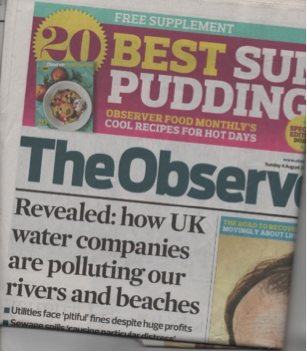
The Observer newspaper has recently (4th August 2013) pointed out that there have been a number of pollution incidents from water company treatment facilities that have been brought to court for pollution by the water companies failing to comply with their treatment works discharge consents. Such prosecutions have led to fines that; in the eyes of Joan Walley MP, the Chair of the Parliamentary Environmental Audit Committee, do not reflect the profitability of the companies polluting and that they do not reflect the severity of these environmental ‘crimes’.
Other MPs such as Simon Hughes state that profits are the important issue for the water companies and that they are proving to not be good stewards of the nation’s environment. The article on the paper’s front page and beyond outlines that there have been 1000 prosecutions over the last 10 years resulting in a total of £3.5 million in fines. On the face of such figures the sums appear pusillanimous and ‘right thinking’ individuals would agree that the there is something not quite right in such a state of affairs.
The answer to this conundrum is in the lack of data published, the level of fines being usually determined on the facts and the mitigation value of the company’s response to curtail such pollution allied to its actions to remediate and restore the environment after a pollution event. The courts are independent of politics and the agencies of taxation and their fiscal sanction is the penalty excluding costs of prosecution and environmental restoration. These added costs are not given in the article but will be many more times that of the fines.
The aspect of guilt is further muddied by aspects of from whence the pollution materialised. Was the pollutant coursed by a poorly run treatment works, a rogue discharge such as an illegal dumping of waste that the works could not have control of or prior knowledge of so it could prepare for its reception or was the reason mechanical breakdown?
This aspect of past governmental activity when utility companies were privatised was most disliked by the people within the water sector, such a notion as profit and corporate ownership of the nation’s water resource was most troubling to them both as individuals as well as a professional group. The politicians saw it otherwise, the governments of the 1970s saw the costs of drinking water treatment rise and during the 1980s saw Britain named the Dirty Man of Europe for its sewage polluted rivers. Denis Healy MP stated that there were no votes in sewage or words to that effect and the state could not afford a clean environment. Privatisation was the governments chosen course and did allow an industry to rediscover itself; it was able to actually identify its assets, one may wonder how one might lose a sewage works but such had happened many years previously when the old water authorities were being created out of the old urban and rural council owned infrastructure.
Once the water companies were created the regulator of the period, the National Rivers Authority (NRA) developed a wish list of improvements that were only too obvious and this is still continually added to by the Environment Agency as each 5 year spending round for investment is negotiated with the officers of the water regulator. Such regulation has to accept that as technologies develop and as discharge regulations tighten up the water companies look to maximize the value of investment both fiscally and environmentally. The requirement for businesses to give their investors return on their investment as well as servicing their corporate debt are laid down as legal requirements of publically listed companies has to be treated with the same importance as the ongoing care and consideration for the protection and development of environmental issues.
It may appear that shareholders win out above the environment, but schemes to increase river water quality are still being planned and implemented by the water companies on scales that mimic the Victorians’ largest scale projects; such schemes as the Thames Water ‘Tideway Tunnel’ which is starting to be constructed will improve the River Thames water quality and remove tons of storm water detritus from the river when completed.
Sometimes it might be better to encourage the water industry to do better and aim higher for environmental achievement rather than brandishing the cudgel of increasing fines for allowing our waste to escape, the population is the polluter in the first case and the water industry has the job of removing it from our sight.
August 2013.