Introduction.
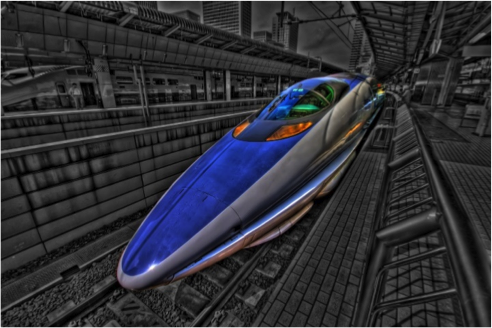
HS2 as a subject is the best bet this winter for anger round the Christmas tree, the logs that are being cut on frosty mornings in the Chilterns the chopper will fall and the saw will tear into the flesh and bone of the well-meaning developers and planners who many who live upon its route wish had never taken up their professions. The idea of the new strait track of the railway violating, dividing, this landscape and changing it forever. The locals are restless and many MPs quail at the prospect of a festive season being harangued by their constituents over the mulled wine and mince pies at the innumerable constituency events that they are ‘expected’ to attend rather than sharpen their views on the subject in the bosom of the family far away from the Westminster hub-bub or the constituency horrors!
The environment lobby, farmers, many landowner, majors, colonels; retired service personnel, Labrador owners, flat earthists and the myriad others who hate the prospect of cutting 10 minutes off the journey from London to Birmingham and 14 to Nottingham and Manchester. The government and the councils of industry appear to love the speed and the prospect of the development of new employment and wealth creation along its route, though communities away from the line will suffer through lack of rail expenditure for local upgrades of track and rolling stock.
Such a grouping of people as has been brought together to protect this swathe of rural heaven; or England, depending on one’s views, has seldom been achieved by such an inclusive government. The publication of 50,000 pages of environmental statement that gives an overview of the route and the remarkable realisation that the planners have proved their brilliance in their rout selection with the deposition that this slice of the rural wonder including that of the Chilterns is not as special as it was believed. The knowledge is reassuring and such an epic library of information as that ancient woodland once beloved of poets and wildlife does not now cut the mustard and it could now be curtains if there is a badger set in the area and if one such was heard to cough it might be the end for the whole community
The planners might have got it wrong just as the Victorians got it right but only with a tussle when the Houses of Parliament wrangled over the fire and smoke belching leviathans initial routes across the nation. The prospect of startled cattle and turning the servant girl’s head with the prospect of going beyond her village for the first time were fiercely debated for the greater part of twenty years as each railway route was enacted in the respective chambers. Many of their Lordships chamber did not wish to have their land dissected by arteries of commerce as the new railways were seen interfering with their chase, the pursuit of Reynard being more desirable if left to be hunted without check. Further the fear that ease of movement may encourage the already dwindling numbers of country folk to decamp to the cities for wages in the growing manufacturing conurbations where the streets were paved in gold and the rookeries were the then antithesis of modern social housing. The landowner needed his farms to be farmed and labour was cheap and a chap may not realise he was anybody if there was not a poor man at his gate to salute you when leaving ones castle to go about one’s daily round of pleasure seeking. These land owners though were not fools, they saw the benefits as well as the drawbacks the country was about to change and locomotive transport and speed were of the age. There were many who, though not welcoming the new-fangled juggernauts, made arrangements for their own stations to be built and the railway companies accepted that ‘their lordships’ and their kin could require a passing train to stop on demand to convey their personage on from their property or to return them to their own soil without the tiresome expedient of having to enter a carriage or alight with the hoi-polloi. Badminton Station being a good example of such arrangements. The Duke could be at his Pall Mall club in three hours rather than three days. Our more egalitarian world today precludes such joys but it is notable that nostalgia is rife and such delights might be looked on by many today as picturesque.
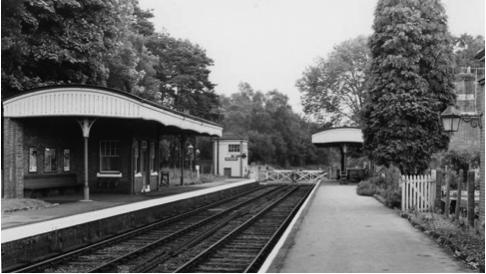
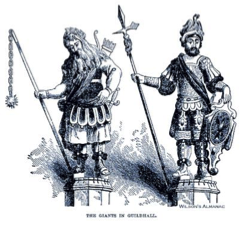
As the age developed towards the 1850s the railway gave rise to tourism with the capitals dwellers discovering the pleasures of fresh air, people started to explore out of the metropolis to the seaside or into the Arcadian idle of the chalk lands to the north of the capital. This is the nub of the issue, the chalk lands that are the source of the pure waters brought to the capital by the New River and the mythic home of Gog and Maygog the legendry founders of the capital itself.
The area has been carved up for some time, the Romans with their routes of communication, turnpike roads, the Victorian railways, the motorways, new towns and the urban creep of the capital itself as it sprawls forth from Harrow on the Hill. HS2 will carve tunnels and cuttings leaving this landscape lacerated as no other engineering scheme has done; so it is said. It leaves one wondering what benefits this leviathan of government infrastructure placement might offer to sugar the pill and make it less a carbuncle but a conduit of general good. The present but wavering justification is the shortening of time taken to escape from points north of the Watford Gap to reach the civilisation of the south-east. This region not lacking in population nor the growing conundrums of how to keep the most populous region of the nation watered.
The Victorians understood the issues that are now even more apparent; the water supply that the capital needs is now largely reliant on that supplied from the capitals surrounding and underlying chalk strata, large abstractions in the north and south from the fine limestones, water from the Chiltern’s chalk which supplies the New River and purified Thames river water. The resource is at times reaching its nadir and certainly will as the region’s population grows further.
The route of HS2 is for much of its length a virgin route untrammelled by 19th and 20th century infrastructure that is to whisk its passengers from place to place. Its boundaries are though broad and available to be used to carry the plethora of 21st century refinement; fibre optics, broad band it can also be used for the transportation of water to the southeast from the already existing reservoirs of Wales via the present connections in Birmingham (the Vyrnwy Aqueduct) and as the construction develops the waters of the northern fells and Cumbria can be accessed via the present connections to these sources in Manchester. This is not new, the plan was drawn up in the 1800s and even then the daunting task was shelved, the cost, the rights of way, the building of far flung water collection grounds all conspired to make the scheme impossible, but with the dawning of this infrastructure project the costs might be deferred or spread by all who need it as well as the tax payer.
It is understandable that many who live along the route of this proposed line are unhappy, they feel that their homes will become the sounding board of locomotives roaring through the night, some homes will inevitably be destroyed, good grazing and arable land will be lost and sown to concrete, the view will alter as if an arterial road had been unrolled across the verdant landscape.
It does raise a question of what might have occurred if the lords of the manors across the nation had won and defeated the railway acts of the 19th Century. The prospect of the country as an industrial state reliant on mail coaches and private transport stifled by the horse. It is true that the mail would get through but first class would be a slow communication. The prospects are nearly as dire as the lack of the automobile or the aeroplane which both nearly defeated the railways in the 1950s and 60s. If the introduction of a new transportation route is to be provided by the state the need to maximise the route’s value to the communities along its route as well as its targeted destinations.

In this introduction there has been an attempt at even-handedness, the issues are complex and need to be set in historic and geographical context. The plan is a major worry for those that wish to preserve both the natural and built environments. In London the major redevelopment of Euston Station and the streets and gardens surrounding it will be lost amongst the most notable changes in the capitals streetscape since the Blitz. The Chilterns, designated an Area of Outstanding Natural Beauty and areas of the Midlands of not dissimilar value. The effects the new line will have on landscape functionality will be widespread, and as with most large planning issues of a benign nature the immediate impacts will be the most apparent and with time its presence will merge into the physiological impression of the area rather than the initial upset it will undoubtedly engender.
Water Issues.
The first phase of HS2 (London to Birmingham) will meet waterways and open water at various points along its length, both canals and rivers, natural and manmade lakes: the effects on all will first be aesthetic, ; an initial view of what is envisaged for the rivers is in its own way as benign as the concept itself
The River Misbourne will be passed via a tunnel that will take the line thirty metres below its bed, but still within the saturated chalk. The effects to the groundwater flow within the chalk will not be fully understood till the tunnelling has ceased and if the line acts as an artificial barrier with repercussions that will doubtless make their appearances. The river at its points of crossover with the tunnel will be unaffected; the Misbourne is one of the lesser known rivers of England but an important one for all that. It is one of the chalk streams of the Thames Valley, a rare and threatened habitat.
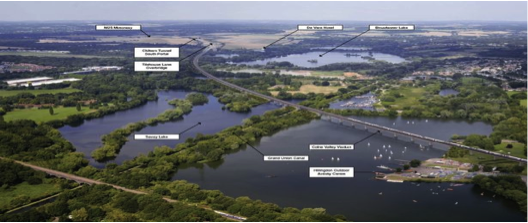
The largest open water complex effected by HS2 is the site of the Hillingdon Outdoor Activity Centre in the Colne Valley; interestingly these bodies of water are the result of quarrying minerals and were once seen as environmental vandalism. The track will be taken across the water via a viaduct that mimics the Victorian viaduct that runs to the west of it and passes over the Grand Union Canal in a similar manner. The sailing club and bird watchers now complain that their interests will be disturbed but all forms of transport; roads, motorways (M25), canal and railways already coexist in a false land and waterscape.
At the other end of phase one outside Birmingham the River Tame was going to be moved out of its present course; this was in a canalised stretch beneath the motorway and in moving was to be given a more naturalistic channel; early protest stopped the move as it was easier and cheaper to move the railway into the air like the other stretches of Warwickshire’s rivers, the rivers Avon, Leam and Anker all will be crossed by viaducts that should not impinge on their ecosystems. The Warwickshire Wildlife Trust sees the route as a bad thing but also a way of improving what is already in place as a means of mitigation for changes that would need to take place elsewhere. The element of pragmatism is markedly lacking in many areas along the route of HS2.
End Note.
Such animosity to a scheme that many believe cuts the heart out of Middle England is still not a forgone certainty to get underway; the baying of the electorate in the shires is loud and clear with many Members of Parliament uncertain of their futures if the scheme is still on track at the next general election; many will have a happy Christmas.
To be continued……..