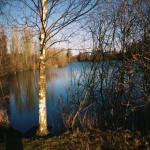
A preliminary overview of the lake after a visit on 16th January 2014.
Introduction.
An article appeared at the back end of 2013 in the Newark Advertiser about Balderton Lake regarding its purpose as a fishery; stating that there were concerns for the water quality and the lack of young fish. The Trust wrote to the Parish Council who own the water body which is leased to the Grove Angling Club who use it as their primary fishing resource offering to help find some answers to ways that this situation might be improved.

An official visit was arranged to walk the lake and discuss with Parish Council Chair, and others on Thursday 23rd January 2014. Prior to that meeting a visit was carried out to consider the situation and take a sample of lake water for preliminary analysis.
Past Research.
The Parish Council provided a copy of a report prepared in July 1993 by Dr Bruno Broughton. This report was commissioned for reasons that were similar to the present set of issues that appear prevalent today; good spawning and good cadres of mature fish, many of which had been introduced as maturing fish, the fry/juvenile fish not coming through to maturity.
The Visit.

The weather was bright and dry, the whole lake was walked round. The notable condition was that the water was near colourless with no turbidity. There was some bank clearing in progress and a conversation with one of those present who will be attending the meeting with the council; he repeated the reported outline of the plight of the lake and gave other background management and angling information. Much was useful and gave information regarding local air pollution and related industrial facility management malpractices. Detail regarding quality of the angling catches was given with detail of the actions taken by the angling club to improve the habitats in parts of the lake. Past management actions such as liming of the water carried out in the 1990s.

Information on predator presence was useful; some cormorant visits, particularly in the early mornings, saw billed duck being considered more of a problem. No mink sightings have been reported and water voles are present on waters close by to the lake.
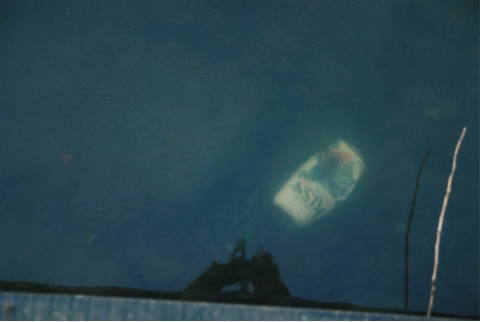
The water was clear, the beer can was over a foot below the surface. (Note no algal growth about the top of the can.)
Samples were taken on the eastern shore of the lake in sterile bottles and taken away for analysis.
The aquatic avian population was not diverse, comprising largely of Mallard and cross bred duck, geese, coots and one great crested grebe. There were no cormorants present.
One angler was observed setting up on the eastern side of the lake, he was not actively fishing he was not inquired of regarding sport.
Water Clarity.
Water as already noted was remarkably clear. As there was a note that the water in the 1990s was noted as clear with low levels of algal content an experiment has been carried out of feeding a sample with a low dose of nitrate fertiliser and monitoring the resultant effects alongside a non-fertilised sample. The trial is ongoing, but there was no apparent rapid development of algal growth.
Water Analysis.
Analysis was carried out using test strip methods to gain an insight as to basic water quality. The room for error is not great if the methods outlined are carried through as required. All tests were carried through twice as a check on the results gained.
PH 6.5
Manganese 0.05mg/l
Total Metals 20ppb
Total Chlorine 0
Total Hardness 250ppm (GPGH 15)
Dr Bruno Broughton’s Report Actions.
It is noted that some recommendations have been acted on, particularly the bank erosion has been stopped with revetments of wooden stakes used to stabilise the banks. Some diversity has been added in the form of some wetland habitat, flag iris and some reed planting has been effected. Lime dosing of the water body has been carried out, but was discontinued in the 1990s.

22nd January 2014.