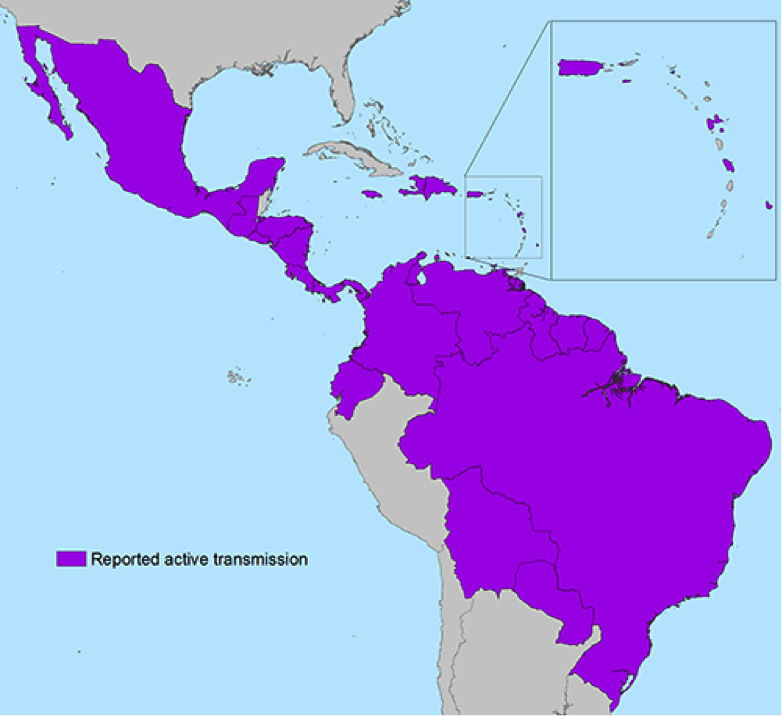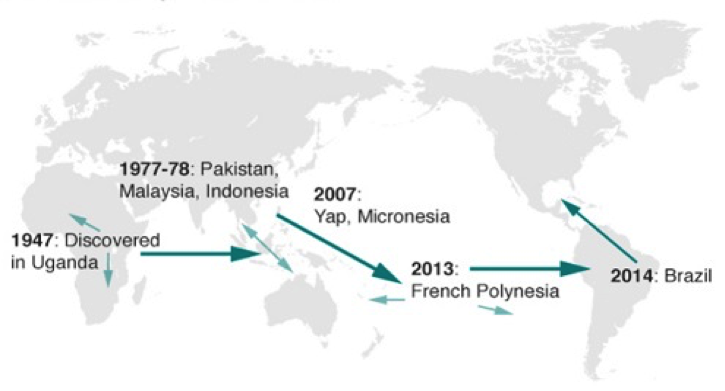
Zika virus is a problem, it is at present developing an ability to move faster between population centres than has previously been witnessed and has jumped both continents and oceans. It is at present endemic in Brazil and Central America up to the borders of the United States of America.
The disease was first recognised in East Africa in 1947 and it has since then gradually made fresh appearances in outbreaks in Malaya, the Philippine Archipelago in 1978 and islands in the Pacific Ocean 2007-2013 and Brazil in 2014.
It has though significantly developed since it arrived in Brazil, possibly due to some form of the disease entering the country during the World Cup Competition held in the country in 2014. Since its initial landfall the virus has spread throughout the country and into the northernmost South American countries, through Panama and into Mexico. It has also reached the Caribbean islands though interestingly no cases have, as yet, been reported to have occurred on the island of Cuba.
The disease is believed by the World Health Organisation (WHO) to be becoming more virulent and developing its methods of spread. Originally the disease was felt to be derived through mosquito bites which passed on the infection to the victim of the bite, more recently (February2016) the disease is now seen to be capable of spread via human to human sexual contacts. This though is yet to be fully proven but appears to have been the case in certain instances.
The main vector for this virus is via mosquito bite; the type capable of carrying and passing on the Zika virus are Aedes aegypti, the same mosquito that commonly spreads Dengue and Yellow fevers
The Vector mosquito is a common tropical variety that is well known to science due to its past abilities to spread other infectious diseases. Unlike malaria where the female Anopheles mosquito is a tropical and temperate species, which is smaller and more numerous outdoor variety the Zika spreading Aedes is attracted to living in urban environments and has to some degree adapted to living within homes, even breading in vases.
The problem is that like many diseases spread via mosquitoes the ability of each variety to adapt is ongoing with no trait fixed or to be relied upon. This has to be even truer now with the onset of global warming. The ability for these urban home loving tropical mosquitoes to travel far further than was originally believed, 400 metres maximum in 2012 has now been shown to be rather a poor judgement with specimens being found in Southern Britain, Bavaria and the Caucasus. This means that the insect can and most probably does, (air currents and weather permitting or enabling) have a presence across a far larger territory than was hoped or believed.
The Trust is both keen on wetland habitat and desirous of limiting the spread of mosquito borne disease. The constant fear that wetland habitat will harbour these insects is true but then as in the 1900s to 1970s the eradication of such water features was common and by allowing crops to be grown where once fever claimed lives added profit to the option. Today the value of wetlands is better understood, their role in slowing global warming and sequestration of carbon only now becoming apparent to more people: the politician and the mob see an easy set of sollutions infront of their eyes, eradicate marshes and the problem solved except it will be the wrong answer and the wrong set of premises that are being answered anyway.
The problem with this what often is a mild fever in adults and children can be traumatic in its repercussions for a pregnant woman who contracts Zika Fever, the child may suffer from a deformation of the cranium and abnormalities of cranial function. These issues lead to eventual premature death in many instance.
Such an illness is sure to spread alarm and rightly, the answers are not easy, there is no treatment as yet for such a fever and governments are taking the unprecedented step as in Brazil to ask women at this time to avoid becoming pregnant. The laboratories, private and government funded are looking for answers, vaccine, genetically manipulated male mosquitoes who are infertile or can produce only sterile progeny, neither of these options are popular with those opposed to genetic modification. The use of nematodes is another option that has both its detractors as well as advocates, but certainly one sustainable part of an arsenal being rather too hastily put together, several without vigorous testing.