Why?
The reason for this short introduction to the condition of the Atlantic salmon is the considered concern for the species survival: declining numbers have been reported for at least 50 years with the declining continuing at an accelerated rate over recent years. There are odd anomalies such as the Irish Government reintroducing estuarine netting ahead of other European fisheries (appendix I) in contrast to salmon quotas of 24 fish per annum set by the English Environment Agency on a fisherman in the River Severn (Western Mail 10th June 2016).
Clean Rivers Trust have heard and witnessed many aspects and reasons for this decline in returning
fish stock. These have included global warming, adulteration of salmon genetics, habitat damage, natural weather patterns, industrial salmon fishing and industrial removal of salmon food target species.
The plight of this regal fish often called the King of Fish has reflected the value of rod fisheries that are still rising as are the costs of single day tickets even though most days are ended with no catch or those caught being returned to the stream.
Introduction.
The Atlantic salmon is recognised as a prized culinary and sporting fish that inhabits the waters of the north Atlantic and southern Arctic oceans. Once a common sight on all rivers of Europe, Greenland, and North America which discharged into those seas. Throughout much of recorded history salmon were a staple food of much of the population up until the 19th Century. The fish were caught mainly at fishing weirs, by longshore netsmen and fish traps on river, known on some rivers including the River Severn as putchers. The salmon are caught as they return to breed in the shallow headwaters of the rivers of their birth in gravel scrape nests.
Salmon have always engendered study and regulation, since early times the salmon has been a fish of record, the Royal Rivers of England, Severn, Thames, Trent and Yorkshire Ouse had the catch numbers monitored and from the at least 13th century the first attempts at legislation regarding protection of the species imposed upon them. Such interest suggests early issues of ownership, superstition and an understanding that these were unusual creatures. Their seasonal presence and disappearance like the swallow or swift
The Lifecycle of the Atlantic salmon.
The salmon starts out as ovum and milt covered over with light gravels that the female parent has placed over the mats of eggs so that they are not swept away. After hatching the proto-salmon are supplied by nutrition from an egg sack that is suspended beneath them. Once that egg yolk is expended the young fish start to feed for themselves; at this stage of their life they are known as parr. They live in these headwaters for 1 to 3 years before they go through a major biological and physiological change which allows them to tale to living in salt water. When this osmosis capability is developed they are heading downstream as smolt, they at the same time develops a natural magnetic stripe along their flanks to aid navigation in the ocean. Once out in the open sea their genetic navigational urge takes over and the natural currents allow the young fish to head north to the rich feeding grounds where they will stay for a further period growing, some only stay for a year, others up to seven and then the fish head for their home rivers surfing the currents and when close to their landfall smelling/tasting their home flood.
River Specifics.
The salmon river fisheries of the North Atlantic region are varied with regard to the numbers of fish that are returning to their native rivers. The more northerly fish are larger and they are also longer lived: this is noticeable on both sides of the Atlantic. The Spanish stock, at the southern extreme of the fish’s range, are notably smaller in cadre size both in length and weight. This physiological alteration has occurred over the last 50 years and has led to fears of eventual extinction. The southern range fish of the US such as swimming the Connecticut River system are not so effected.
The rivers that make up the Severn and Wye Catchment in the UK reflect many of the issues that have impacted and continue to trouble the North Atlantic Salmon. The fish that has been the symbol of clean and free flowing rivers. The fish when returning to fresh water ceases feeding and relies totally on its body mass to power itself to it spawning ground. All aspects of water chemistry will impact its chase upstream. Acidic water damages the gills eventually stressing the fish to a standstill and eventual death, water structures such as weirs, locks and other barriers can be impassable at various low flow regimes. The spawning ground habitat if degraded will not stop spawning but will ensure that the eggs are unlikely to hatch: if they do the young hatchlings will be struggling to develop. As over 40% of healthy hatchlings are predated in the first few months of life. The rivers Wye and Severn are subject to all these issues though much has been achieved to rectify the acidy in the upland headwaters of the two rivers. This acidy was brought about by high levels of sulphur dioxide emission from the industrial areas of the South Wales Valleys. The rain falling on a southerly wind over the hills feeding the rivers fell as acid rain. The old river protection boards spread thousands of tons of lime during the 1980s and the rapid decline in industry over the last 25 years has seen acidic intrusion to drop considerably
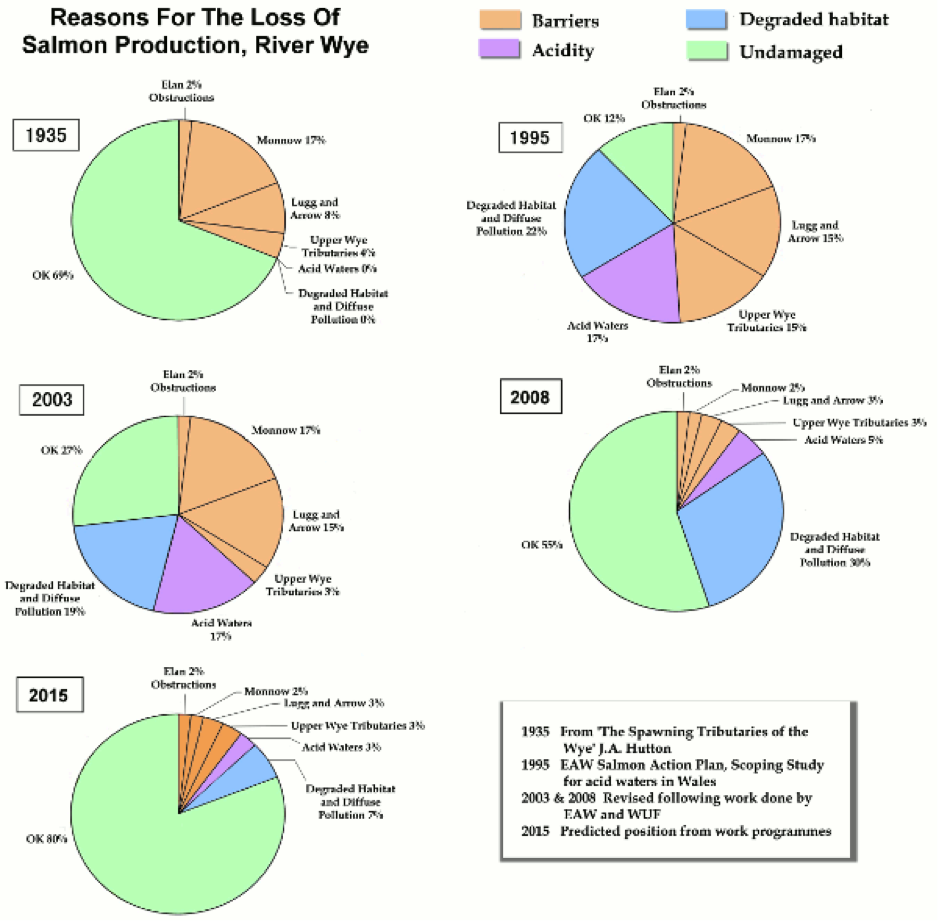
(Source: Wye and Usk Foundation 2016)
The River Thames’ last true runs of salmon were in the 18th century though some fish were noted to still travel through the lower reaches as late as 1830, by that date the water of the river through the capital were so polluted that the fish would have had their gills cloaked and died through lack of oxygen. There have been many attempts to reintroduce salmon to the headwaters in the form of fertilised eggs, parr and smolt but the lack of returnees makes it likely that the navigational footprint is genetic at a very primary level which cannot be overridden by actual geography. This exercise has cost several millions of pounds since the first attempts in 1976.
Scottish fisheries, amongst most economically valuable fly fisheries in the world: rivers such as the Spey and Tweed have been notably affected by this slump in numbers of returning fish and at the same time being amongst the most cared for habitats in which to run and breed in. the Tweed has experienced a 50% drop in population since 2012 and returns for demonstrate fish catches dropped by 50% in one 12 month period (2013/15).
The Spanish and Portuguese fisheries were once acclaimed for both their location and the quality of their fish. As with fish breeding at similar latitudes on the other side of the Atlantic the warmer waters allow the young fish to develop more swiftly than those of more northerly climes. Often parr develop to the smolt stage of their life cycle within 1 year and head out to sea. This early development has not change over the last 75 years but their size on return to their native rivers has markedly reduced over the last 30 years. This has been shown to be a reduction of 30% to 50% of body mass as well as a reduction of 40% by number.
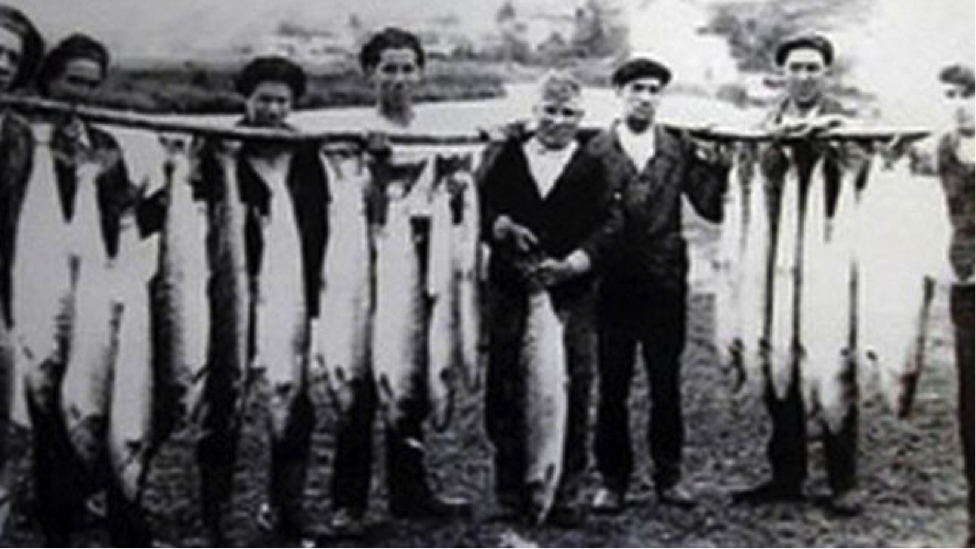
Salmon fishery harvest North Spain 1950s.
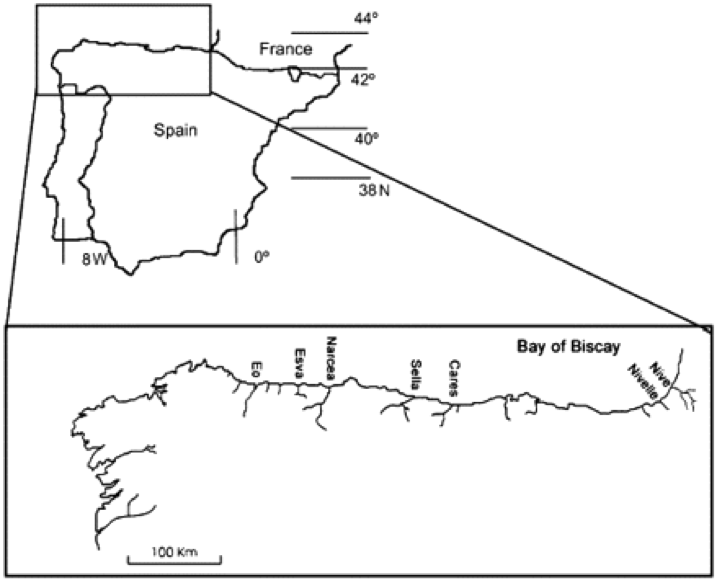
The rivers of Spain and Portugal that are the breeding focus of Atlantic salmon.
The fisheries of the North American seaboard can be split into those of Canada and the United States of America. The southern fishery is much reduced from what it once was due to habitat degradation and other factors that are as yet uncertain. Restocking of some of the rivers and the Great Lakes have had spasmodic success but more sustainable results than in other areas of the salmon’s range.
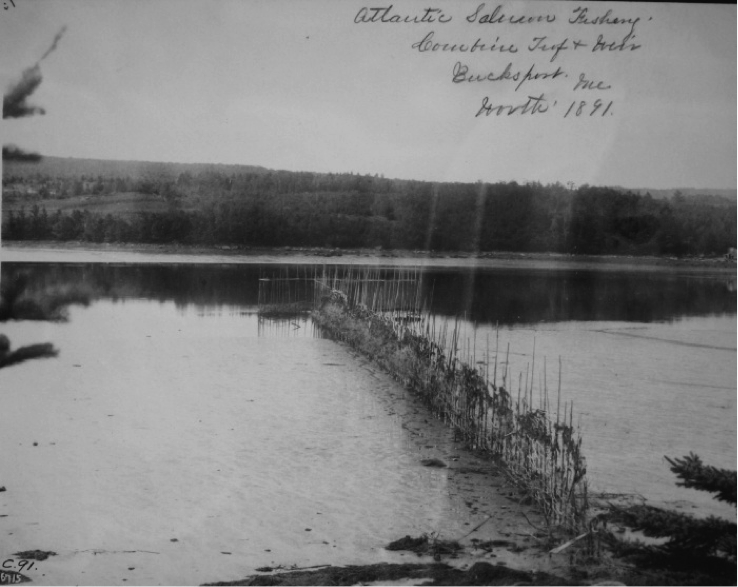
A fish weir in New York State in 1891.
UK Regulation.
In 1285 it was recognised that a closed season was necessary for the husbanding of salmon stocks in England and the concept of “authorised” nets was introduced in 1376. This was not so much a conservation measure as a tax raising operation as many of the fish weirs and traps across the country were licensed and the crown received revenues from the owners (in 1086 the Doomsday Book notes fish traps and weirs for taxation purposes). The salmon decline was noted in the Tudor period and by the reign of Elizabeth I a minimum catch size of 16 inches was recommended. By the early 1800s a report to the House of Commons Board of Trade noted that excessive netting of salmon and Sea trout in river estuaries and rivers was impacting on the fish catches upstream of the tidal reaches. The advent of the industrial revolution brought about the first pollution limitation legislation: though local regulation regarding adulteration of river water qualities had been enacted earlier with regard to town sewage disposal in relation to drinking water collection and Friday fish stocks. Closed season and weekly closures; net mesh size, net volume and size regulations; recruitment of water bailiffs funded by the state (not the gillies and beat keepers of the fisheries’ owners that are the Victorian addition to the policing of the rivers).
As a result of still greater volumes of industrial pollution of British rivers, a Royal Commission on River Pollution was appointed in 1860 to enquire into and address defective regulations, poaching, obstruction of free passage for fish and the lack of river management. Much of this resultant legislation is still in place today with the appointment of Boards of Conservation and Fishery Boards controlling fisheries. These regulations and traditional in-river fishing methods appeared to address exploitation of fisheries. Even so many rivers were beset by industrial and urban pollution reducing catches and effectively killing some rivers such as the Thames and Trent.
All the regulations regarding the conservation of Salmon were re-enacted in the Salmon and Freshwater Fisheries Act 1975. Since then little or no Parliamentary action has occurred: over the last 41 years no enquiry has taken place or new legislation enacted even though members of the All Party Parliamentary Fly Fishing Club are vociferous regarding the need for action, no action has been implemented, such as the implementation of the recommendations of the North Atlantic Salmon Fisheries Convention that was unanimously agreed internationally in 1990. Much of the present regulation operated by the regulators of rivers: the Environment Agency (England), Natural Resources Wales and the Scottish Environmental Protection Agency are by-laws and local regulation put in place by agreement with riparian owners and federations of fly fishing organisations, the laws appertaining to poaching are still redolent of the 17th Century though minus the sanctions of death or penal servitude.
Activity.
The adult salmon returns to the breeding grounds in the gravel beds of the upper reaches, breeding through the high water months with its young spending between 2-3 years in the river before they head for the ocean to find feeding grounds. Little was known about their life at sea so the species remained relatively anonymous and it was hoped that with improving water quality the future for the king of fish would be secure.

The range of the seagoing Atlantic salmon.
However, during the 1960s their feeding grounds were discovered in the northern waters of the Atlantic off the Faroe Islands and around Greenland. Devastating overfishing then took place using modern fishing techniques and monofilament nets. By 1981 over 100,000 tons of fish were caught off the Faroe Islands alone. The future for the salmon was bleak and would have been exhausted within a decade.
These salmon would have originated from many different countries of the North East and North West Atlantic – conservation measures at sea became a priority. The North Atlantic Salmon Conservation Organisation was established, the number of fish caught is now more closely monitored and factory fishing for salmon is now much lessened. This work is ongoing, as “buyouts” have to be negotiated between the conservators and the fishing companies, there is piracy at sea and changing legislation in the Baltic nations.
A much depleted set of year cadre stock have to overcome existing and new threats such as diseases such as sea lice, industrial harvesting of species which form a large part of the salmons’ diet, coastal and offshore drift net fishing, poor water quality – particularly in their spawning ground – due to water abstraction and agricultural run offs, need to improve riverside management, predation and also the effects of climatic change and the plight of the salmon is still in question.
The new century saw the publication of the MAFF Salmon and Freshwater Fisheries Review – the overriding aim being to ensure the preservation of the species. A most comprehensive report which, if implemented, would be greatly beneficial to many forms of wildlife in and around our waters. All interested parties, which were not always “mutually compatible”, were invited to contribute and all 195 recommendations were unanimously agreed upon, however, many of these are still under consideration by the Government. All mixed stock fisheries banned or bought out i.e. no high seas fishing. Fish only to be caught in the river of origin and only when it can be shown that sufficient fish are returning from the sea to ensure an adequate breeding stock in that river and other similar recommendations.
In March 2003 the Severn Estuaries Action Plan highlights a further need for reduction in fishing effort however the heritage and cultural value of some of these fisheries is recognised. The limited few remaining traditionally run fisheries will be allowed to continue with annual reviews. 2004 saw an increase in the numbers of salmon returning from sea to some UK rivers, however, conclusions should not be drawn from one year’s figures, but it certainly was an encouraging sign that proved to be a false dawn.
Reasons for Decline.
Breading Habitat
The breeding habitat of salmon is ideally a well oxygenated gravel based stream with a swift flow but with adequate areas of slack water. In many areas within the catchment of the fishes’ range these habitats have come under pressure. Such issues as increasing road runoff and field soil erosion having a detrimental effect, particularly by allowing silts to cover the gravels and deny returning fish access to their nest sites. Even if a salmon nests successfully the silts can stop the eggs developing and the juveniles suffocate in the mud covering the gravels.
Beavers
Beavers were considered a major problem for some salmon runs in the US and in the Baltic with some actions to eradicate some communities and the dams destroyed mistakenly, as it now has been shown. The beaver, both the American and European varieties have now been demonstrated to be an active player in salmon conservation with their dams providing deep water that does not freeze to the bed of a stream or river allowing parr to survive severe freeze conditions. The dams themselves are no barrier to returning fish with most jumpable or walked over.
Deep Sea Fishing.
Deep sea fishing has shown it can influence returning salmon numbers by the excessive fishing of Atlantic salmon in the 1980s and 90s. These catches have reduced markedly due to the purchase of quotas from the fishing fleets operating in the northern seas by the North Atlantic Salmon Group.
Sadly these same fishing boats are now taking a wide variety of the salmons main feed species instead. Prawns and squid plus small fish make up the preferred menu of this fish and as such puts it in direct competition with the needs of human kind who are developing a liking for a similar diet.
Salmon
Salmon themselves are problematic to their own survival in that the salmon is constantly returning to the same river as its forebears so the possibility of genetic problems through inbreeding with closely related members of returning fish is growing due to the reduction of fish stock. There have been active interventions to increase the gene pool in Northern Spanish and Southern French salmon stocks. The use of Norwegian and Scottish ovum and smelt have not proved successful, though trials are continuing on the Gironde.
Salmon feed
Salmon have a varied diet once out at sea with squid and prawn making up the major proportion. This high protein feed allows many of the fish to rapidly grow and reach maturity and start its return journey to freshwater to breed.
Much of this diet is now industrially harvested for human consumption along with small fish and sand eels that are caught to cater for the fertiliser manufacturers on an industrial scale.
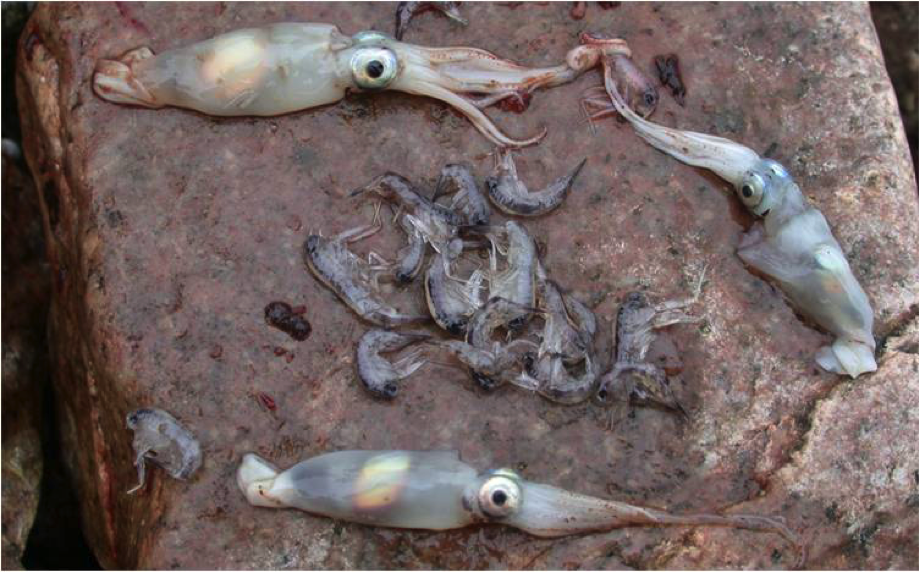
Salmon food and growingly popular commercial catch for human consumption.
Pollution
Pollution is a major issue regarding salmon ability to return to its spawning grounds, especially that of heat pollution from sources such as power station cooling discharges that remove the oxygen from the receiving waters.
The juvenile fish are susceptible to agricultural pollutions, road runoff, sewage and any other discharge that will limit oxygen supply within the water flowing across their gills.
Global Warming
The issues of global warming is cited as one of the reason for the decline in fish populations and it is certain that increasing climactic uncertainty is affecting habitat. The melting of the arctic ice is a possible regulator that can push back increasing sea temperatures from the arctic water where the fish mature. Any stress to the fragile ecological status of the Atlantic salmon needs to be addressed as has been carried forward by the Norwegian Fisheries Organisation that considered cardiovascular trauma in rapidly changing water temperatures, this particular work demonstrated the remarkable
One predator that has gained Atlantic salmon as a feed species is the Atlantic Bluefin tuna due to rising ocean temperatures at the southern and western extremities of their range due to rising ocean temperatures. The over exploitation of this fish (1970s and 1980s) and its ongoing recovery due to active EU fisheries intervention has seen the Eastern Atlantic population return to near 1950s levels.
Other climactic problems have been found in several areas where spawning grounds have been washed away or covered over due to increasing flood events due to increased catastrophic rain events.
Restocking
Restocking of salmon has generally not been a great success in European waters with few returnees successfully breeding in either France or the North Iberian Peninsula. In Britain many millions of salmon eggs have been stripped or harvested from wild salmon but the majority have been bred for the farming market rather than the reintroduction of the fish to their past habitats where they are now absent. The Thames being a case in point which has for about 40 years been stocked with cadres of eggs, parr and even smolt but as noted elsewhere in this report the project has been notable for its lack of success. The Environment Agency is now starting a similar scheme to reintroduce the salmon to the River Trent catchment with the hope that the returning fish will use the headwaters of the Dove and Derwent that drain from the Peak District of Derbyshire.
Genetic Alteration
Issues of genetic alteration of farmed salmon is an issue confined at present to the US where there have been and continue to be trials of genetically modified or engineered fish to suit market need, increase omega 3 being particularly prevalent. Some of these fish have escaped over the last 5 to 10 years and their fate is unknown.
Water Abstraction
Many rivers and streams across the UK have suffered from over abstraction of drinking water at their headwaters. Some have suffered so badly that their upper reaches dry up during the summer months.
Farmed Fish
Farming of Atlantic salmon has become a widespread industry across the natural habitats of wild Atlantic salmon. The increase in fish farmed has developed from a base line of 100 metric tons produced in 1980 to 2,087,100 metric tons produced in 2014. The wild Atlantic salmon catch makes interesting comparative reading in that 1,000,000 metric tons were caught in 1951 with peaks of wild catch of 1,500,000 in 1975 and 1,600,000 in 1988, in 2013 the catch had shrunk markedly to 280,000 metric tons.
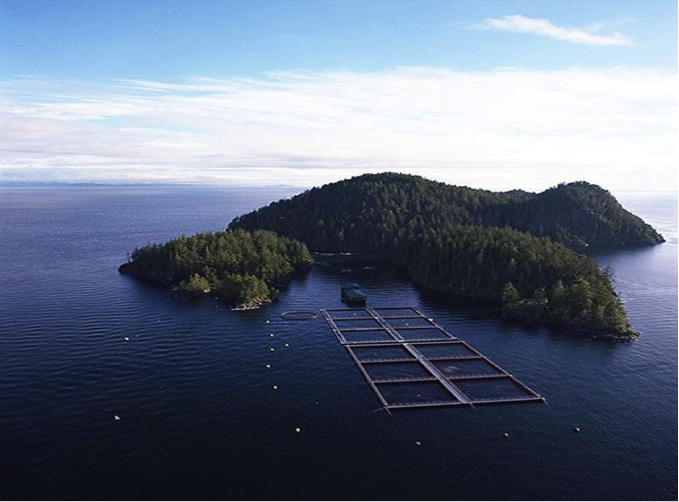
Atlantic salmon farm of Eastern Seaboard of New York State.
The increase of farmed fish is not just remarkable for its success but also its growth appears to mirror the decline or collapse of the wild fish catch. There are several issues that may be considered but the most important appears to be the proliferation of disease which is prevalent in caged stock. Some wild salmon naturally come into geographically close contact with the farms and their soup of waste that flows from the netted areas. Other fish will come into contact with escapees that are contaminated and such problems as lice can cause fatalities and disorientation very rapidly.
Predators
The predators of the salmon are varied and numerous
Returning fish, par and smolt
- Man
- Otters and other aquatic mammals including mink
- Herons, cormorants, goosander and other avian on/by river birds
- Fish eagles and ospreys
- Pike and other larger fish
- Shark, especiallyporbeagle shark (Lamna nasus)
- Seals
- Atlantic Bluefin tuna (Thunnus thynnus)
Ovum, parr and smolt
- Amphibians
- Fish
- Eels
- Birds
- Rodents
- Mammals
- Grass snakes
Postscript.
This short overview is Clean Rivers Trust’s initial foray into this subject are which will be investigated in greater depth and reported future in later papers and briefings. The overwhelming element of this short paper is the erratic nature of fish numbers in various fisheries. The most alarming being the numbers returning to their home rivers, such reduced numbers and the plethora of reasons put forward for this state of affair are also notable. The plethora pf Rivers Trusts spawned by the excellent work carried out by the West Country Rivers Trust in the last twenty years, has much of the physical work in hand regarding the environmental and habitat restoration and rejuvenation. The knowledge that riparian owners now can receive either grants of fiscal support from government via Wildlife Trusts is reassuring to know. Such work as has needed to be undertaken for many years has not been carried out by the waters owners. The salmon having always been considered a right of those that control the rivers access and a valuable harvest in the sale of rods by season or day. In the early 1980s the Author recalls riparian owners mourning the salmons decline but at the same time not wishing publicity in case the fly fisher ceased to pay for their sport and went to Norway, Canada or Greenland instead.
The catching of salmon is a thrill experienced on the Spey, Coquet and Wye many years ago by the Author and the reasons for much that has damaged the rivers has also been witnessed on a , pleasingly, diminishing scale over more recent years.
It has now become a leap of faith that all the countries across Europe are attempting to reintroduce salmon into their rivers from which they were lost for at least one hundred years. The Industrial Revolution saw the demise of all salmon apart from the Elbe by the early 1800s, the Netherlands few local rivers that saw salmon runs were lost with the development of the polders and land drainage. The Swiss salmon runs came via the Rhine basin which has been without oxygen over many years and is still stuttering to be restocked after 40 years of attempted reintroduction. The Baltic Sea and its many river systems suffer greatly from industrial, and military radiation poisoning with many of the larger fish including the salmon and the North Sea Common sturgeon unable to tolerate the water quality for any prolonged period.
Sadly reintroduction methods have, in many instances, been ill founded due to an over eager enthusiasm to see these fish return to run upstream as in medieval histories when all ate of this splendid creature. Too often the habitats that are prepared for these hatchlings, milt and ovum are not bedded in: the fresh gravel is not as it should be set firm or ungraded, fish passes and weirs are functioning as stops to migration. The re-creation of iconic rivers is a slow process as is the development of habitat for iconic fish species.
The issues of global warming and the raising of ocean temperatures has had a negative effect which will increase with time. The salmon has its place at the international table of creatures at risk due both to its culinary and economic value. In such it is one of the more fortunate of those at the brink of total decline.
Appendixes
I
“Wild Atlantic salmon are now available at fish counters around Ireland. This salmon comes from sustainably-managed traditional net fisheries on estuaries and rivers around Ireland, where the number of returning salmon allows fish to be harvested, while maintaining a healthy stock of spawning fish for future generations.
The total commercial quota for harvest is 11,131 from a total of 58,599 (angling and commercial combined), which makes it a premium product. These salmon can be regarded as truly organic, having lived life in the wild ensuring firm flesh and high levels of healthy Omega-3 oils.
Salmon conservation measures ensure that only recorded wild salmon, commercially caught within the state, may be sold. As part of the regulations, all must have a valid gill-tag or tail-tag (in the case of imported wild salmon), before processing, and only authorised dealers or commercial licensed salmon fishermen may sell them.
It is not permitted to sell rod-caught wild salmon within the state or sell wild salmon without a valid gill or tail tag attached.
Sean Kyne Minister of State at the Department of Communications, Climate Action and Environment, said: “We all have a duty to ensure that conservation measures continue to be effective. Buying or selling illegally caught salmon jeopardises Ireland’s potential to have a sustainable salmon fishery into the future.””
Irish Times 20th June 2016.
II
Organisations that are dedicated to the conservation of the North Atlantic Salmon.
- Atlantic Salmon Conservation Foundation
- NOAA Fisheries Atlantic salmon page
- Atlantic Salmon Federation
- Issues salmon face – Smithsonian Ocean Portal
- State of Maine, Atlantic Salmon Commission
- University of Massachusetts information regarding Atlantic salmon
- Atlantic salmon’s page on World Wide Fund for Nature’s website
- Alaska Fish and Game Atlantic salmon page
- Atlantic Salmon Trust, an organization working to protect the Atlantic salmon
- Atlantic Salmon Fishing, Information about Atlantic Salmon Fishing
- Ontario Ministry of Natural Resources, Information About Atlantic Salmon Restoration Program
- Atlantic Salmon Fishing Reports & Images
- Salmon Ireland, information on the salmon rivers
III
Fishing for Atlantic Salmon on the Wye & Usk
The Wye is traditionally known for its large spring fish of 20lbs+ and March, April and May are good months for them. Early season water levels are usually high enough to bring fish in from the estuary and for them to disperse throughout the river, which can give sport to beats even above Builth Wells. Late May, June and July have a strong run of fish in the 8-14lb class, followed by a very variable run of grilse.
During July and August, low summer flows often restrict fishing to the beats downstream of Monmouth. However, any significant rainfall during the summer months will distribute the run of summer salmon and grilse to all parts of the river, giving the fly fisher perhaps the best opportunities of the season. June, May, July and October are the most productive months. Autumn can bring fish on the take in most sections of the Wye. Ideally, a good flood is needed to flush the river out. Thereafter rainfall will dictate where fish will most likely be found: the wetter it is, the further up river fish will travel. The Wye does not have many new fish in October but those present are good fly takers. Salmon stocks are recovering after 30 years of decline.
In recent years the Usk has been the most productive Salmon river in Wales. In 2004, 2007, 2008 and 2012 the catch exceeded 1,000 fish. The Usk is a good deal more dependent on rainfall than the Wye. The season starts with a modest spring run from early April that builds into very productive summer fishing during late May and June. Rainfall and flow are critical in determining how far fish will travel with high water suiting the Brecon to Abergavenny reach while lower flows confine consistent sport to the river below Abergavenny. The Usk has a much later run than the Wye and the chance of a fresh grilse fish or summer fish is good right up to the end of the season. September and October are the most productive months and often account for 50% of the annual catch. The Usk has some classic fly water although spinner and bait are allowed at certain times. In wet years, large numbers of fish can be present in the Brecon area before the end of the season but in most years the best of the salmon fishing is to be found from Crickhowell downstream. The best months are October, September, June and July.
Salmon Season: 3rd March to 17th October for both Wye and Usk
3rd March to 17th October – Mandatory catch and release.
3rd March to 31st August – Spinner and fly fishing.
1st September to 17th October – Fly fishing only.
NB the season extends to 25th October on Irfon, Ithon and main Wye above Llanwrthwl Bridge.
USK (All dates inclusive)
3rd March to 15th June – Mandatory catch and release.
3rd March to 31st May – Fly Fishing only.
1st June to 15th June – Fly fishing & spinning only.
16th June to 15th September – Spinner, fly fishing and permitted baits.
16th September to 17th October – Fly fishing and spinning only.
IV
Loss of regional population structure in Atlantic salmon, Salmo salar L., following stocking
+Author Affiliations
- Departamento de Biologia Funcional, Facultad de Medicina, Universidad de Oviedo 33006 Oviedo, Spain
- ∗Correspondence to E. Garcia-Vazquez: tel: +34 985 102726; fax: +34 985 103534. e-mail:egv@fq.uniovi.es.
- Received November 2, 2005.
- Accepted March 30, 2006.
Abstract
Many wild Atlantic salmon populations have been stocked with cultured fish during the past century. To evaluate the degree and the direction of the resulting genetic changes in wild southern European populations of Atlantic salmon, the variation at microsatellite loci was examined in historical and modern scale samples from five Spanish and two French rivers. Significant genetic differentiation between neighbouring rivers, which is typical of Atlantic salmon and which existed before stocking, appears to have been lost after only a decade of stocking with fish of foreign origin. Apparent introgression of foreign-origin genes into local gene pools was detected in the populations studied. These results indicate that stocking risks the loss of genetic diversity in wild salmon populations.
V
Thanks.
Mark Zorab, Sir Anthony Milburn, Wye Salmon Association, Oliver Henderson, the Showers Family and Francis Wilson.