In 2019 an article appeared in the Financial Times relating to the development of a minewater project that the Coal Authority kept under wraps for some considerable time. It was referred to as a wine cellar in Gateshead in the northeast of England. It has recently been brought to my attention once again as it is one of the only projects that has published costings and mentioned pay back times.

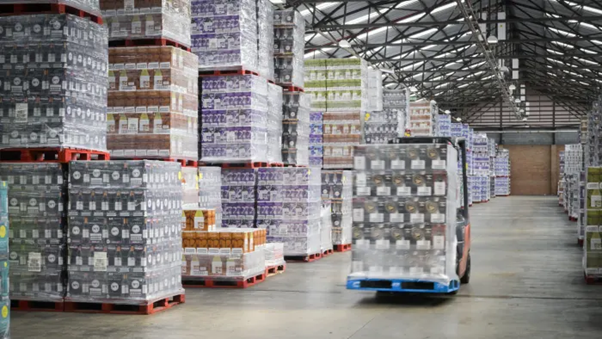
Lanchester Wines’ minewater heating system keeps millions of bottles at the correct temperatures ©Mark Pinder
Such information might be useful in the next while when companies are striving for their businesses to become carbon neutral in the next few years.
The company put down one borehole within one of its warehouses costing in excess of £250,000 which failed to provide water. The company accessed water close by in its ‘yard’ raising some 39 litres per second via three other extraction points. It raised a further 67 litres per second from another borehole within its other nearby warehouse facility.
The project used an open loop heat exchanger that utilises ammonia to concentrate the heat harvested from the minewater. The minewater being taken from deeper horizons of the worked coal seams beneath the site and after passing through the heat exchanger returned to the mine system at a higher open seam. This allowing the water to recharge its heat load as it circulates through the void spaces within the worked coal seams.
Thew Environment Agency accepts in such instances that such operations need no abstraction licence as no water is lost through the process. Such a stance is also taken with in flow hydropower operations on rivers.
The cost of the minewater scheme was not as modest as was hoped due to miscalculated placement of the initial borehole and other glitches and at £3.5 million is not to be ignored. The company though envisages payback to be achieved well before the company achieves carbon neutral status which is expected to be in 2025 or 2026.
This is a great news story that needs greater public awareness raising. There are many minewater treatment schemes already in place plus hundreds of minewater treatment schemes planned though the majority are to negate minewater pollution issues and led by the need to stop pollution of rivers across the coalfields of the UK. Others: large numbers of metalliferous workings are also in need attention.
The best answer is the most economically attractive, that is to marry need to potential user and develop a match that allows a more sustainable way forward. Such a vision is possible in the South Nottinghamshire Coalfield where British Geological Survey have had a second go at identifying what is happening underground since its first attempt proved incorrect. This new scenario outlines potential rebound of minewater north and in towards the west of Nottingham in the near future.
To marry the City Council’s wish for a set of sustainable district heating schemes and the Coal Authority wants to avoid a rather public embarrassment of minewater pollution in the area this may be a marriage of desire and convenience.
The Coal Authority must act, they must stop sitting on their hands and hoping issues such as the potential minewater rebound will not happen. If it does happen and action has not taken place the more than 20 years lead in time will have been wasted. Where will the buck stop?
There are several Members of Parliament who would like to see this autonomous branch of Gov.UK fail, I do not support that view.
Professor Harvey Wood.
Director, Clean Rivers Trust. 16th June 2021.