Two surveys conducted recently by that indispensable journal, The Engineer, have explored the perception of their readership regarding the water companies in England and Wales.
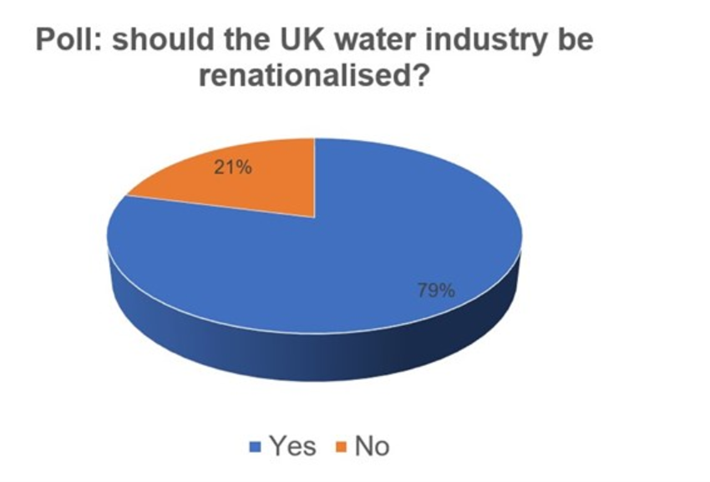
The first asked the straightforward question ‘should the UK water industry be renationalised? The readership’s response surprised me on one level but with the current brouhaha about sewage pouring into rivers and contaminating the seas around the nation wrecking bathing water quality may be seen as a gut reaction. The poll showed overwhelming support for government to take back these companies into public ownership.
In the real world taking back profitable companies from shareholders, several of whom are not plutocrats but pension funds that benefit many people in their later life. The compensation would need to be huge and in these troubled economic, environmental, and social times such a move is all but prohibitive.
When the water industry was privatised in 1989 the government saw that the state of rivers and coastal bathing waters were in a parlous state and there was no way that the government could underwrite the water authorities or allow the water rate to triple or quadruple to treat sewage. Denis Healy stated in the 1970s that ‘there are no votes in shit’. At least the privatised water companies could borrow funds in agreement with OFWAT the industry regulator and first backstop for the government to see water bills to the public did not rise too much and frighten the electorate.
The problem with the water companies was that they had little knowledge of financial issues of the marketplace, they also did not understand that the British public were changing and did not give deference to company chairmen. Today many could not give a toss for them.
Some water company boards went mad and thought they could do all kinds of things rather than supply water and treat sewage, these strange changes in philosophy included supplying office services for local authorities and building hotels. The environment lobby came of age with the European Parliament election of 1990 and many water companies realised that they were at the top of the tree amongst the dirtiest men of Europe. (Not altogether fair but Europe was good at papering over their environmental crises.)
The listed companies of the City hate criticism. The water companies muddling along for the first AMP periods (5-year periods of agreed price increases and investment permitted by OFWAT) and as the second AMP period was ending, company share prices were low and foreign investors and utility companies saw them as cheap and easy pickings. The globalisation of utilities saw energy companies from Europe buying into the British water market. Guaranteed profits and new expertise that could be hived off to be marketed as a consultancy both to the original parent company and shipped abroad.
Many water companies saw openness as a sign of weakness and as European management practices came to bare water companies began to change their names to emphasise their broader interests, United Utilities, Kelder, Pennant spring to mind. Other water companies though stayed closer to their roots.
Today some water companies are demonstrating that though they claim to care demonstrate the opposite by even stating that pollutions from their major sewage treatment works were not their fault. The Environment Agency takes a few of the companies to court and publicly pat themselves on the back for a major fine delivered by a court on the polluter.
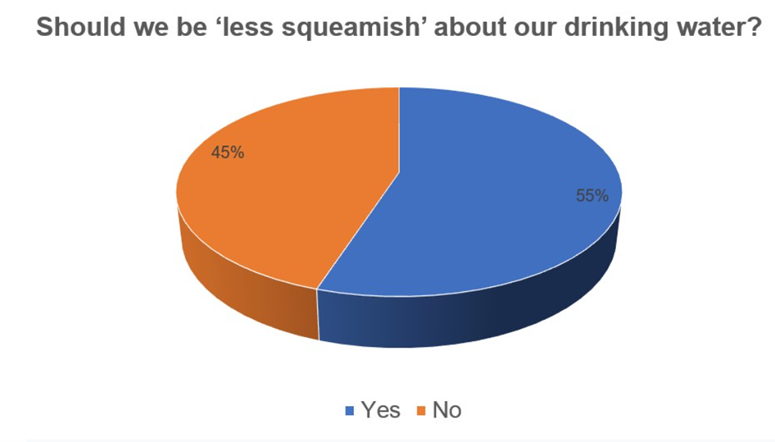
There is something fundamentally wrong with the water industry today. It may be that the second poll carried out by The Engineer demonstrates this well. This poll put forward the idea that wastewater treated to a standard could be used for potable supply. This really asked do you trust water companies not to poison you. The fact that in parts of the country some drinking water is already contaminated, endocrine disrupters and their mimics being one set of chemicals not mentioned by the water companies and only very occasionally by the Environment Agency. They are in our drinking water as they come from treated sewage waste waters that are discharged to rivers where they are abstracted again and served up to customers. These are hoped to be only tiny amounts, but their presence is blamed for the drop in male fertility.
The accidental adulteration of public water supplies to the population of Camelford, Cornwall, in July 1988 by the South West Water Authority. 20 tons of Aluminium sulphate was added to the public supply. The contaminant freed up lead, copper and many other metals and contaminants in the pipework of the town bringing about some severe reactions. The authority did not tell the public of the accidental pollution for 16 days. Such an event strengthened the government’s resolve to carry through the privatisation of the water industry and limit any future public liability.
Today the general perception of the water supply industry is good, the standards are considered better than any other nation’s; UK water is safe. The government do not force water companies to mass medicate the waters supplied to the nation’s taps. The growth in bottled water sales and under sink water filters is though a demonstration that the publics perception is changing. The 45 percent of people responding to the survey demonstrate this well.
One water company used the slogan ‘your water safe in our hands’, but how long will the majority of the population continue to believe that?