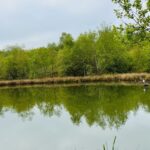
Cinderhill Acid Tar Pits, Derbyshire.
Cinderhill Tar Pits are a large set of old quarry pits that were filled during the 1960s and 1970s with acid waste sump oils: waste from steel furnaces and casting sands was added at the same time in the vain hope that these additions might stabilise the tars that would not set.
The Trust has been working on the site for four years and have developed an understanding of methodologies using phytoremedial measures, particularly the growing of willows, and poplars to stabilise the site, break down the acid tars rendering the pits both safe for the general public to visit and stopping acidic rainwater runoff from the site. This resulting in a removal of a major source of pollution to the local brook and protecting the water quality of the River Derwent.
The next years will allow the project to encompass the whole23 acre site clearing it of its acidic carcinogenic legacy. The work will see four more lagoons remediated, a lake deacidified and its chemistry radically altered. Several major oil tar spills coving several acres will also be made safe and revegetated with trees.
Other Tar Pits.
The Trust has found from investigations locally that there are at least eight more tar pits in the Belper area, some of which are having a detrimental effect on the local water courses leading from these sites towards the River Derwent. They were all deposited in the 1960s and 1970s. The same source of pollutants has also left large legacies of acid tars in the Wolverhampton and Walsall areas. These we are in the process of identification and developing strategies for each their remediation. We have been asked to consider using our methodologies at another acid tar pit at Hoole Bank in Cheshire by the local authority but have not been able to get onto the site due to access agreements not being possible at present. It is hoped to put a trial in place in the next year.
Plastics Breakdown.
This project has developed directly out of our work at Cinderhill (above). The University of Nottingham have been looking in depth at some of what is going on with the workings of bacteria and fungi breaking down the hydrocarbons of the acidic tars.
One specific fungus has been isolated as a main player and it is as yet uncertain if it is as yet known to science. The capabilities of the fungus are remarkable and may be the first natural entity that can break down PVCs, amongst the most difficult plastics to destroy. The fungus digests the PVCs it is fed on, even breaking down the chlorine elements to a harmless residue.
We wish to work further with the university on this and involve the waste industry and the British Plastics Federation.
Giant Willow Aphid, Tuberolachnus salignus.
These aphids have done a great deal of harm to the willows on our research site, even though most were removed o by hand and squashed. Most authorities such as the RHS are not worried by odd outbreaks of these pests today but in a book on cricket bat willow production published by the Forestry Commission in 1938 they were noted as a problem. The book states that they can kill mature willows in one season.
Little of their life cycle or much else is known about them and it is possible that they are becoming more common today. If this is correct the effects on the rivers and landscape will be huge. Loss of major tree stands on bank sides and additional flood issues may be considered as to be expected. One remembers the devastation brought about by Dutch Elm Disease.
The Trust is to produce a full research program that will be conducted with some urgency.
Minewater Remediation and Alternative Uses.
The Trust has been involved in this area of research now for more than thirty years and has helped develop several methods of treating polluted water from abandoned mines across the UK. These have included both coal and metalliferous mines with each water being unique to that specific site due to the local geology of each area.
The Trust has pioneered the concepts of minewater heat use in the UK since 19995 and are now seeing the first fledgling steps being taken by industry and house builders. Local authorities have always liked the idea and now with the rise in gas prices heat networks are looking financially viable as well as being environmentally prudent. There use is especially viable for areas of fuel poverty and public housing.
The uses of minewater as a resource are now becoming acceptable both as industrial supply for process water and now bespoke supply as they are devoid of chemical elements that do not need to be stripped from mains supply. We demonstrated such a scheme at Whitehaven in 2000.
Rivers Wye and Usk.
The River Wye has become a course celebre for pollution from the chicken rearing industry due to the practises employed in maintaining clean growing sheds to raise their poultry. The Trust has devised several methods of removing the problems before they reach the watercourses to bring about the pollutions. The River Usk has a larger problem in many ways than that of the Wye but has fewer friends who might raise the issue.
The Trust is putting together a group who can work with the farming industry and putting forward methodologies for the solutions to at worst only marginally impact profit margins and at best be a fiscal benefit.
Health and Water Borne Illnesses.
Over the last 12 years the most popular articles read on our web site have related to the problems of water borne diseases and illnesses. This is also the most common subject asked of us by individuals who contact the Trust. With in increase in numbers of participants in wild swimming and just cooling down in inland rivers during recent hot summers this is no surprise. The whole gamut of possible illnesses is large. Weil’s disease brought about by rats, crypto sporidium from sewage works and animal faeces, and much else. Polio has recently been found in the River Thames and there are mosquitoes that are able to transmit malaria being found in the UK. The Coal Authority had a risk assessment carried out on a proposed wetland treatment facility in the Pennines on the subject.
More work on the education of the public on simple hygiene and care is amongst the aims of this project alongside the development of a better understanding of likelihoods and risks as global warming develops.
River Trent Catchment Biography.
The River Trent and its declining water quality was the initial reason for the foundation of Clean Rivers Trust in 1990. It is planned to publish a biography of the whole river. It is to be a major challenge as it is the largest river catchment in the UK.
The plan is to bring as much knowledge of the river as is possible, it will look at the river’s prehistory its formation as it flows today. Issues of flooding, pollution, natural history, industries and shifts in population and the human influence will be addressed.
A period of four years has been set for the research and completion of this task.
Blue Carbon, East Anglian Coastal Marshes, and Midlands Wetlands.
The ability of wetland and marsh to retain carbon within its muds and ooze is now widely accepted across much of the world. This along with their importance to wildlife has made the important for birds. Resident or migratory they are across the globe being protected by the Ramsar Agreement. Forty-five years ago, people were being fined for owning wetlands in countries around the Mediterranean, many were swallowed up by holiday complexes on the Spanish Costas.
Now the protection of marshes such as those on the North Norfolk coast are recognised as vital carbon repositories and along parts of the Bristol Channel new marshes are planned and some have been created. The government’s acceptance that much coastal erosion can not be stopped is giving great new opportunities for further coastal marsh and wetland to be established.
Along the rivers of the UK the establishment of new wetlands is a crucial element of flood control going forward along with the problems of climate chaos. These wetlands also help to seque4ster carbon for long term storage. The development of wetland corridors on major rivers can in many instances link the inland rivers systems with their estuaries.
The Trust has worked with several Wildlife Trusts and other bodies to move these ideas further. Several hundred acres of inland wetlands have so far been accomplished and there are plans for many more going forward. The Trust looks to these developments to be vital in helping to cleaning rivers of many pollutants that have come to our attention over the thirty years after gross sewage pollutions were removed from most waterways.
Cornwall and Devon Mining.
Cornwall and Devon are the most active areas of the UK with plans to reopen metalliferous mines, also the winning of lithium which is also abundant. The Desire to care for the environment is expressed by all the companies involved, but there is a lack of expertise within the industry worldwide at the present time. Many consultancies have opened offices in the region, but few have the knowledge necessary.
The Trust’s knowledge of care of water from mines along with the issues of tailings dams, their construction and management, which is still very much a choice for each individual mining entity.
Flood Issues.
The Trust had its offices flooded for several days in 2000 and was cut off for two weeks. The experience allowed us to develop an intimate understanding of much that is to be experienced by those who experience such events.
The Trust has looked at issues across the UK, the Summerset Levels and Thames Valley along with the Trent Valley. Pollutants, raw sewage, agricultural wastes, along with industrial flotsam. Dead animals, horses, cows, sheep amongst the sights that do not improve those suffering inundations mental health.
The initial planning and advice the Trust offers is in constant review so we might respond rapidly and accurately. The ability to understand flood plain maps requires an understanding of the landscape and river form beneath the blue that marks the areas liable to flood.
Always Available.
The Trust is always available to help with any water related issue.