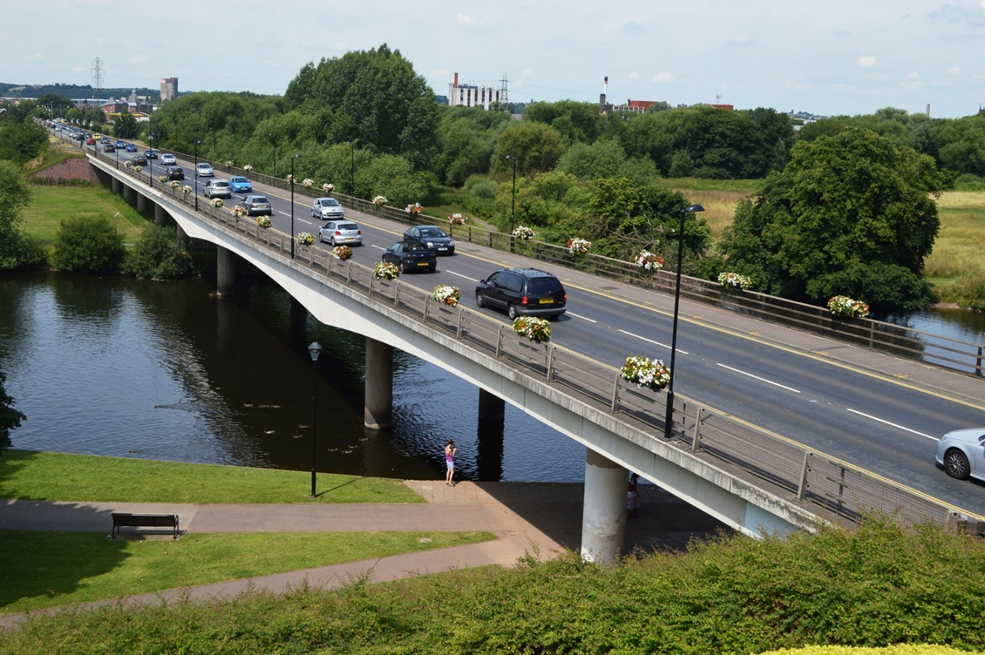
The River Trent at Burton on Trent in the distance. St Peter’s Bridge (Wikipedia) crossing the River Trent and its washlands: an important leisure facility and biodiverse wetland area.
LBC Radio News picked up on a story (18th June 2026) generated by a group of river water quality campaigners near Burton on Trent where the main comparison was made with a pub lavatory ‘s water. The landlord it would appear looked after their toilet facilities well!
The growing strength of citizen science has been demonstrated by this publicity though there is no real focus except the lavatory was cleaner than the river. The focus, if one researches further, one finds on Spotted: Willington Freedom Group (https://www.facebook.com/groups/1310355632463338/posts/3572169892948556/ ) Facebook page the reason is clear as the group publish their data and relate their concerns to swimming water quality.
We quote LBC’s web site text in full:
‘I wouldn’t let my dog in there’: Exclusive testing finds River Trent water contains more E.coli than a high street pub toilet’
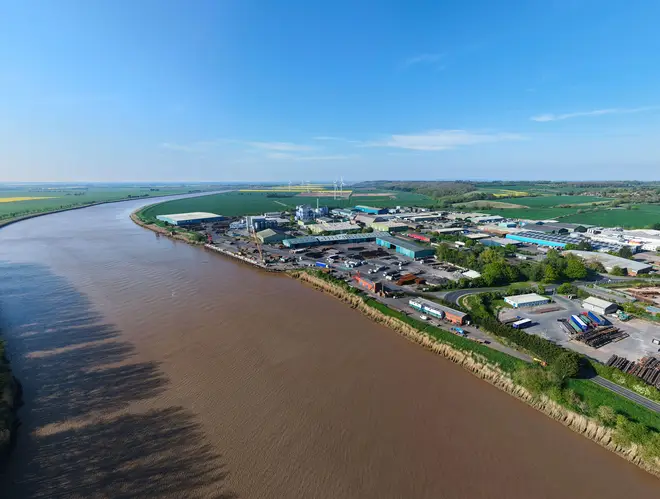
Photograph of the River Trent (©Alamy) as used by LBC on their web site with the headline and article. This is not the River Trent at Burton on Trent but close rto the Humber Estuary many mile further down river.
‘Six sets of water samples were taken upstream and downstream of an outlet outside Burton upon Trent in Staffordshire between 31 July 2025 and 12 March 2026 and analysed by a UKAS-accredited laboratory.
The testing found sharp rises downstream of the pipes in E. coli, intestinal enterococci and coliforms: bacteria commonly used as indicators of faecal contamination and which can cause sickness bugs like gastroenteritis.
A sample taken from an unflushed toilet in a high street pub chain recorded 8,500 coliforms per 100ml.
That was lower than most of the river results recorded in the same testing programme.
On 31 July 2025, for example, river samples taken downstream of the pipes showed 141,000 coliforms per 100ml.
Some results were so high they exceeded the lab’s normal upper range.
Karl Birkinshaw, Chief Operating Officer at water hygiene consultancy Envirocloud which analysed the samples, said the more extreme downstream samples had to be diluted before they could be measured properly.
He told LBC: “We’re looking at toilet roll, looking at human waste, we’re looking at all the nasties that find their way into the sewerage system.
“Above the outlet we’ve got typical levels of biological growth, but below the outlet we can see it’s dramatically increased to an extent where the normal type of analysis wouldn’t give us the result.”
“It was too high,” he added. “If you’ve got a thermometer that goes up to 100 degrees, we were way over 100 degrees.
“If you ingest the water, you’re going to get upset tummy, possibly stomach cramps, sickness,” he said. “Who knows, potentially in hospital, depending on how serious it got.”
He added: “I wouldn’t go in here at all. I wouldn’t let my dog in here.”
For one Burton dog owner, those fears are all too real.
Emma O’Brien told LBC her dog Nova became seriously ill after swimming in the River Trent near Branston last summer while O’Brien was away on holiday.
“It was quite soon, so within four to six hours,” she said. “Then she was sick all night and then she was taken to the vets the next morning as an emergency.”
O’Brien said Nova was “bringing up brown green sludge”, could not keep water down, and needed an emergency injection to stop her from being sick, followed by antibiotics and a special diet.
“She was frothing at the mouth, couldn’t keep anything down, really shaky, just not herself at all, she didn’t move for a good 48 hours.
“It is angering. Why should they be putting this waste in the rivers that we believe are clean and healthy?”
LBC shared the results with Severn Trent, and a spokesperson said the company welcomed community interest in river health, but that “accurate conclusions cannot be drawn” from the test results alone, as bacteria such as E. coli can also come from wildlife, livestock, septic tanks and urban runoff.
The company said it is not solely responsible for the Trent’s overall condition, that this stretch of river is already classified as having “poor” ecological status for a range of reasons, and that it has plans to improve network performance in this area before 2030.
The data was also shared with the Environment Agency, which said it takes water pollution seriously and, after reports of discharges from Stanton Sewage Treatment Works late last year, warned Severn Trent and instructed it to take action to prevent it happening again.
It said officers carried out a full site inspection last week and found those actions had been taken.’
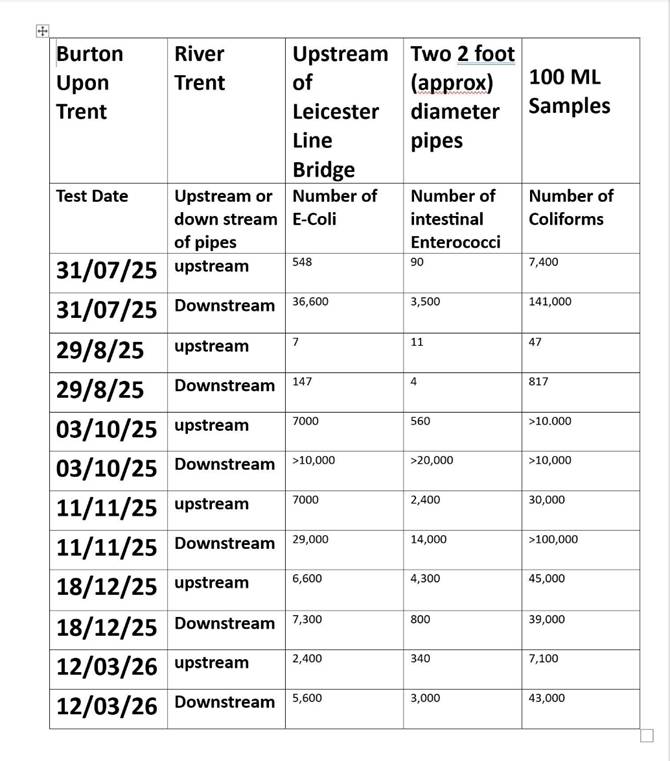
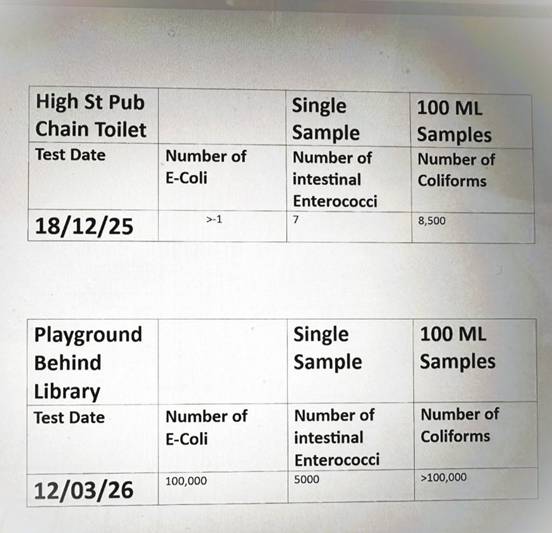
Data from Spotted: Willington Freedom Group
Comment
This research would appear to have been a fairly grewsome undertaking demonstrating the fortitude of those conducting the sampling. The River Trent is now the only Royal River of England without a recognised bathing spot which is somewhat unjust and to many unacceptable. These campaigners need to make themselves known to a wider audience, so their wishes are understood more clearly and without the wrong illustrations.
The sewage works that is mentioned in the LBC broadcast was named by the Environment Agency as Stanton, which has a poor history of compliance due to the significant increase in population in the area, south and west of the river and Burton on Trent. The Environment Agency appear to be heralding this site as a victory as it has recently been inspected by Environment Agency staff and received a good report due to improvements in operations there.
Let us ask for areas along the river’s length in which the wild swimmer might be relatively safe to swim. Let rivers be suitable for idlers. Let us have sewage works that actually produce decent quality discharges to the river as at times these discharges make up more than half the water river’s volume.
25th June 2026