23rd April 2012.
Introduction.
Harvey Wood from Clean Rivers Trust has been invited to see the situation regarding the lake at Kakinga in Sembabule District, Uganda by Lukanga Stanley of the District Forestry Service in collaboration of the Kakinga Community Watershed Management Group (KCWMG).
A Briefing of the project was forwarded to the UK and is appended to this short paper. The issues covered by the Briefing are briefly explored below. THE FOLLOWING COMMENTS AND IDEAS SHOULD ONLY BE SEEN AS INITIAL THOUGHTS AND NOT RECOMMENDATIONS. A visit to the site will take place between 28th April and 5th May 2012
The catchment of Kakinga Dam is the largest of three dams in the Sembabule Rural District which total 621 hectares. These dams collect rainwater during the rain seasons April – May and October – December. The water collected is imperative to the communities of the area as there are few groundwater sources in the area. Further to this there is a mobile cattle / pastoralist use of local water supplies.
Research in UK.
The Kakinga Dam/Lake is situated on the Kakinga stream; flowing from south to north, which when flowing empties into the Nabakazi watercourse that flows from west to east. The shallow valley of the receiving water is a seasonal to permanent wetland. The final outfall is into Lake Victoria. The southern point of Kakinga Lake is on the Equator.
The average rainfall is noted variously as about 30-35 inches or <10000mm per annum with the majority of the rain falling between October and December with another short period of rain in April/May.
The dam is situated at about 3800 feet above sea level, constructed primarily of earth with concrete spillway. It is one of the oldest structures of its type in the region and was renovated in around 2006.
The regional vegetation/ecology is noted as moist thicket to dry acacia savannah. The main grass resource of the area being Themeda triadra; known as red grass or kangaroo grass. This is recognised as a fine grass for ruminant feed.
The agricultural makeup of the region is primarily cat6tle, but with some annual crops being grown. This area of agricultural endeavour is increasing year on year.
A wide search of internet sites gave a reasonable amount of information about the region in a general manner. A number of books were acquired for the Trust’s library and are listed at the end of this paper in the bibliography.
A study of the lake from satellite photographs was undertaken which raised a number of questions and started further avenues of thought. These include the heavy growth of aquatic plants or algal flowering. Sites of heavy soil erosion from rain events are apparent as is the sparse nature of trees and grass/vegetation in areas of the hills surrounding the site. Habitations were noted, but nothing could be gleaned regarding drainage or waste treatment facilities.
Action Possibilities for the Lake.
These three sections are broken down by complexity, labour and cost. The content should not be considered as more than thoughts to be considered whilst in the field.
Small Scale.
Lake areas and bank side erosion could be controlled by channelling use to set access points and create hard standing areas to protect the areas. Fencing off the rest of the bank with native thorn bush and wire would control much unwanted access. There may be problems with goats browsing young saplings.
The managing of access points to the water would be much safer for young people and the elderly as the sites of access would be frequently visited by more people.
Ground vegetation might be established by creating a meshed surface of fabric or wood so as to stop erosion and flood removal. Some plant matting; such as that made with willow (Salix) wands, will self root and establish (4 months) to create a dense barrier that will protect banks from flood erosion and reduce access problems.
Nutrient pollution may be reduced significantly by the creation of a buffer strip made up of marsh plants such as reed and Typha which would also have possible other uses when being managed. The source for such plants may be found in the marshes to the north of the lake.
Watering animals should be away from the lake where possible to avoid excrement and other waste entering the water body. The provision of troughs for their use may be run by simple siphons that can be governed by ball cock attachments. The same sort of arrangements for humans could be considered as this would be safer than taking water directly from the lake.
If animals are to use the lake as a water supply directly their use should be limited to the water exit end of the water. Human use would be confined to the first half of the lake. This is by no means good practice but may be better than what takes place at the moment.
Medium Scale.
Slight alterations to agricultural practises would allow flood creating rainfall to distribute itself more evenly across the land surfaces, thus avoiding the creation of head gully erosion.
To aid revegetation of areas a method of folding off parts of the land might be considered so as to allow growth and establishment. This would allow a demonstration of good practise and encourage methods of fold pasture/grassland management by area to avoid over grazing. This would further help the water in the lake and its siltation problems.
In areas of the lake catchment where the rain cascades down the hillside bringing high loadings of mud that will silt up the lake bunds could be constructed to impede the flow encouraging a slowing down of the water velocity and its destructive nature. These impediments would act as traps for the silt and could be developed over time into agricultural areas of value.
Looking at satellite images of the lake there appears to be a large growth of aquatic growth; possibly water hyacinth (?) that is starting to dominate the southern part of the impoundment. This does need to be removed to a great extent. There are uses for the plant as cattle food, both fresh and as a silage constituent. It is though laborious to remove, harvesting sounds better and makes the task seem more worthwhile.
Large Scale.
The need to channel much of the flood water away from the lake and habitations during the peek periods of rainfall could be achieved by putting a set of water channels in place on the hillsides that allowed for heavy rains to be moved away from the ‘at risk’ areas. This might allow ad hoc new fresh water storage capacity to be created; or at least water bodies suitable for livestock use.
Water Harvesting.
The majority of methods are well known though there may be problems for people taking the first steps, also in some communities the ownership of personal supplies of near perfect water can be an issue with regard to protection of property.
The most valuable supplies are from roofs, followed by water harvesting in plastic sheets, either laid in ground hollows or suspended from tree branches and piped to storage.
Water storage vessels should always be covered, to avoid insect/mosquito breeding infestation, and have two emptying points the lower one to remove sludges, dust from roofs and leaves. The second outlet tap to be higher up the vessel to take water for household use
Containers for water storage should be as close to it place of use as possible and as large as is convenient. They can be at ground level or below ground. The second type of storage is likely to be considerably more expensive and harder to keep clean.
Types of vessel suitable can be cement/brick and plastered/waterproofed internally, plastic drums, cleaned oil barrels. If any container is thought too small they can be joined to other vessels by piping so as to increase storage capacity. The creation of ‘tank farms’ may be considered desirable for remote communities and isolated buildings.
Water Distribution.
The lowest cost of distributing water over large distances is by gravity; the problem of filling the tank and the actual construction cost of a raised water storage vessel or water tower being the major factors.
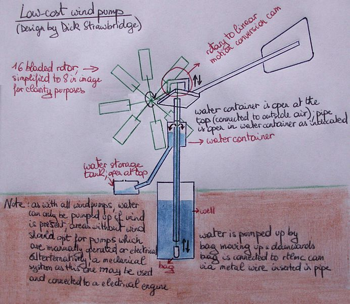
Filling tanks can be achieved over short lifts with wind driven screw pumps. Electric pumps are now inexpensive and, if not abused, trouble free. Solar and wind power generators can be used to operate the motors. The costs of such mechanisms can be the biggest factor in deciding on more rudimentary methods. Maintenance can also require outside contractors which can be costly and technicians hard to get when required.
Water tanks may be made out of timber and butyl rubber sheet; they can be built by a competent carpenter. The main expense in such a construction being the rubber sheeting. Cement and brick constructions are, in many locations, the best construction materials, but are usually the most expensive options. Iron or galvanised sheet can also be used very satisfactorily if maintained correctly.
Water distribution can be achieved over considerable distances to standpipes connected to the tank by simple flexible plastic piping. This would allow for less time being spent water carrying on a daily basis.
Sanitation.
In European eyes the natural value of western style sanitation is obvious, elsewhere in the world the collection and treatment of human wastes has a different set of issues to overcome. Local, ethnic and religious taboos are strongly held by people in some areas. In many areas there is a phobic reaction to the collection of human waste in pits or containment systems. This can prevent system management such as emptying or employing the wastes for purposes such as agriculture. Sanitation has to be customised to local needs and customs and at least with the support and involvement of the community as stakeholders. This support being vital to the goal of reducing defecation in unregulated areas and the use of poor facilities that lead to health and pollution risks.
Pit latrines being the most common facilities need to be sited if possible so as not to course pollution to water resources. The design of such facilities needs consideration with the use of twin pips as an ideal option. The use of ash and vegetable leaves amongst the human waste can within a short period of one pit being closed and the other opened for business being excavated not as foul smelling sewage, but pungent compost.
The use of raised floors and tanks so as to facilitate the emptying and removal of waste to a designated area for composting is another option, but needs to be undertaken on a regular basis to avoid foul odours and liquids over topping the containers that would stop the facilities use altogether.
The smaller the number of persons using a toilet facility the better for its upkeep as there can be a personal, family, or group pride in its proper care and function.
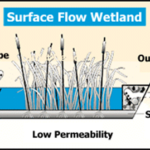
The treatment of human waste and its liquid fraction can be achieved using plant matter such as reeds and sedges in reed beds that take up much of nutrient into their biomass.
Harvey Wood.
Clean Rivers Trust.