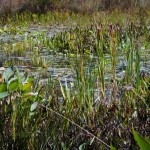
We like wetlands, as do many industries and other organisations. They first started to become popular in the 1990s when many water companies started to install them for tertiary treatment of sewage, mining companies use them for the treatment of contaminated water from mining, paint manufacturers used them to pick up some chemical and excess pigment. They were considered filtration systems and still are by some people still: they hope that they might be installed and left to do their thing. Wetlands though are dynamic systems that will do their own thing.
All liquids placed into a wetland will look to pass through a barrier by the simplest rout. They will find areas of the substrate that might be cut through so bypassing the majority of the treatment. Weeds will come in and outgrow the young reeds and then a replanting will need to take place. Reedbeds are often said to last 7 to 10 years but with care and maintenance they can last much longer.
Wetlands are not a walk away solutions.
They require upkeep. They do not need much time every month but there needs to be a walk over every few weeks and any concern is reacted to immediately and not being held back for a budgeted action. Often this sort of hold up to maintenance can bring about a much more costly or even whole replacement cost.
Types.
There are many forms of reedbed and wetland, some are more naturalistic than others. Some are more aesthetically pleasing though many of the most beautiful do not work as efficiently as a simple square bunged engineered reedbed.
Surface Flow Wetlands.


Subsurface Flow Wetlands.


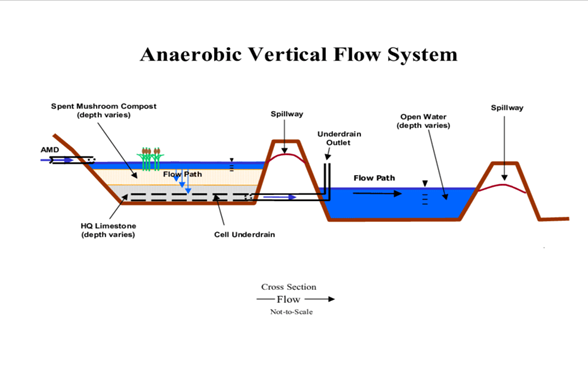
Vertical Flow Wetland Systems.

Establishment of Reedbeds.
- Nutrient status of substrate for example highly enriched substrates will result in rapid green growth but weak rhizomes, while imported reeds struggle in calcium enriched waters. Poor substrates may also be problematic with the need to fertilise the reeds once planted. This was the problem at Wheal Jane minewater treatment trial sites in the 1990s.
- Turbidity – elevated levels of turbidity can seriously affect plant development if the young plants are submerged for prolonged periods of time.
- Water levels – high fluctuations in water levels or periods of prolonged submergence can kill off early stage reedbeds. Control of water levels needs to be possible.
- Potential for algae blooms – nutrient enriched waters often form algae blankets which can smother leaves and result in poor photosynthesis. Sewage tertiary treatment sites do not need highly nutritious substrates otherwise such blooms can be overwhelming.
- Preferential pathways for treatment water need to be avoided. All liquids flow towards the easiest flow pattern. This can lead to too fast a retention time, channelling and erosion leading to loss of plants.
- Weed establishment and competition – out-competition with nettles, docks, or invasive species such as Japanese knotweed or Himalayan balsam.
- Bird predation – a small group of geese and high levels of coot and similar wildfowl can graze and permanently damage large areas of reedbed.
- Animal predation can be a problem in some parts of the UK, coypu, though supposedly now extinct have appeared in some wetlands. They eat the rhizomes and roots and destroy large areas quickly. Similarly wild boar will both eat the rhizomes and make wallows in the reedbeds.
- Wind shear – sites that are exposed to high winds can damage young plants prior to establishment. Sacking or net fencing placed around new plantings can aid establishment. Do not plant tall reeds on the top of a hill, rushes may be a better bet if it is the only location available.
- Plant suitability and health – imported stock or plants poorly cared for can struggle to establish in new sites, particularly if they are not of local provenance. Local reeds are the preferred option and in many areas it is possible to obtain quite large numbers of plants at certain times of year from internal drainage boards or other bodies.
Reedbed / Wetland Basics.
The wetland will reward care and maintenance, the planting once completed should be maintained. The designer will have specified the flora that is to be included in the planting, reeds, rushes, flag iris or Typha being the most common. Trees or alien species of plant such as Himalayan balsam have no place in the reedbed. Many reed beds have a liner to stop the effluent being treated soaking away before treatment has been achieved. Trees will puncture reedbed liners quite quickly and rendering the installation useless. Nonnative species of plant can bring about major die back of some reed and rush thus compromising the reedbed. In such instances the undesirable plants need to be removed and any missing reed replaced.
A back-end carr system that includes trees in an unlined separate area prior to discharge to the natural environment may well be worth considering. Willows and poplar being ideal as the roots continue taking up nutrient even in very cold weather.
The integrity of a reedbed / wetland requires regular inspection, The desirability of attracting wildlife needs to be considered. Undesirable animals such as coypu, need removal whilst otters need to be monitored. Wild boar are another species to be kept out of a reedbed as they will wallow in the substrate and eat plant roots. Sussex and the Forest of Dean being two areas of concern. Grass snakes often take up residence in reedbeds, they will hibernate in nests of reed litter. They are to be welcomed as they keep mouse populations down and deter rats to some extent.
Microbial Populations, the real workforce.
The microbial population of a reedbed are a constantly changing community. Each reedbed will have their own unique population. Many reedbeds when first commissioned will have been seeded with a bacterial sample often either from a sewage works filter bed or as was done at some sites from local reedbeds. The actual makeup of individual bacterial communities is unlikely to be known. A university such as University of Nottingham will gladly look at what is present.
The microbial population lives within the rhizosphere where the reeds start developing their root systems. The rhizomes act as a form of pump drawing oxygen to the rood and at the same time supplying air to the bacterial / microbial population.
Wetland / Reedbed Life Span.
Many textbooks state that wetlands used for tertiary treatment of sewage might have a lifespan of 7 to 10 years. In our view this is pessimistic and with care and maintenance double that age can be achieved. Reedbeds are costly and the longer the active life can be extended the better.
Preferential Pathways.
Preferential pathways are shortcuts for effluent water passing through a reedbed. These channels can develop quite quickly and need checking when first they become apparent. Reprofiling gravels or other substrates in such areas plus planting of new rhizomes where plants have failed.
Extremes.
Reedbeds can survive both frost and drought for shot periods, in tertiary treatment of sewage neither should be a problem but if preferential pathways or other idiosyncrasies occur either problem can occur. The wellbeing of a reedbed is up to the quality of maintenance given to the site.
Diseases.
Working within a reedbed can have health hazards. Insects, particularly mosquitoes can bite. Rats are common in the beds; gloves and an awareness of Weil’s disease are important. If flue like symptoms develop a visit to a doctor is best. Inform the doctor that one has been in a wetland suitable for such concern.
Washing hands and face are desirable prior to eating or drinking.
November 2023