The Loire is a personal delight of narrow gorges and broad river plain, bridges and chateaus. A childhood playground for only too short a time but the river stayed in my memory as did the sites that lie on either bank. In later life the revisiting has been both nostalgic and mind opening. Unusually for a place to be remembered from childhood the scale of perceived enormity shrinks with progressive years to reach its correct proportion; the Loire does not, it is big in my memory and in reality is the same; awe inspiring and a river of global scale.
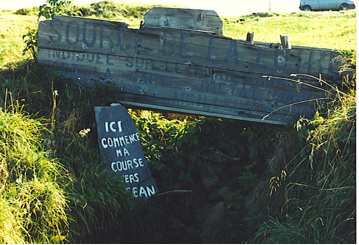
The Loire drains a fifth of France, it rises beneath Mont Gerbier de Jonc in the Ardeche region of the eastern Massif Central and enters the sea via its deltoid estuary at Saint-Nazaire on the Bay of Biscay having travelled over 1000 kilometres in its journey. It has been a navigable but difficult river to travel, flood and drought, sandbanks and swift situation have made it always a wily river that could catch out the unprepared skipper of river transports. The river in parts has been embanked and dredged, but still it demonstrates its ability to thwart easy navigation.
As a child I watched my mother trying to catch fish off a shingle spur in the middle of the river with little success, a Frenchman just downstream was never idle; constantly reeling in mighty specimens that left a four year old agog. Salmon of such size went to Paris so I was informed; my Mother was presented with one fine example, to show my Father that her time had not been totally wasted.
The river is a famine and spate channel; at periods of high water flow, volumes of 2000 cubic metres per second at Orleans is not uncommon, at summer flows it can reduce dramatically to10 cubic metres per second. Its headwaters flow north from the spectacular Massif Central, the region of extinct volcanoes and ravine like valleys, forested banks and tumbling streams. At Orleans the river doglegs to the west towards the Atlantic, which it enters through a delta.
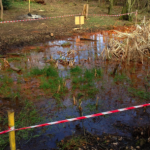
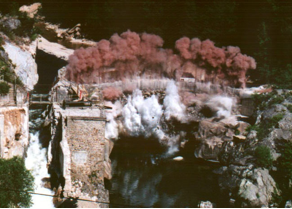
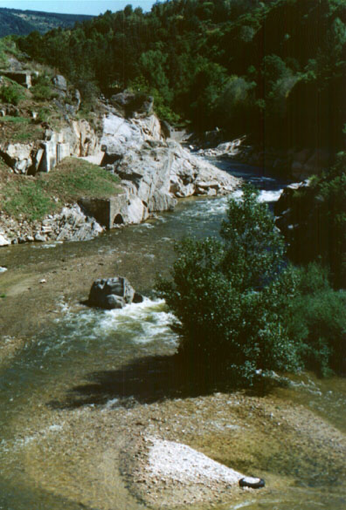
In the upper reaches the salmon breed in the many tributary streams, historically many of these have been blocked by dams used once to drive mills or to generate power on a small scale. In France such structures have been reassessed nationally as to their value to the communities in which they are situated, their environmental desirability to the sustainable long-term goals of ecological regeneration and biodiversity. Several dams have undergone this investigative process and in the Loire catchment a number have been removed.

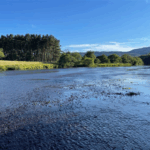
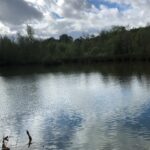
These Three Pictures Show the Dam at St Etienne de Vigan in the Upper Loire Catchment; before, during and the site after its removal.
Such engineering projects are being considered across much of Europe to allow natural river environments to re-establish themselves and to remove bocks to fish migration.
The river is a major generator of power with four nuclear power plants, three on the Loire itself and one on the Vienne. There are 38 dams, several of which are hydroelectric generating stations which are located across the whole catchment.
The Loire region has a population of around 12 million people living along its banks with over one third inhabiting communities of 400 or less. It is a predominantly rural landscape that produces one third of the fat stock and half the cereal production of France. Over 300,000 hectares are reliant on irrigation for crop production. Vineyards are important to the economy of the region with a complex selection of grape varieties and wine types reflecting the local climate, terroir and base geology.

The use of the rivers water for irrigation has been aided in becoming more sustainable at times of reduced river flows by using moveable river barriers to act as temporary dams that increase the water storage facility of the river.
The river is recognised as the last truly wild river in Western Europe; its importance to both national and international biodiversity is still only becoming better known and understood. As a bird migratory route and a haven to rare and threatened wildlife it is of premier region of bio diverse importance in France. The river is home to more species of dragon flies than any other river in Europe: it has the highest phytoplankton diversity in the country, these algae are mainly found at the seaward end in great numbers within the remnant delta but along the length of the river the diversity of growths is remarkable. The amphibian population is equally diverse with at least six species of toad, eight frog and three newt varieties.
The river is a showcase for the art of chateau building through one thousand years of fluctuating architectural fashion, power and taste; these building also showcase the regions geology to an exceptional degree. Much has been written about their grandeur and purposes; little can rival the spectacle.
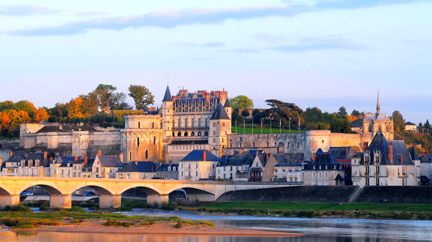
The Chateau of Amboise makes Disneyland Paris look distinctly pedestrian even with its recent flood defences and modern bridge.
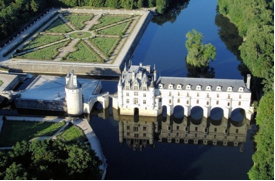
Chenonceau reflects the power of state and nature.
The rivers delta is not a large Camargue like wilderness; it is a mixture of navigable estuary which allows shipping up river to Nantes and severely restricted intertidal marsh. The navigable channels have been engineered over a period of two hundred years, not just ships reach their destination but the seawater mixed with freshwater further upstream than would be natural and the channel was curtailed. Over the last twenty years the authorities that care and regulate issues relating to the river have considered ways of developing a more natural environment. The studies have led to proposals that will place a manageable height barrier immediately below the port of Nantes which will allow shipping to pass through but hold back the salt/brackish waters from travelling beyond which will encourage the upstream river to return to a more natural condition. Downstream of this barrier the development of wetland, salt flat and intertidal environments is to be encouraged with the designation of sites deemed as suitable for such receptive schemes.
The Loire through its three stages, the gorges and fast flowing headwaters, the valley, a designated world heritage site since 2000 with its chateaus, vineyards and agricultural importance and thirdly the tidal section that has vestigial delta features and a dynamic restoration plan. The river has a guardianship that listens to its population spread out ain communities along its banks as well as being willing to take action in the best interests of the rivers ecology and long-term wellbeing. I am sure that many will disagree.