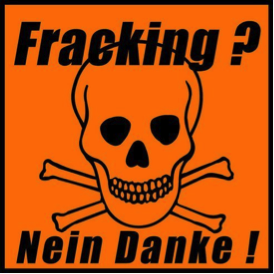
It has become clear that Clean Rivers Trust needs to outline its position regarding shale gas/oil winning and the processes known colloquially as fracking; the technology that frees the hydrocarbons from their parent rock to which they are bound in a variety of chemical bonds. The process has stimulated groups within society, ( such as those resident in areas geologically suitable for the use of this technique as well as those opposed to any new exploitation of fossil hydrocarbons from the Earth’s crust. This has led to the creation of antagonism, fear and misrepresentation within the debate. Reliance on sound science is challenged by the innovative nature of the process coupled to genuine fears regarding personalised impacts on property values, health and geological risk.
The need for further fossil hydrocarbon development is questionable on many fronts:
- The price of gas and oil is low across the globe and availability is high
- The ability of the UK to service energy needs from current sources globally at an economically competitive level is not in doubt
- The need for an expansion in the supply of fossil sourced carbon burn is highly questionable at a time when all the global companies are writing off billions of dollars of surplus “fossil” based assets on their balance sheets.
- There is a clear national and global trend for the switch of energy generation from non-fossil to, renewable or more sustainable resources is now the fastest area of growth in many economies. This is accelerating as the renewable technologies benefit from economies of scale, falling capital costs and non-dependence on artificial subsidies.
The legitimacy of several of the exploration area license holders suffers from their inability to deliver basic assays of possible reserves or proof of fiscal probity; others are holding licences in order to inflate their balance sheet valuations artificially to attract takeover interest. . There is a demonstrable need for companies that have experience of operational attainment within small and densely populated locations. None such exist embracing the full range of services such as drilling, strata fracturing and well sealing after assays of oil and gas are complete. Similar safeguards would need to be undertaken if any operational infrastructure was commissioned and exploitation of mineral oil or gas were to commence commercially.
Conversely the Government and those pressing for planning permissions at potential sites are doing little to make their cases transparent, instead relying on generalised and vague statements relating to energy impoverishment or supply shortage and uncertainties in the short to medium term across the UK. This at a time when coal burn is being replaced by the fast roll- out of renewables in the market place. The dash for gas of the 1990s has left a stock of large capacity power generation facilities that are not as responsive to the vagaries of the market alongside the ailing nuclear facilities which are also being decommissioned; Thus matters are not helped by a seismic shift from a highly centralised to a highly decentralised generation base for electricity in particular with a network distribution created for a past era. This situation is unlikely to be resolved by the coming of shale gas and oil but rather by greater technology development in downstream supply and battery storage systems for domestic as well as commercial applications. The Trust takes a pragmatic and possibly cynical view that shale-borne hydrocarbons are popular with HM Treasury merely because they are a potential stream of revenue income to return us to the substantial yields enjoyed from North Sea fossil hydrocarbons over the last 40 years.
Clean Rivers Trust has no remit to comment on these broader economic and political issues but they are germane to our core interest in the interaction between the solid, gaseous and liquid minerals industry activities and the impact on what we regard as an underground aquatic environment.
Pollution mitigation, control, monitoring and remediation remain central to our focus. Our understanding of the chemical compositions of the fracture or slicking fluids, the pressures or intensity of injection in relation to the target strata and the characterisation of horizons in which the gas or oil may be enmeshed qualifies us to comment on the various issues involved, if necessary on a case by case basis. Each is unique. Fortunately the Environment Agency in England is not allowing the drillers the luxury as in the US of lagooning the used fluids on site for release into local water course or groundwater. Correctly they are having to store the spent fluids in bunded tanks or passing those fluids to a tanker for treatment at properly licenced hazardous waste facilities. That is to be commended.
The protection of the ‘aquatmosphere’, the space that lies beneath our feet, and the ground that filters and holds much of the water that enables human and animal life on the surface is absolutely critical. Clean water is not an infinite resource contrary to popular belief. Once aquifers and other pathways for potable supply via the base flow of rivers and streams are contaminated they can be lost for decades. Those responsible (in pursuit of the removal of saleable assets from the geological “bank”) must recognise their liability to cover the indirect as well as the direct costs of their activities. (The so called “externalities” in the jargon of economists.)
This must be the primary concern of government, (national and local), planners and environmental regulators. The decision to support such exploitation in the absence of transparent safeguards will merely add fuel to the (often) non science based opposition from those with equally selfish approaches. In reality it can be legitimate to claim that fracking will not lead to widespread environmental damage, it will not lead to significant land subsidence, sink holes will not open up on a widespread scale but each case is unique.
Geology, rainfall, permeability, chemistry and other factors suggest that there are areas where fracking may do just that. In historic mining areas where seam after seam of coal, iron stone, clay, metals, stone and gypsum will need to be well understood for such sites to be trialled. They could very well be vulnerable, as will areas where minerals have naturally dissolved beneath the surface. Ripon in North Yorkshire may be one such area for concern yet it is under active consideration for planning applications. Aquifers that supply potable water must obviously be protected from shallow exploration or exploitation. Risks of polluting the public water supply or of inundating fracture zones both nullify the effectiveness fracture operation itself and raises unquantifiable risks of tectonic movement.
The Trust has assessed similar such strata fracturing operations in Spain, the North Sea as well as in the UK for other purposes: These studies have included burning coal in seam, freeing oil to flow in directional drilling schemes and opening the pores of aquifer rock to allow water to flow. The use of explosive, concussion, heat and pressure have been utilised for hundreds of years allowing a knowledge bank of good practise to exist. This has often been overlooked for expediency within the shale oil and gas race in the US due to the frustrations of opening the strata and encouraging the flow to be sufficient to create payback at a time of peak oil prices. However the world has changed., Britain is a small island with a density of population that must not offer undue flexibility to the ‘Frackers’ or give them any comfort in relation to dilution of regulatory oversight or freedom from passing on their “externality “ cost legacies to societies yet to be born. There is no need as the exploration processes are well established and quantified.
In short, Clean Rivers Trust would see the exploitation of shale gas and oil a retrograde step in developing an energy strategy for the next thirty to forty years. Our central Government must be persuaded that it is being seduced into imagining that this is a cheap and easy route which will return us to a world of energy independence and financial income flows from licencing and revenue taxes. Fossil carbon industries are dying year on year and this is a blind alley, technologically, geologically and economically. We must look to the future and not the past to re-generate our industrial base. Government must do all it can to ensure that the attributes of such developments are not damaging for the natural environment and do not overstep what needs to be a good neighbours policy towards the communities within the operational areas of exploration, development and production.
We will do all in our power to support that objective and those who advocate that case alongside us.