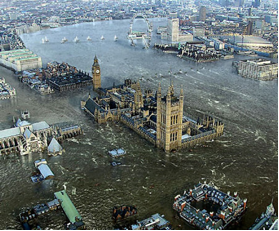
This last week has seen the government of the UK display an uncertainty about the future of river management in England. The ministers for the Environment and Agriculture have different visions for the long-term upkeep of smaller rivers, streams and ditch systems that are at variance one from the other. One minister favours the idea that local people and environmental groups should manage the water quality and water systems as catchment ecosystems, the other wishes to see the rivers managed by farmers with the overall premise to expedite water away from the land so as to minimise flood events and to shorten them when they do occur.
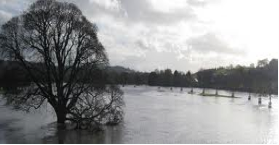
River Eden in flood.
The age old lines of concern were demonstrated by the BBC Radio 4’s Farming Today program which though not having either minister willing to speak had a farmer and a conservationist from the Wildlife Trust both giving a view. Both were sensible and gave optimistic voice to the ministerial points of view that they felt comfortable with. The farmer saw that flood was to be avoided by drainage systems being returned to the protection of the land by increased ditching and dredging of streams and smaller rivers, the environmentalist, though seeing a need to avoid flooding desired habitat to be protected, the water quality to be maintained and improved.
These two sets of views go back twenty years before the Drainage Boards across England were required to carry out their watercourse management planning with due regard to the needs of wildlife as well as those of agriculture. At that time these independent drainage authorities, paid for by farmers levy, carved out drains across their areas with little consideration for wildlife, today the system has changed allowing wildlife equal status to that of drainage of the land.
These sets of divergent opinions; flood prevention and conservation priorities for action are riven with likely disagreements; the interested parties are equally diverse in their views regarding care and maintenance of the riverine landscapes. These parties include farmers, insurance companies, bird watchers, anglers, walkers, boaters and canoeists, conservation groups and others. This array also includes the academics and others interested in the soils abilities to retain moisture in the face of global climate fluctuations which also impinges on the issues of flood avoidance with the need to retain water in times of plenty for a time of drought.
Simplistically; people including farmers who have been flooded or threatened with inundation are the ones that have the sympathy of the majority of the public and the insurance companies on their side, the opposition, if that is not to strong a word, are a cross-section of other river users who are more interested in the navigation, sport, recreation and conservation of wildlife. The latter grouping is a diverse and disparate set of groups whose often divergent opinion regarding protection of species and maintenance of ecosystems divides them.
There should not be a running battle; this has been brought about through government strategic planning that in their view will in the future lead to cost savings. A plan that will require the local populations along rivers and streams to decide how clean their rivers and streams need be and, if pollution is present how it’s clean up might be funded and waters restocked with fish.
Over the last twenty years all parties have come together with the regulator, the Environment Agency to agree ways forward through public consultation and research, this approach is costly to the state; it is also in these fiscally tough times in the governments view to be avoided where possible. This method has been shown to work well but times are changing.
The proposed privatisation of the regulator in England would allow large savings and the sale of the several prime location offices across the country which could bring in a good amount of revenue to the treasury at the same time. The public would, as in the United States, need to find funds to care for the environment that citizens may wish for or rely on industry to fund the most attractive schemes as part of their public relations. The need to use volunteers to maintain the environment is fine on some projects as is already the norm for several environmental groups, but to fulfil a national agenda of management and maintance to just keep the status quo is unlikely to be achieved.

Is the Agency loosing focus through government?
The present situation is that bank maintenance is carried out by the Environment Agency along major rivers alongside farmers. The Agency has found this role more and more onerous and not a role for the regulator but the only organisation capable of clearing the detritus of flooding or raised water levels after winter, keeping flood banks clear of scrub or other damaging material. The Internal Drainage Boards maintain the drainage systems in most low lying areas or those liable to flood in conjunction with the farming community. Farmers and landowners maintain the secondary streams and drains out side the drainage board areas as and when they have the time and identify need. The Environment Agency carries out all aspects of pollution control and discharge regulation, abstraction, fisheries and restocking of waters that have been polluted; it has its own fish hatchery located in Nottingham for the supply of coarse fish for the purpose.

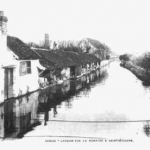
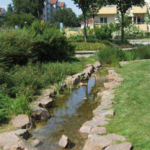
Engineered watercourse for a drainage board.
It is now becoming plainer that those interested in their rivers needs need to be proactive and decide how they feel about the future of their rivers otherwise the government will impose a set of schemes that are both inappropriate for the natural ecosystems and not what is desired locally.
The T rust respects the fears of flooding having experienced it at first hand, but is also aware of the damage of returning environmental decision making and funding actions to communities that are financially challenged and with little enthusiasm for the environment beyond their gardens, villages or towns. An ideal, if change is inevitable would be to return to the river boards of the early and mid 20th Century where a modest professional staff worked for improvements across the length and breadth of a catchment.
This form of management would allow for ‘joined up’ thinking and actions into the future.