The Selby Coalfield has been closed 9 years and is now almost forgotten; it was the
largest project to come to fruition under the management of British Coal. It was seen as
the long-term answer to the UK’s energy needs and was expected to supply fuel long
after the North Sea oil and gas reserves had become depleted and shut down.
The site was recognised as being of economic value after coal exploration boreholes were
sunk in the area during the early 1960s; planning and development of the stand alone
coalfield carried on from the 1960 through the 1970 to when the first of the five pits
began operating in 1984 at Wistow, the others opened shortly afterwards at North Selby,
Ricall, Stillingfleet and Whitemoor. The project was an unusual and complex scheme that
had all five pits linked underground by railway and conveyer systems with the sixth site
at Gascoigne Wood being the handling site where all the coal from the mine system was
brought to the surface by a drift.
The size of the coalfield was compared to the land area of the Isle of Wight, its only seam
that was worked being the Barnsley, other seams were also economic to be mined but due
to the geographic location of the mine at the southern end of the Yorkshire Ouse there
were fears of subsidence that might course large areas of flooded ground. Subsidence
events and the wetlands were created when such land stability issues arose on the Kentish
Stour which were caused by the mining from Chislet Colliery in the 1950s and 60s.

The planning of the new Selby Complex was greeted by the UK’s electricity generator
the National Electricity Generating Board with a large increase in power generating
capacity close to the new coalfield. Drax and Eggborough were built as generating sites
and the power station at Ferrybridge was increased in size and all are now involved with
diversified fuel types and carbon capture initiatives.
The Power Hub.
The concepts that allow the old mine system at Selby to become a twenty-first century
zero emitions power generating hub are several fold; its geological isolation from other
mine workings, the flooded nature of the mine workings, its proximity to major power
stations and its own major connection, at Gascoigne Wood, to the National Electricity
Grid.
The ownership of all the old mine sites by one
company is a further benefit to the scheme,
which of a magnitude only considered
nowerdays for nuclear electricity
generating facilities.
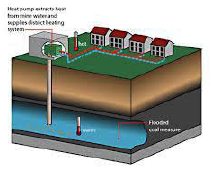
The generation of energy by the use of the water from the flooded mine workings would
be a profitable enterprise in its own right. The provision of heating and cooling for
industrial development at stable prices unaffected by the cost of natural gas has potential
benefits. One significant benefit is that this low/negative carbon source of energy would
allow neutral and negative carbon industrial environments to be developed as well as
more traditional low cost industrial air conditioned facilities.
Such schemes have been in place in the US and Canada since the 1980s, more recently an
industrial and district heating and cooling scheme has been developed in Heerlen in the
Netherlands. In themselves these developments allow for large potential savings to both
private householders and to industry and are potentially capable of being installed across
not just the old coalmining areas of the UK but around every deep mineral and
metalliferous mine. Schemes are in development across Europe, in Norway, Slovenia,
Belgium and France.
 The Selby Hub takes this concept of naturally heated water and facilitates the recycling of
surplus and waste energy sources. At the heart of this ‘cycle’ would be the energy from
the power stations at Drax and Eggborough which would be routed from the power
plants and taken to deliver there thermal benefit to the floodwater below the surface in
the closed mine. In the same way other local energy producers and surplus resources
could receive a commercial return from their production. The minewater which is
efficiently insulated belowground in the complex of abandoned roadways and workingscould be increased in temperature from about 25 degrees centigrade to a temperature
suitable to drive turbines to generate electricity on a national scale. The proposed power
generating engines on site at Gascoigne Wood would also return their waste heat to the
waters below ground in a virtuous cycle of continuous replenishment.
The development of the Hub would allow for the ongoing generation of electrical energy
with zero carbon emissions and significantly assist in the reduction of the carbon
footprint of the power generating facilities at Drax and Eggborough. The environmental
gain allied to a major energy generation facility at a modest operational cost is attractive
for both industry and government.
Concept Breakdown.
The concept is an innovative development
that uses technologies that have been proved
in several countries and over a number of
years so are known to be reliable as well as
economically sound.
The use of low grade heat from groundwater within river terrace gravels to allow for the
heating of offices and factories at low cost have been developed in the UK and been in
use for several years. The more efficient minewater utilisation which offers higher
temperature waters has not yet attracted commercial interest. A few trial schemes have
proved the technologies employed but other regions of the world have developed the
concept and the efficient use of the resource over a 40 year period. In the US and Canada
the use of minewater has proved to be both economically attractive and environmentally
sustainable and the Dutch have now opened their first project which will be emulated
across the European Community except in the UK. The British Government are not of the
opinion that the technologies of geothermal energy are the best route to go with regard to
energy supply and so far have preferred wind and hydro generation allied to the planning
of a new generation of nuclear power stations.
 The concept of augmentation of ground based heat from the waste heat derived from
conventional coal powered power stations might seem to be an anomaly in these days of
‘alternative energy’. However as a valuable resource ‘departing from the norm’ would be
entirely justified and receive a welcome from those in the power generation industry for
whom the waste of the resource has been something of an embarrassment..
 The possibility that the coalfield at Selby might still be powering the nation after North
Sea oil eventually has run out could become a reality, though not as at first thought. The
economics of the scheme are relatively straightforward, the employment potential of the
area would be increased and such a groundbreaking scheme would usher in a new lease
of life to the present coal and biomass stations of the area.
© Wood & Wood Clean Rivers Trust May 2013