Moving Forward.
Clean Rivers Trust (CRT) has witnessed the development of The Rivers Trusts Movement in the UK, either individual watercourse, catchment or region; the West Country Rivers Trust being the first of these and now the Rivers Trust which acts as a linking mechanism between them all. Their activities are wide ranging but specific to the areas that are their constituency, though much can be translocated from one catchment to another, particularly the engagement between the rural and urban elements of each area and the championing of good practise in the areas of agriculture, fisheries management and other specific local issues. CRT though not part of this movement has been involved in advising several of the individual trusts and thinks that they have the potential to deliver much of benefit to the river environment across the country.
Clean Rivers Trust feels that there is opportunity for these organisations to become important players within the economic environmental networks that are now starting to develop in the UK and in Europe. The geographic foundation of each trust gives it strong links to its region, the rivers have for thousands of years been the umbilical cords for the communities along their banks. They have fed, fuelled, housed and transported people and goods and have been the primary arteries of culture for millennia.
Much has been developed since the 1980s when there was the European initiative to see environmental and social collaboration along major rivers, especially those such as the Danube and Rhine which, being transnational waterways with many varying water qualities, political and social variances were of major environmental and diplomatic concern. Other rivers especially the Gironde/Dordogne in western France were put forward for consideration for special consideration. In 1990 the Vallee de la Dordogne was targeted as the European river to be highlighted by developing an interdepartmental understanding of the river as a total entity. A conference and summit was convened in February 1992 where the Charter was signed by national and local leaders.
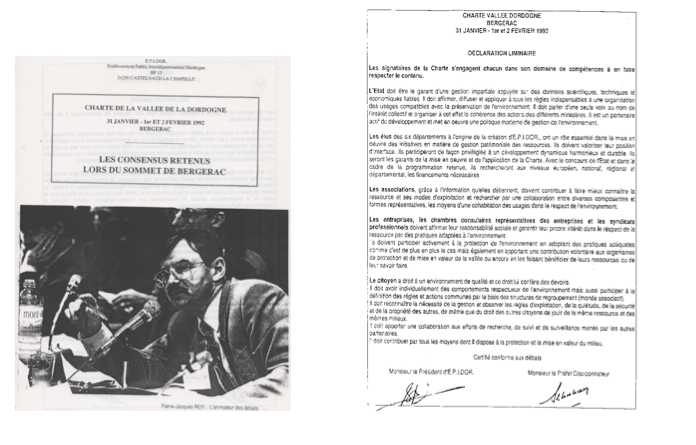
The Dordogne was subject to scrutiny that broke it down not just as a river corridor but as a cultural and economic entity. It allowed for the river and its catchment to be seen almost as a quasi-state in its own right. Economically, socially, culturally, all were given equal status including such issues as power generation, transport, communications, environment, agriculture, industry, employment and tourism. Leisure activities, standards of housing, social service provision, planning divergence between the particular departments and authorities through which the river flowed were also noted. The picture that emerged was very much a snapshot of the south west of France at that time; much was said about the increase of sanitation and the changes in plumbing that was then being desired by the citizens, both in cities and the smallest villages.
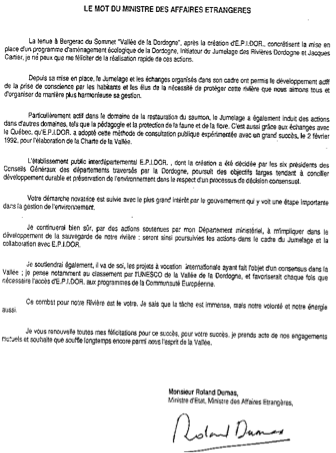
Like many ‘good things’ at the time initiatives such as this were saddled with the bureaucracy that went with the territory and certainly was unsustainable, eventually it petered out, but the initiative was certainly not wasted as in France today the rivers have all been seen afresh, they are much more noticeable to authority and citizen alike. CRT in 1992 put forward a plan for the River Trent Catchment of a similar nature, this foundered due to the thirty odd local authorities’ fear of red tape which the French had at least confronted.
Attitudes have altered in the last twenty years so that today such initiatives could work on major catchments in the UK, it can now work on the Gironde/Dordogne in France. This is due to the stakeholders being aware of possibilities of regionalisation and understanding of the technology that enables economic and environmental harmonies to be modelled. The most notable outcome of the study of the Gironde in the 1980s being the development of awareness of the issues of bio diversity that has now not just appeared in Bordeaux (thanks to the work of the Societe Linneenne de Bordeaux) but has been taken up by the country as a whole. The flora and fauna of France has become a major fascination that has encouraged tens of thousands of the population to research their home areas leading to an awareness of many regions of the country; putting much of the rest of Europe to shame. The publication of the definitive flora of the nation’s regions is now well under way.
At the same time as the increase in awareness of nature the recognition of the importance of industry to the wellbeing of the natural world is recognised; jobs, the economy, tourism all have their place alongside the natural world. This acceptance stemming from the understanding that a firm economic base helps fund the care of the natural diversity that makes each catchment/region unique.
The Rivers Trusts are set up to encourage local partnerships across catchments, through this there is potential that could be of benefit to both the human and natural environment on an unprecedented scale.
Harvey Wood.
Acknowledgement and thanks to Dr Bruno Broughton for introducing me to the idea in 1992.