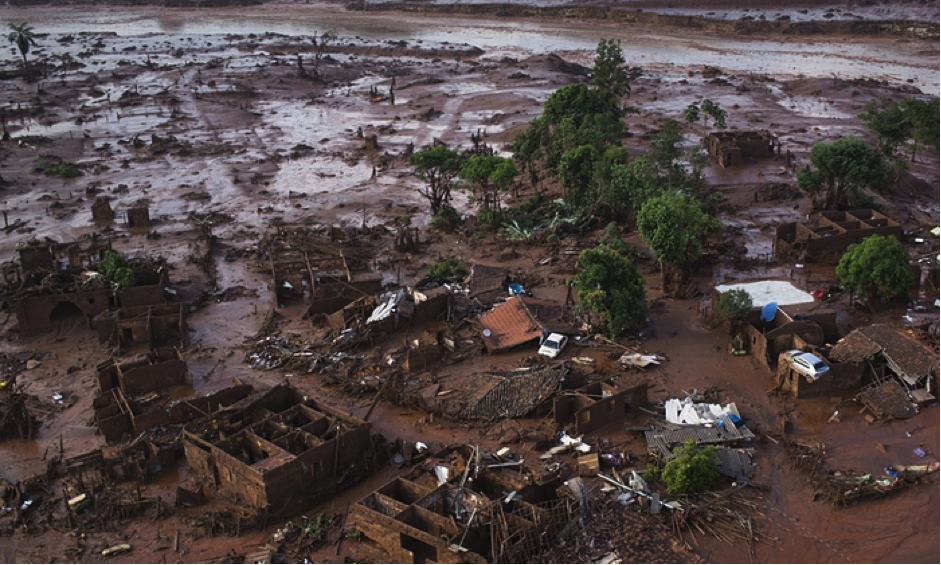
The town of Bento Rodrigues.
The last year has seen mine ponds or tailings impoundments in the news again, last year the Trust publicised the Mount Polly tailings impoundment breach that sent huge volumes of toxic muds into the river system in North West Canada, this year a number of deaths, pollution of the Rio Doce and flooding Bento Rodrigues and other villages and towns, drinking water supplies were compromised for 2 million people.
Last year(2014) there were at least another 3 tailings dam failures worldwide, one of which occurred in Brazil with some fatalities but no publicity due to an embargo of news put out by the mining company in that isolated area. The others did not rank interest due either to isolation of location or lack of media interest as there was other news to carry, IS, the budget or the results of a hockey match.
Bad planning, bd maintenance, bad management, are all the responsibility of the companies who place these structures where they are; they are also the responsibility of the authorities who grant the permissions in the first place to build these structures the way they are. Such a statement as this suggests an antipathy with mining that would be wrong, the Trust has worked with mining companies for the last 25 years, with some that are amongst the largest in the world to some of the smallest. They have all similar problems to manage and all have demonstrated proficiency in water handling. All mining companies have risks to balance with regard to water, land stability and retention of wastes.
Over these 25 years there has been one abiding lesson learnt, the understanding of risk alongside an understanding of detail. The man who does the menial job of going round the impoundment dam day after day out looking at the debris that always finds its way to block spill ways or ensure pipes are not backing up. This man clears the blockage clears the pipe; it is his job. If he is away from work, that is when the problems are apt to occur, a good mine operator will send a senior surveyor out to take a look, see that things are as they should be, this is not the case in many instances, a fellow seen doing little or an idle fellow is more likely to be dispatched to the isolation of the spoil and water lagoons. He will sit in the cab of his wagon keeping warm, dry; smoking, texting waiting for the days end knowing all will be well, there are no problems up here there never are. As he sits snug the spillway blocks the pipe clogs and the reputation of a mining company hangs in the balance.
Other reasons are technical when a tailing facility fails, lack of foundation for volume retention; the common and somewhat insane idea of some engineers to raise dam walls to prolong an impalement’s life, rather than build another: there may be a lack of space, the mining company’s Finance Director wants to limit expenditure again, the mine has only a limited life left; there are many excuses for cutting back. The thing is that mine tailings dams are designed and built to specification. To then burden the dam with greater stresses than its original design allowed for is folly. The mining company relies on their consultants in many instances, these specialists when they redesign or reprofiled a dam to take a greater burden often leave out of the equation the original builders of the dam, the workforce whose keying of the foundation on a Friday late afternoon was rushed so as to get home or to Mass. All workers in the world cut corners, most are corrected the next working day but others are not.
Other dams are placed well and correctly upon ground the condition of which might not be fully known or understood: a lack of rain for some years has removed a spring line on a hillside. The rains return and the springs start functioning again, slowly, at first and a slight increase in flow of water into the toe drain might be noted but nothing untoward. This may not be until the base of the well-built, well placed dam liquefies and descends down the valley with the contents of the dam following it.
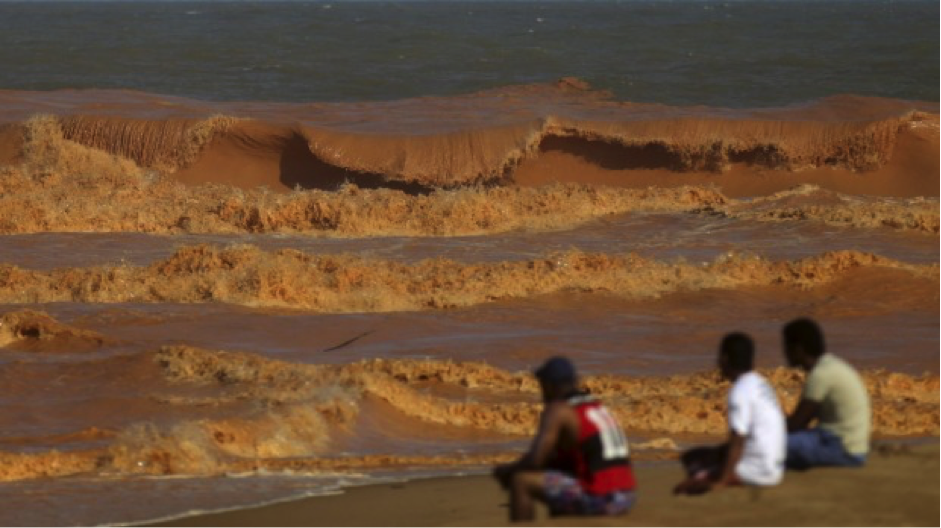
The Rio Doce reaches the Atlantic Ocean as an ochre tide.
The large mining companies are no worse nor better than the smaller companies, their reputations though vital for their listings on the Stock Market somewhere around the world, whilst the smaller extractive companies are privately-owned. In Brazil BHP and Vale, two respected major mining giants showed that size does not mean safe working. The mining companies from Australia and South Africa have seen their stock prices plummet. The corporate fines already have been eye watering billions of dollars, though much is insurable risk and should not impact on the companys’ bottom line. The mine being a standalone joint venture can go bankrupt and not bother the parents in the long term.
This is not a diatribe against mining companies nor against winning minerals from the earth, we need the resources for our lives, computers and bread all have components that come from the ground. It is a warning that mining companies are not now run by miners but by accountants. Few such people have spent time down a mine or weathered foul weather in great open pits. They spend their time productively protecting their investors’ money without the grounding in the essences of their industry.
The attitudes of the boardroom soon make themselves clear in the mine manager’s office. The mine surveyor with his cad and pencil recognises the headquarters call for more productivity and less supernumerary staffing, assistants and reliefs. The risk assessment and the thoughtless act allow cockup to course accidents and disasters as does the arrogance of some. The tailings dam surveyor who is a member of that club of almost masonic power, they have the knowledge and the right to stop operations but seldom if ever do so as they would not criticise one of their ilk.
The mining industry like all others has its areas of expertise that does not like to be overviewed; from the man in the cab waiting for the day to end to the labourer skimping on the foundation of a dam. The manager who is reliant on the dam man, off for any number of reasons is as vital as the face worker or chief executive officer.
The answer needs to be that all in the industry are engaged; from boardroom to drain-man in the care of these sites. They are not places of joy for many and for those that are uninvolved but are neighbours they can be hell. Mines, quarries, pits, they all play a role in wealth creation, supply the needs of a modern society and there is definitely no reason for the endless annual round of handwringing after each disaster as these should not happen.
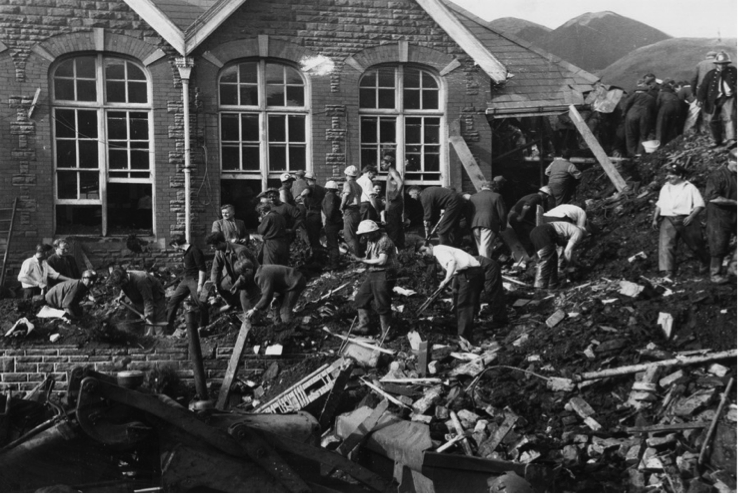
Aberfan, South Wales, 1966, 112 children and 28 adults killed when a dirt and slurry impoundment moved.