Several years ago, I came across a Nottingham City Council / British Waterways strategy report that was written in the 1970 / 80s outlining an exciting proposal to bring a new inland port to the City of Nottingham. It was a tantalising report that would allow major barges to pass up and down the river to and from Hull and Goole and deliver goods to distribution depots in Nottingham. It talked of in-transit warehousing and an increased river frontage value. It would have been the hub of export for Midlands manufacturing.
On the face of it, it was before its time, green transport infrastructure, less lorries on the roads, lower freight costs and a rather more leisurely way of moving containers and other cargos.
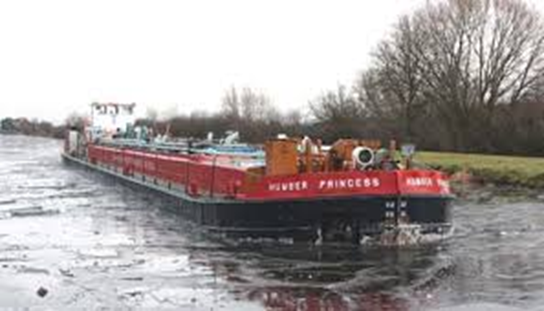
At the time I read this report I was living right alongside the river; I watched the fully laden Whitaker’s tanker barges traveling, lumbering low in the water on their way up to Colwick and riding empty, high, and fast heading for Hull. I remember a police boat pass my bedroom window one winters night; the flashing blue light was somewhat unsettling as the river was up and from behind the flood bank it appeared to be flying.
It was a scheme that was Utopian, it was an outline for using the river as a conduit for commerce on a scale unheard of in England prior to this. But now looking back with better access to information and data this scheme was only the continuation of what had originally started in the 1930s to bring Nottingham City into an exciting new age and become a European City.
The City in the 1930s expanded its freight capacity at Trent Lane, Lady Bay. It started building infrastructure that would allow large volumes of freight to be loaded and unloaded from parges bringing and despatching the needs and exports of the Midlands directly to and from Hull. In 1938 over 250,000 tons of goods had been handled at Trent Lane depot. In 1964 over 1 million tons of cargo passed up river to Nottingham and this doubled in the 1980s. Most of the traffic being petroleum being taken from Hull to Nottingham. This came to an end in 1991 when the railway won the contract and since that time less than 200,000 of cargo move on the Trent and that mainly to the wharfs near Gainsborough.
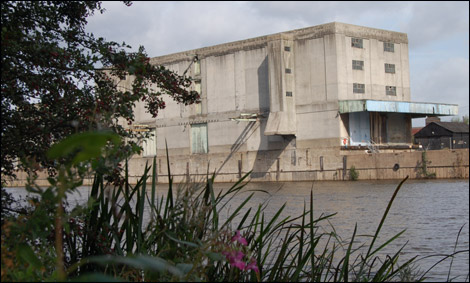
The Trent Lane depot, Nottingham in 2006.
The war of 1939-45 and commercial considerations effected the traffic on the river. It dwindled, but the plan I read was the last-ditch attempt to rekindle the dream of the port at the heart of industrial Midlands.
The River Trent is and has never been a stranger to traffic, from prehistoric times craft have plied their way up and down this meandering river. It does meander and, prior to the installation of flood defences in the mid-20th Century these meanders changed with regularity, in near annual winter floods new channels were cut and remnant ox bow lakes left as evidence to the changes. The importance of the river economically has been vast, families have grown wealthy shipping commodities along its length from Wollaton coal travelled to Hull for export in the 1500s, Burton Beer travelled to Russia in the 1700 and 1800s.
The River is one of four Royal Rivers thus titled by Edward the Confessor, the other three being the Thames, Severn, and Yorkshire Ouse. Nothing much can be done to the river without the passing of Local Acts through Parliament. No ferry can open, bridge be built, weir or lock may be constructed without the passage of a Bill through Parliament. The first Trent River Navigation Act was passed in 1603 and the last was in 1901/3, it took its time as it was an expensive process.
Fish traps and other structures that impede travel on the river could be removed without fear. Damage to navigation was prohibited, it still is, the river had to be kept navigable and as such minimum depths are legislated upon. The complaints of boaters and gravel barge skippers on the Trent suggest the Canal and Rivers Trust (once were British Waterways) are lax in this direction.
The plan to engineer a passage for large barges and tug propelled barge trains was a remarkable dream. The meanders were to be trimmed away with high banks and dramatic navigational changes through towns such as Newark, where a new river would have been cut to avoid the twist and turn of Nether Lock. The cost was to be huge then and the Parliamentary time to get such a Bill through both houses of Parliament was thought to be 4 to 5 years.
The environmental benefits were outweighed by the negative and damage to the natural flow systems irreparable.
We were fortunate that this did not take place, oh so lucky. But it makes us aware that every project that initially may be green need to be examined from all angles.