Introduction.
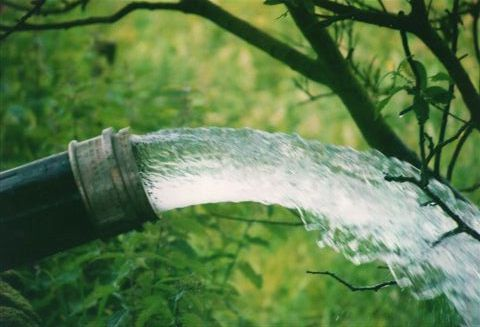
Minewater from the Solway Anhydrite Mine, Whitehaven, Cumbria 1999. 26oC. Process, product, potable, heating and cooling, a near perfect minewater.
Mines and the water one might encounter entering them, flooding them if the mine is abandoned is a form of heat reservoir that is available to some degree or other wherever deep mining methods have punctured the earth. At Annesley Bentinck Colliery when it was fully functioning, water was pumped from underground at a steady rate of 1.2 million gallons per day, the water was warm, 270C winter and summer over the 3 years that it was monitored on a once or twice weekly basis.
A remarkable sight in winter when it discharged into the first settlement lagoon on the top of a spoil heap covered in snow. The steam rising and mirroring the steaming cooling towers at Ratcliffe on Soar Power Station which could be seen in the distance.
For years since the Trust has been looking at ways to utilise the low-grade energy now stored within the flooded, abandoned coalfields across Britain, we have also looked at and been involved in projects in Europe and elsewhere. The waste of energy at a time of climate chaos that might be considered at least low carbon and might be developed as neutral and could be in the long-term carbon negative deserves attention.
Flooded mines are a threat to the natural environment. They can pollute potable supplies in aquifers sited above the coal measures or the minewater if it reaches the surface and drains to streams and other watercourses can pollute them, iron, zinc, aluminium, any number of other metals will destroy surface water quality as will the acidity of some mine water. In the 1990s several thousands of kilometres of streams and rivers in the UK were polluted in this manner and many streams still are.
Gripe.
Minewater as a resource has a poor record of coming to fruition in the UK. In Scotland, a scheme to be co funded as part of the Heerlen Project could not get off the ground due to Scottish local authorities squabbling and losing the EU funding. The first projects to be put in place were two private initiatives which were unknown even to the Coal Authority till the Trust cited them as successful outcomes of the technology, Shettleston (1999) and Lumphinnans (2001). Another that the Coal Authority does not publicise due to legal issues is a wine cellar warehousing operation that uses minewater as its air conditioning energy source at Gateshead.
The UK has been slow in the extreme bringing this technology into play but now the Coal Authority might just find the way clear to enabling new schemes to go ahead. The issues of reducing global climate change, the reduction of carbon emissions and the desire to come up with green initiatives ticks many of the boxes to bring change about.
Clean Rivers Trust Projects.
The Trust has put forward several schemes that might well have succeeded in today’s climate. These have been an array of sites and that had backing from landowners and financial sources.
- Queens Medical, Nottingham,
- Jubilee Campus, Nottingham,
- Lynmouth, Northumberland,
- Welbeck, Nottinghamshire,
- Calverton, Nottinghamshire. (Lack of water in shaft),
- Annesley, Nottinghamshire,
- Camborne / Redruth, Cornwall,
- Cinderford, Gloucestershire,
- Ashington, Northumberland,
The Trust has been involved in two schemes in Europe, and three others in the UK. We have had to look at the apparently intractable problems based around open and closed loop systems. Research being continued at the University of Nottingham may steer a way forward.
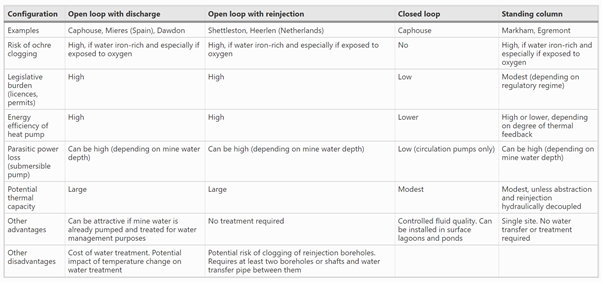
Banks D 2019
The issues that are consistently placed in the way of minewater energy are numerous and include:
- Title to water and heat,
- Mineral ownership,
- Coal Authority role and rights,
- Legislation,
- Abstraction licensing,
- Return water as unused, not waste disposal and licensable,
- Health risks,
- Liabilities,
- Minewater pollution under the Acts re abandonment post 31st December 1999,
- County / local council issues of flood risk,
- Hazardous substances control.
Real issues include:
- Saline waters,
- Iron in all its forms,
- Managing minewater in a useful fashion, not in the ‘middle of nowhere’, if feasible,
- Market identification,
- Site potential, creating higher grade heat and possible power developments,
- Importing heat in a sustainable way,
The UK has got a long way to go in getting this prixe rolled out across many areas. The fiscal benefit to the Coal Authority to help cover some of the nations liabilities in covering costs of minewater pollution remediation need to be weighed against relieving fuel poverty in many areas of mine closure blight. Though in many areas such as Kent where mining ceased forty years ago the economic and environmental effects of closure are still very evident.
Coal mines are not the only source of heat from minewaters, iron, stone, metals: tin, copper, lead, need to be assessed along with gypsum, and anhydrites amongst others.
The information below is gleaned from many sources and hopefully allows those interested in this subject to be reassured by its content.
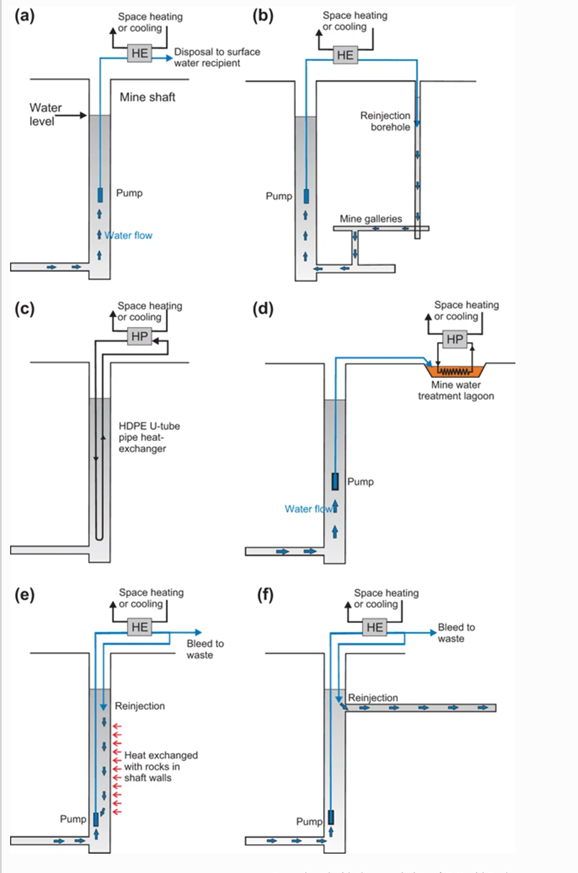
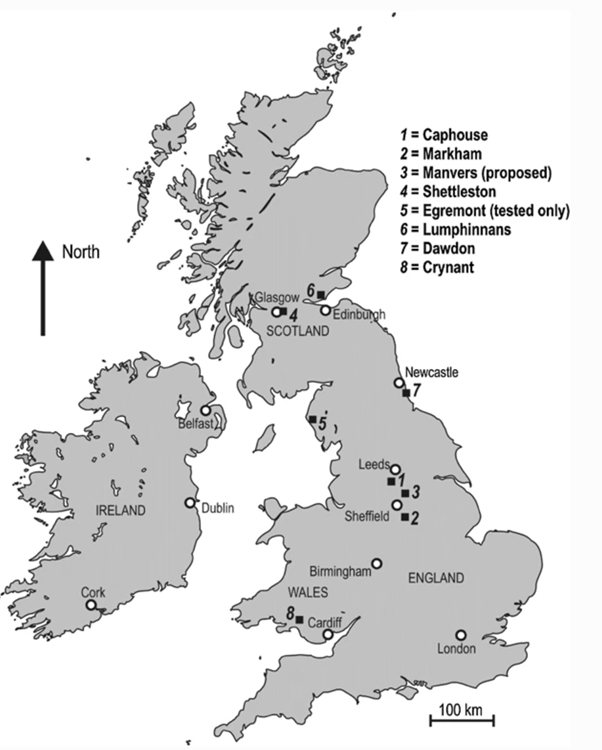
Europe
Closed and flooded mines have good potential as low-enthalpy geothermal resources, which may be used for small to medium scale power generation and for heating and cooling purposes. This efficient, cost-effective solution has been implemented in many countries around the world and has significant potential in Europe, for district heating and the creation of sustainable postmining communities. Heating and cooling makes up half of the EU-28 total final energy demand and relies mainly on fossil fuels (Heat Roadmap Europe, 2017).
In Europe, the market share of district heating technology is only about 10% of the heating market. Of some 5 000 district heating systems, 180 are geothermal, with a total installed capacity of around 1.1 GWth, producing about 4 250 GWh of thermal power. Many EU countries have targets to increase geothermal district heating in the energy supply but are falling short of these due to difficulties with implementation The geothermal potential of closed underground coal mines in Europe has been estimated in the order of several thousand megawatts thermal (3GWth is proposed as an initial estimate) with an estimated reduction in CO2 emissions associated with using the mines instead of conventional heating and cooling technologies at around 5 000 tonnes/year. This could provide an opportunity to quickly expand the geothermal share of the district heating market whilst reducing emissions and reliance on energy imports.
For example, Slovakian coal mines exist in areas with relatively high temperatures at depth. The potential of mine waters here been established at Nováky (20°C), Handlová (11.6°C), Cígel (14°C), Modrý Kameò (closed, 17°C) and Gbely (16°C). Whilst most are still in operation, these mines could provide between 0.69MW and 5.79MW, respectively.
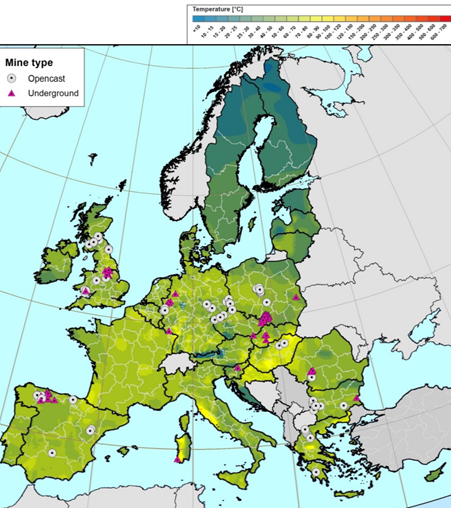
Data source for the base map: (Limberger, et al., 2014)
Other European projects are located in Germany, Norway, and Spain. In almost all cases the heat is used for space heating in buildings but other uses such as heating pools are also mentioned. Most of the described projects were found in Germany. The “GrEEn-Projekt”, in the Alsdorf municipality in North Rhine Westphalia, a geothermal system for several buildings, is owned by Energeticon Company. In the old mining town of Ehrenfriedersdorf, two different geothermal projects have been implemented which utilize the mine water from different sections of the closed mine. In Freiberg, Saxony, two geothermal heating systems exist. One is used for heating a castle and museum and one for heating buildings in Freiberg University of Mining and Technology. In the city of Marienberg, a geothermal lowenthalpy project uses mine water temperature to supply heat to the adventure pool, Aqua Marien, a tennis hall, and some supermarkets. In Wettelrode, Saxony-Anhalt, a geothermal pilot system was installed to provide heat and hot water to the for the Wettelrode Rohrigschacht mining museum, similar to that at the Caphouse Mining Museum in West Yorkshire, UK.
The mining techniques used for exploration and evaluation of potential mineral resources are applicable for the exploration and assessment work for geothermal project development and the equipment and services originating from the mining sector will need to be used in order to speed up the growth of the geothermal sector. Since the geothermal industry currently lacks skilled workers, scientists and researchers, the sector is likely to try to absorb workers from declining industries (Schütz, Huenges, Spalek, Bruhn, Pérez, & de Gregorio, 2013) such as coal mining. The most important professions for geothermal organisations include geologists and engineers, geophysicists, geochemists, technicians, maintainers and drilling consultants and such workers could transfer from the mining sector with varying degrees of retraining. Typically, more jobs are created during the exploration / construction phases than the operation of the plant itself, hence the mining professions would most probably have transferable skills in particular for these phases of geothermal projects.
Despite the positive socio-economic impacts that may be achieved by using mines for the recovery of low carbon geothermal energy and the large number of closed mines, relatively few mines have been used in this way in Europe. The REMINING-LOWEX project funded under FP6 (SUSTDEV) was aimed at the redevelopment of European mining areas into sustainable communities by integrating supply and demand side, based on low exergy principles. In this project, four local communities (Heerlen in the Netherlands, Zagorje in Slovenia, Czeladz in Poland, and Cherno More in Bulgaria) aimed to demonstrate the use of local but low-valued renewable energy sources from water in closed mines for heating and cooling of buildings through integrated building and energy system. They aimed to create two sustainable mining communities (Heerlen and Zagorje) with 50% to 100% CO2 reduction and 60% renewable energy sources. The Heerlen project, located in the province of Limburg, the Netherlands was considered by EU Commissioners and EEA, the most successful.
Netherlands.
‘Minewater’ district heating project, Heerlen
The region of Parkstad Limburg, once reliant on coal mining, is now a hub for new energy research, where educational and research institutions, entrepreneurs and government collaborate to gain valuable experience through practical experiments in new technologies and production facilities such as the Heerlen Minewater project. The project aims to promote local employment, involve local educational and research institutions and to achieve a high social involvement and sustainability awareness of the inhabitants.
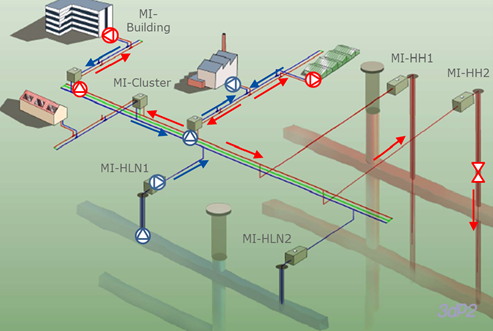
Now one of the world’s largest geothermal district heating systems using mine water, the Minewater project began as a pilot system, completed in 2008 (Verhoeven R. e., 2013) and was upgraded to a full-scale hybrid sustainable energy structure called Minewater 2.0 (Verhoeven, et al., 2014). The project is a part of the Heerlen Sustainable Energy Structure Plan and includes energy exchange rather than energy supply, making use of cluster grids to exchange energy between buildings and the existing mine water grid to exchange energy between cluster grids. Energy is stored and regenerated in the mine waters, rather than depleting it through the addition of a poly-generation system using bio-CHP, solar energy and waste heat from data centres and industry. Cooling towers are used for peak cold demand. The hydraulic and thermal capacity of the mine was increased by improving the well pumps and pressure system and by reusing the existing mine water return pipe to supply and dispose of mine water. The supply of hot and cold mine water is fully automated and demand-driven by using a pressurized buffer system at extraction wells and special injection valves at injections wells. Mine water installations at the various buildings, clusters and wells are controlled via internet-connected process control units that communicate to a central monitoring system (Verhoeven, et al., 2014). In 2015, the objective was to service 500 000 m2 by the end of 2016 (Verhoeven R. e., 2013) with an eventual total of 800 000 m2 resulting in a CO2 emission reduction of 65% on heating and cooling for these connections (Verhoeven R. e., 2013).
Spain
Vital Álvarez Buylla Polytechnic and Hospital Heating / Air Conditioning Project.
Introduction.

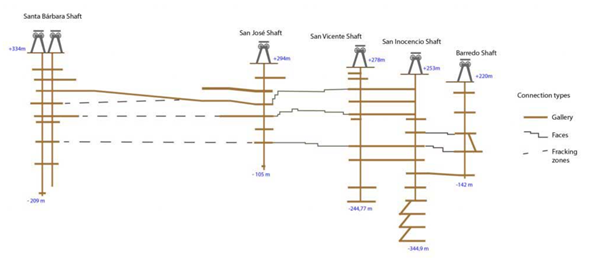
The Central Coal Basin of Asturias occupies an area of about 1400 km2 and is the biggest outcrop of materials from the Carboniferous period in Spain. Over more than two hundred years the mining activity in the basin evolved from drift mining or “mountain mining” to mining by means of vertical shafts, with some reaching depths of 700 m or even more. These mining works have been interconnected by complex networks of galleries.
Since mining work began, 300 pits, drift mines and 73 vertical shafts have been opened, so the hydraulic system of small multilayer aquifers has evolved into a karst type hydraulic system (Pendás and Loredo, 2006) due to traditional mining methods and the thousands of kilometres of galleries that have cracked the surrounding rock mass.
Mining companies bear the operational and maintenance costs of the mine water pumping system, and these can be significantly reduced by heating and air conditioning buildings using heat pump technology that makes use of the heat energy of mine water.
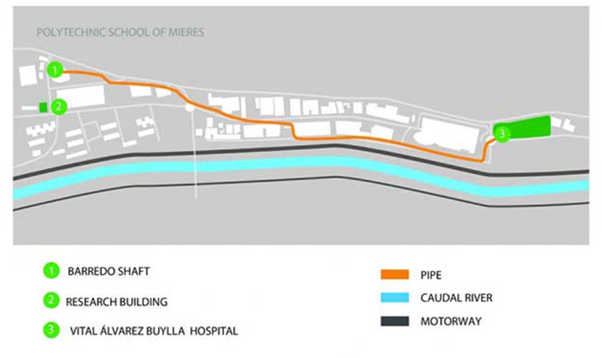
The state-owned mining company Hunosa has built a Geothermal Facility that utilises the energy contained in the drainage water of the Barredo-Santa Bárbara system coal mines, extracted from the Barredo mine shaft in Mieres, Asturias, to heat and air-condition the Vital Álvarez Buylla Hospital (4.3 MWt), the Research Building on the University of Oviedo’s Mieres campus (720 kWt) and a building of the Fundacion Asturiana de la Energía (125 kWt).
The Hospital Supply.
This hospital serves more than 70,000 inhabitants, mostly from the Caudal River Basin, including the nearby urban settlements of Mieres, Aller and Lena. The hospital facilities have 120 rooms for patients and 28,000 m2 floor space. The stable temperature and high available pumping flow of the mine waters allowes them to be used for geothermal heating and air conditioning.
The water flow to meet the demands of the hospital facilities, which varies due to the heat exchange demand, is pumped from the drainage system of the Barredo-Santa Bárbara system coal mines. The pumping station facility comprises four submersible pumps, each with a nominal flow of 215 m3/h and a head of 60 m.
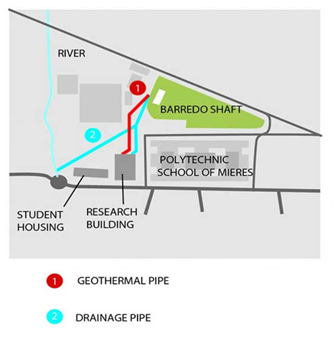
The heat exchange system is located at the Barredo vertical mine shaft. It has a tubular heat exchanger, with three circuits and three manifolds made of AISI 316 stainless steel, designed for a flow rate of 400 m3/h in the primary circuit and 520 m3/h in the secondary circuit. It performs a heat exchange of 3500 kW, as the mine water transfers its energy to a closed loop circuit of “clean” water, which is piped to the hospital, located 2 km from the mine shaft (Figure 8).
Barredo-Santa Bárbara Water Reservoir
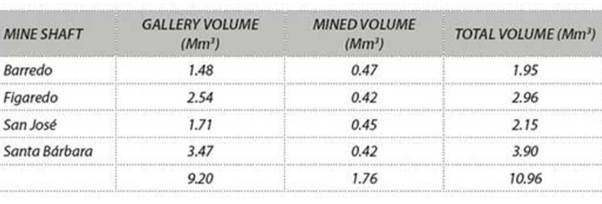
In order to determine the volume available in the Barredo-Santa Bárbara system (Table 2), both the volume corresponding to the mine galleries and the corresponding voids generated by the coal operation (exploited coal seams, backfill zones, etc.) have been taken into account. The mine gallery volume was obtained from the plans of the mine workings in the different mines, supposing an average section of 10 m2. The voids volume generated by coal mining (exploiting the coal seam) has been estimated from coal production data. Estimates consider that 40% of the volume of coal exploited is void space that allows water flow, and that the remaining 60% has been filled by backfilling or controlled roof collapse (goaf), depending on the coal mining method used.
Heating and air conditioning of the Research Building of the University Campus of Mieres
The drainage system of the Barredo-Santa Bárbara system coal mines provides the water flow demanded (120 m3/h), as in the case of the Vital Álvarez Buylla hospital facilities. A multilayer polypropylene pipeline transports the mine water to the Research Building, where it gives up some of its energy, and then leads it to the nearby stream.
The building is equipped with two heat pumps, each with 362 kW capacity and capable of producing hot water at 45 °C and cold water at 7 °C at the same time. A four-pipe fan coil system is used for heating and air conditioning. In 2015 the heat pumps required 61,605 kWh of electric energy and produced 235,747 kWht, used mainly for heating purposes. The use of this system results in important economic savings and a reduction of up to 70% in CO2 emissions.
Assessment of Mine Water as a Geothermal Resource.
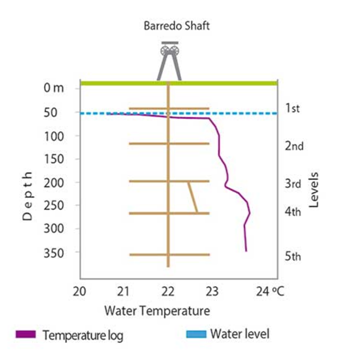
The Barredo-Santa Bárbara system coal mines have an average usable flow rate of about 6.2 hm3/year (pumping average flow rates), a regulation volume (mining voids) of more than 10 Mm3 with a stable all-year-long temperature above 20 °C (Figure 7). The mine water is usable for energy purposes and its quality is suitable for public water supply after being treated. Nevertheless, the elevated hardness of these mine waters is a drawback; this prevents its direct use in the heat pump, and therefore the use of heat exchangers is necessary.
Germany
Mine water from abandoned and flooded former coal mines can be used as a low-temperature geothermal energy source for heating buildings and industrial complexes. The idea of obtaining thermal energy from an inoperative colliery has already been pursued for a long time, although to a rather limited extent. Well-known projects concerning the utilization of mine waters included:
- The building of the School of Design at the Zeche Zollverein complex in Essen (western Germany), which is heated by 28°C warm mine water.
- The utilization of mine water of the former Robert Müser colliery in Bochum (western Germany) as an energy source for the heat supply of two schools and the mine drainage station in Bochum.
- Seven operational mine water utilization plants in Saxony (eastern Germany).
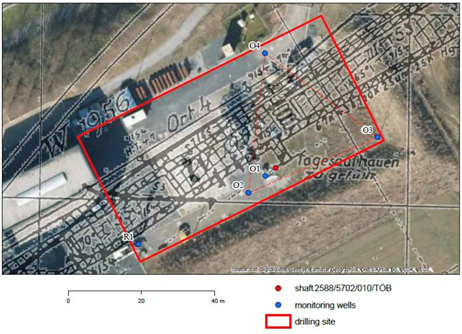
- A pilot project to explore using mine water for geothermal heating has started work in Altdorf, a small city near Aachen in North Rhine Westphalia. Currently a 153-meter strong concrete plug of the old mine shaft will have to be drilled, which is expected to take around 3 weeks. Pipes will be set into the well drilled to tap geothermal heat caught in the mine water in the old shafts of the mine, the hot water derived is then planned to be used for heating for nearby buildings. The project is budgeted at around EUR 1.2 million to be financed primarily from the state of North Rhine Westphalia. The project aims to establish if it is economically feasible to utilise abandoned shafts and mining systems of the old hard coal mining period to win heat out of mine waters, including the Ruhr region. This project is related to the Heerlen Project in the Netherlands.
The thermal utilization of the mine water from existing mine drainage stations, as they are realized in Essen or Bochum, show the highest economic efficiency, as no additional pumping costs are being generated. Due to the lack of suitable customers and a not yet existing final planning security concerning the future locations of mine drainage stations after the end of active coal mining and the renaturation of the Emscher river (heavily polluted by mine water), potential expansion currently takes place to a limited extent. The “open” utilization plan of the Mijnwater project could be realized in the Netherlands, as the mine workings are already flooded after being closed. In the case of a mine water table <80 m below ground, the proportion between the thermal energy obtained and the input energy (pumping energy) is to be assessed as positive, despite the low temperature of the mine water of about 28°C. Nevertheless, the mine water would be brought to a higher temperature level with the use of heat pumps.

A conceptual model of underground heat storage in an abandoned coal mine (HEATSTORE final report 2019)
One of the main aims of the HEATSTORE (Geothermica) project is to create a technically and fully functional seasonal Mine Thermal Energy Storage (MTES) pilot plant to use geothermal heat of the abandoned coal mine Markgraf II in the area of Bochum in western Germany. As for today, a pilot plant has not yet been established, in which the possibility of thermal energy storage in a former hard coal mine has been considered. The conceptual idea of the project is based on the storage of unutilized surplus heat during the summer periods from solar thermal collectors within the abandoned coal mine and using the store d heat during the winter season for heating purposes.
Bulgaria
The abandoned underground Cherno More Coal Mine
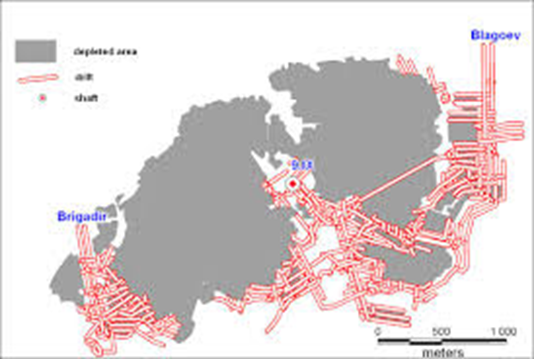
Flooded abandoned coal mines are a potential source of geothermal energy, which could be used for heating and cooling of energy efficient buildings. Cherno More Coal Mine is located in SE Bulgaria and has been closed for more than 20 years.
It represents a large human-induced subsurface reservoir which consists of three interconnected coalfields (“Brigadir”, “9.IX.” and “Blagoev”). Their total volume of about 2.0×10⁶ m3 has been calculated considering the size of the stone drifts. The mine water temperature is measured to be about 16°C in the only accessible vertical shaft).
This is the first study of an abandoned coal mine in Bulgaria aiming at assessing its low-cost energy potential and evaluating the opportunity for heating and cooling buildings. The geological and hydrogeological characteristics of Cherno More Mine have been analysed by using existing archive data and conducting additional chemical analysis of water samples and temperature measurements in the mine.
The obtained data were used to develop a regional groundwater model of the area and a local hydrothermal model for a thermally insulated furniture factory located in the vicinity of the vertical shaft.
The simulated temperature distribution in the mine during exploitation showed no impact on the production temperature by reinjected water under defined steady state conditions, which created a reliable basis for mine water energy use.
North America.
US.
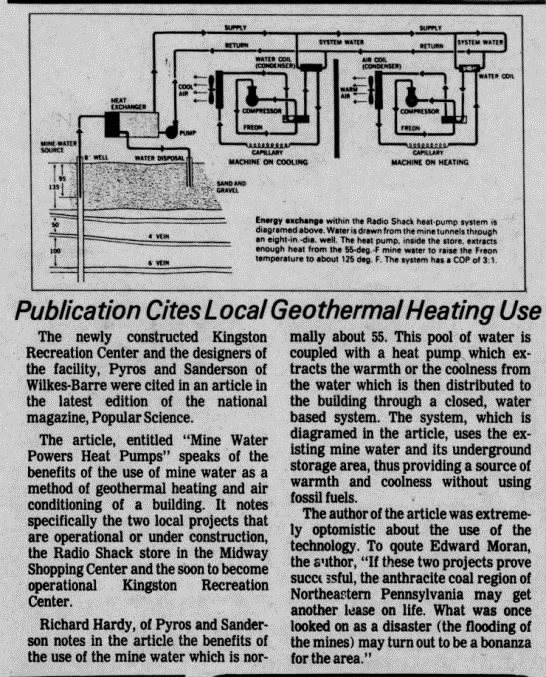
The first noted uses of minewater as a low-grade heat resource were in the 1970s at a Hospital in the Mid-West and at a Radio Shack store in Philadelphia. The Trust has reported on these sites in the past.
Canada
Springhill, Nova Scotia.
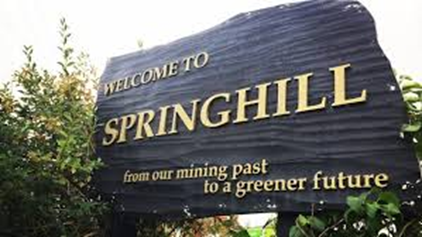
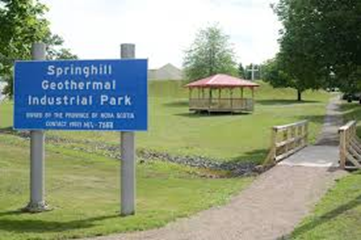
In 1988 Ropak Can Am Ltd, a manufacturer of tin packaging products began using geothermal energy from floodwater in abandoned mines beneath their site in Springhill, Nova Scotia, Canada. The energy was for the heating and cooling of the factory and its processes. This was the first recorded use of this technology in Canada and is now considered to be the first full scale operation worldwide. The initial energy saving to the company was 600 MWh per annum. The initial cost of installation was C$110,000, compared with C$70,000 for a conventional combustion heating system; the company though saved C$110,000 on the need to install dehumidifiers for its production process.
The minewater that was used was raised to the surface at a temperature of 18 degrees C. and was pumped originally to the surface at 4 litres per second. The return flow water was at 13 degrees C. The return water was routed to a different, deeper mine though interlinked below ground.
The heat use was expanded to public buildings in the town and cooled the local ice stadium.
Other Uses of Minewater and Void Space.
Germany.
Mine as hydroelectric fuel cell
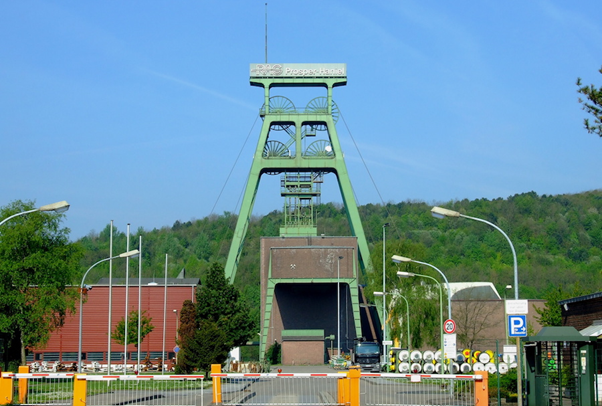
RAG AG-owned Prosper-Haniel hard coal mine, located in the German state of North-Rhine Westphalia, will be turned into a giant battery that stores excess solar and wind energy.
Set to be totally transformed by 2018, the mine will become a 200-megawatt pumped-storage hydroelectric reservoir, which means it will behave as a battery and have the energy to power more than 400,000 homes.
Top of Form
Bottom of Form
When needed to compensate intermittent wind and solar power, as much as 1 million cubic meters of water could be allowed to plunge as deep as 1,200 metres, turning turbines at the foot of the collieries mine shafts. The mining complex comprises 26 kilometres of horizontal shafts.
Miners in the town of Bottrop, who have worked for decades at the site, will remain employed while seeing a shift in their usual tasks. According to Governor Hannelore Kraft, they will continue playing a key role in providing uninterrupted power for the country.
During a press briefing earlier this week, Kraft also said that other mines may follow suit because the state needs more industrial-scale storage as it seeks to double the share of renewables in its power portfolio to 30% by 2025.

University of Duisburg-Essen
Power heat RATIOS.
This is from a corporate advertisement but appears worth investigating further. We wrote a paper on this hypothosis 20 years ago.
GEOTHERMAL IN NEVADA
ELECTRATHERM GENERATES POWER FROM LOW TEMPERATURE GEOTHERMAL

Hot Water Temperature: 110°C Flow Rate: 150 GPM Net Power Output: 65 kWe ElectraTherm successfully commissioned its Power+ Generator at the Florida Canyon Mine in Imlay, Nevada. ElectraTherm marked the occasion at Florida Canyon Mine with a commissioning ceremony including officials from the Department of Energy (DOE) and Jipangu International, the mine operator. Attendees representing the mining and utility industries also joined in a tour of the newly developed Power+ configuration. The machine was manufactured with a cleanable heat exchanger, an increased gross power output of up to 75kWe and a fully-containerized solution for ease of transportation and installation through a grant from the DOE for $982,000. This also marks the first installation where ElectraTherm is providing not only the ORC equipment but ORC power generation as a metered service. ElectraTherm’s Power+ utilizes organic Rankine cycle (ORC) technology to generate electricity from low temperatures unattainable by other technologies. First, hot water enters the Power+ to boil a working fluid into a vapor. The high pressure vapor expands through ElectraTherm’s patented twin screw power block, spinning an electric generator. After turning the twin screw expander, the vapor is then condensed back into a liquid through the use of an external air cooled condenser. Following condensing, the working fluid flows back to the evaporator as a liquid to repeat the process. The result of the project was a successful demonstration and a unit that was sized for smaller resources, could be operated and monitored remotely and was easy to maintain. According to reports by Massachusetts Institute of Technology and the National Renewable Energy Laboratory, there are tens of thousands of oil and gas wells in the U.S. alone that co-produce hot water at optimal temperatures for the Power+. This produces millions of barrels of water which could be captured as fuel to generate clean power. Through collaboration with the DOE and commercial installations, ElectraTherm will continue to make inroads with this tremendous untapped resource. At 8,000 run hours per year, the Power+ Generator will produce an additional 520 megawatts of clean electricity annually.
Websites
https://eurogeologists.eu/european-geologist-journal-43-viesca-geothermal-use-of-mine-water/
file:///C:/Users/harve/Downloads/kjna29292enn.pdf
https://www.geoenergymarketing.com/tag/mine-thermal-heat/
https://www.mining.com/coal-mine-in-germany-turns-into-hydroelectric-battery/
https://core.ac.uk/download/pdf/145637186.pdf
https://link.springer.com/article/10.1007/s40899-017-0094-7
https://cordis.europa.eu/project/id/38639
http://irep.ntu.ac.uk/id/eprint/30526/1/8202_Al-Habaibeh.pdf
https://smartcities-infosystem.eu/scis-projects/demo-sites/remining-lowex-site-zagorje
https://smartcities-infosystem.eu/scis-clusters/demonstration-projects
http://irep.ntu.ac.uk/id/eprint/30526/1/8202_Al-Habaibeh.pdf
https://pubmed.ncbi.nlm.nih.gov/17287046/
https://revolve.media/on-coal-and-water-in-poland/