The Burbot Lota lota.
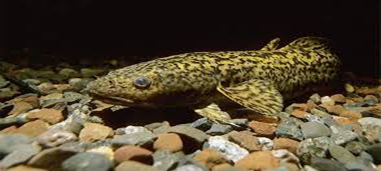
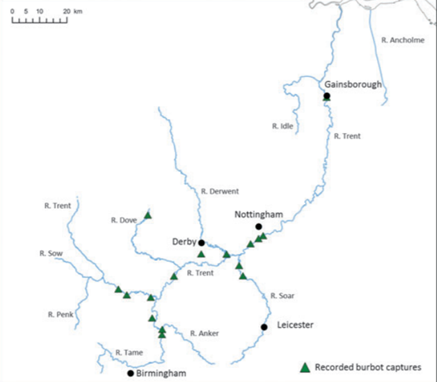
The last burbot to be pulled from an English river was caught on the River Trent just outside Nottingham in 1964. The angler did not realise that that moment would, now be appearing (57 years later) across the national and international media in a frenzy of interest in the quality of UK rivers and statements of pollution being responsible for ridding English rivers of this once ‘common’ fish. The fact that it was never common is though borne out by research, specifically in A review of the historical distribution and status of the burbot (Lota lota) in English rivers, 2011, T. Worthington et al, Journal of Applied Ichthyology.
It was a fish that helped sustain life at times of famine and offered a different culinary experience across the Fens on Fridays for monks in the Middle Ages (Old English Leech Books). In the 19th Century Burbot were recorded as being for sale at the same price as eels on Lincoln Market.
The first note of concern regarding these fish was expressed in 1712 regarding their declining numbers on the River Nene after its canalisation. And their decline was noted with greater regularity and especially from 1905, though some rivers such as the Thet were noted for their presence as late as 1946. Their presence historically in eastern England gives credence to the several historical references that their presence in England came about prior to the disappearance of the land bridge linking eastern England to Germany and the Low Countries in Europe.
There appears to be no culture surrounding the burbot in England as can be found in Germany, Estonia, or Russia, suggesting that this was not as an important widespread species in England. introduction of the burbot to the River Wandle, a tributary of the River Thames in 1873. The fish failed to flourish.
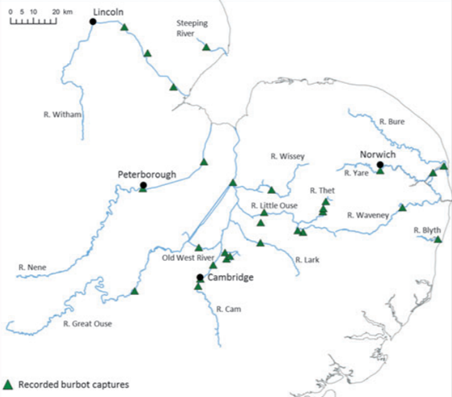
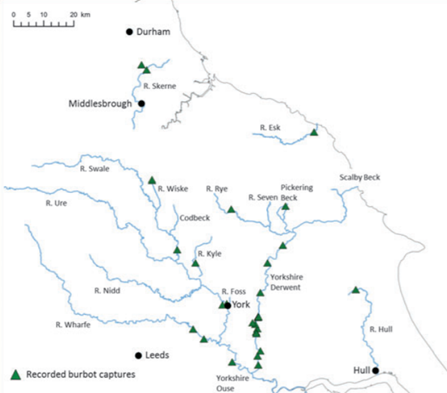
The burbot came into what are now England’s waters at the end of the last Ice Age, in that time the climate has warmed significantly, the rivers are no longer natural water channels. The sediments and hiding places that they like are far fewer, especially after the flood engineers changed river lines in the 1940s through to the early 1960s in response to the floods of 1947 and 1953. Rivers warmed considerably due to industrial cooling of power stations, vegetable washeries and now global warming. These fish appear to prefer cooler waters and to some degree the rivers of the UK are cooling as power stations, especially coal, gas, and oil close. There may be a chance but the Burbot is a fickle fish by nature and it will attack other fish species and has the teeth to kill.
The demise of the burbot can also be linked to the rise and proliferation of in mink populations along many Yorkshire, Midlands, and East Anglian rivers.
The Common Sturgeon, Acipenser sturio.
These remarkable fish that have survived from prehistory into the 20th century are now considered extinct in British rivers though some are observed around the estuaries every year and young fish are appearing to be caught on several rivers including the Trent. These are likely imports and more exotic non-native species illegally released, though one hopes for the unlikely. There are records of some European sturgeon being caught by fishing boats off the South Wales coast and the North Sea coast of Scotland in recent years but nothing demonstrating breading runs up UK rivers.
The history of sturgeon consumption goes back to prehistoric times where evidence of sturgeon being cooked has been found at several Neolithic and Bronze Age sites. In manuscripts from the 12th Century there are reports of plentiful supplies of sturgeon available in London.
The main area in Europe where there is a concerted effort to develop a restocking of the fish is in France, along the Loire and Gironde rivers. The introduced stock are tagged with a yellow tab for monitoring purposes.

Collingham Wharf, Nottinghamshire 1907.
Comparison.
It has been noted that both the burbot and sturgeon are cold water fish. The major rivers of the UK are on the periphery of their ranges. The sturgeon still caught in the cooler waters of northern Europe, especially Russia. The burbot is plentiful in Poland and Russia. Many UK rivers also have warmed due to industry discharging cooling waters particularly over the last century which would be a discouragement for sturgeon migration and damaging to the breading cycle of the burbot.
Both fish do not have scales but a leathery skin which in the past has been known to have been tanned as a high-quality leather for high end accessories both decorative and functional. The fashion has not gone away.

Fish leather tango shoe today.
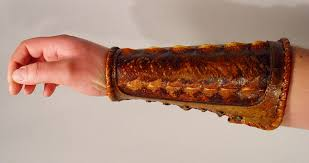
Arm protection for use with a longbow, made from the 12th century to the present-day using sturgeon leather.

A modern burbot skin wallet.
The reintroduction of these fish is problematic due to climate variability and finding stock that are correct for an ever-changing ecology. The introduction of both fish would be instructive as they are both able to fit within ecological voids. The rewilding of rivers as with all else in the UK is a popular call but at what cost to the individuals put in as pioneer stock fish.
Before such experiments take place the removal of heat sources must be undertaken along with other issues such as protection for young fish from predator species fish, mammal and avian.