Introduction.
Endocrines have been the major concern of the water industry for more than 30 years. The Trust has been researching and reviewing research in this field for nearly as long.
Endocrines include polychlorinated biphenyls (PCBs), polybrominated biphenyls (PBBs), and dioxins. Other examples of endocrine disruptors include bisphenol A (BPA) from plastics, dichlorodiphenyltrichloroethane (DDT) from pesticides, vinclozolin from fungicides, and diethylstilbesterol (DES) from pharmaceutical agents. These are amongst the most common found in the natural environment, though they are not the only ones. There are natural forms, the break down of plant residues and other materials.
In the tabloid media these materials were headlined as ‘sex change fish due to the birth control pill’ 30 years ago. Today the world is somewhat more sanguine, and these chemicals are seen to change the breeding capabilities of fish, aquatic avian species and evidence appears to be growing for aquatic mammals. Both birds and mammals that predate fish and other aquatic creatures being at risk. Further, WHO as well as the Environment Agency, DEFRA and the Department of Health are concerned at the cross over of degenerative toxic effects of these materials to humans.
The main issues to be raised being that many of the materials are carcinogenic, they may also cause sterility in human males as well as fluctuations in hormonal balance.
A Way Forward.
How to remove the major loadings of Endocrines from out of both water and food chains is a major issue. The Trust has found that the passing of Endocrine rich (especially Oestrogenic material) waste waters through wetlands can remove up to 90% of such materials. Depending on the bacterial loadings of the wetland.
Two European Projects recently concluded give new impetus to our work, the findings of both pieces of research corroborate our research and allow one to develop more detailed hypothesise. The two research pieces are outlined below:
River Spercheios in central Greece

Sediments from a sand bar taken from outside a sewage treatment works outfall provided the bacterial cohort used to demonstrate the breakdown of Endocrines from an industrial, high output treatment works close by.
The Zenne River. Brussels, Belgium.

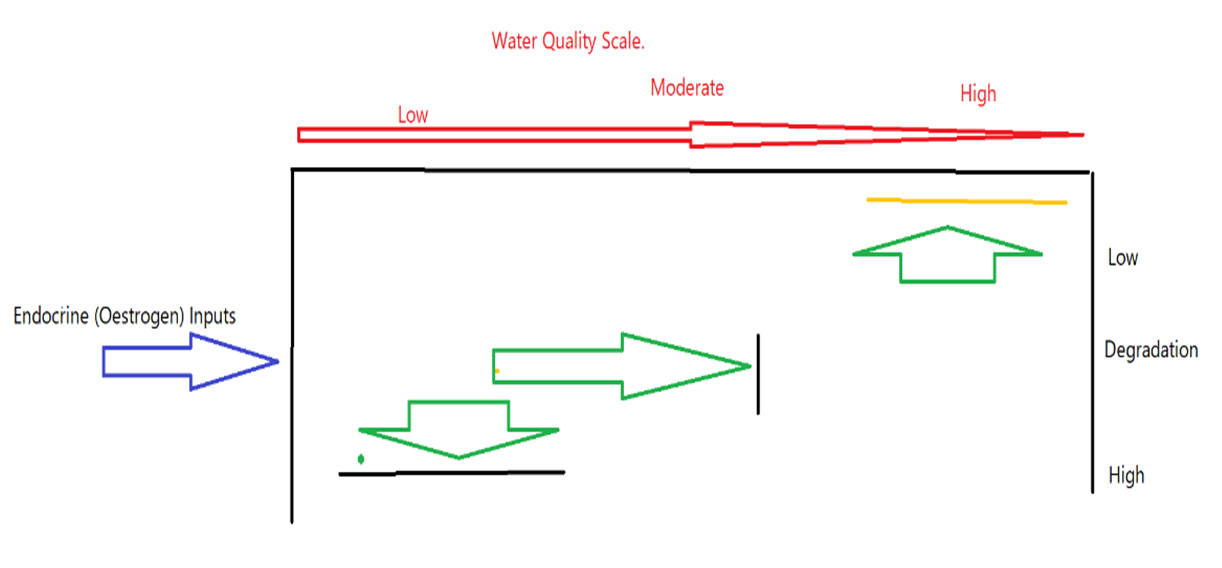
The self-purifying ability of the Zenne River regarding oestrogens was examined with an in-vitro biodegradation experiment using the bacterial community naturally present in the river. Hill coefficient and EC50 values (Effective Concentration at 50%) revealed a process of biodegradation in particulate and dissolved phase. The estrogenic activity was decreased by 80%, demonstrating the ability of self-purification of estrogenic compounds in the Zenne River.
The bacterial loading of the river being dependent on the relatively higher loading of poorly treated sewage effluent leaving the wastewater facility treating the Belgian capitals sewage.
Water Treatment and Quality Issues Regarding Endocrine Breakdown.
The notable need for a healthy, diverse, and regenerative bacterial community within a river system fed by an under achieving wastewater treatment works is now undeniable. The move to remove many of the nutrient sources from rivers makes one aware that such treatment of industrial waste matter may need to be carried not in-flow but prior to discharge to the natural environment.
This might be achieved at the plastics, pharmaceutical or other manufacturing site, though this will only treat a very small percentage of total volume discharged via the sewage treatment works and sourced from the near entire population. The hope to treat within the curtilage of water treatment sites is feasible where there is room, but in the instances of many of the largest sites serving the urban conurbations suitable space for treatment wetlands to be put in place is unlikely to be available. The installation of bacteria towers or other device is then a favoured option.
The use of such schemes has been trialled in the 1990s by several water companies including Severn Trent at Stoke Bardolph Treatment Works for the removal of phosphates alone. The cost though for that single purpose were prohibitive. The use for a multipurpose unit, where the phosphates feed the bacteria alongside the bacterial breakdown of the Endocrines makes it a more fiscally attractive option where space is at a premium.
The use of wetland/carr system being able to home the vast bacteria within an area where space may be made available. This same method might be encouraged as part of a chain of off flow in river clean-up operations where water remediation is desirable but fiscally is impossible. This might be due to historic pollution or an overabundance of naturally occurring Endocrines.
The Conundrum.
A richer nutrient loading of a river such as the Zenne, taking semi treated sewage treatment works wastewater demonstrates the need to consider the place of a river in a modern community. Is it a drain, so designated for its importance in protecting the health of the community or is the river a barometer of our care for the natural environment, of which we are only a small part?
River water quality and degradation of Endocrines.
Costs and the Bill.
The water companies and the government are aware of their abilities to remove the problem of Endocrines from the rivers across the UK but there is one major hurdle that needs to be faced. The cost of treatment of waters. The polluter pays is the principal hat is the usual accepted formular. The problem is that no one accepts they are the polluter.
Is it the pharmaceutical company, the plastics or acetate or chemical company? May it be the consumer or the water company? Who should pay, who is morally bound? The answer is no one at present and in the future generations as yet unborn will have to handle the consequences. This can not be the desired option.
References.
https://www.ncbi.nlm.nih.gov/pmc/articles/PMC7139484/
https://pubmed.ncbi.nlm.nih.gov/29533803/
https://www.sciencedirect.com/science/article/abs/pii/S0048969718304996