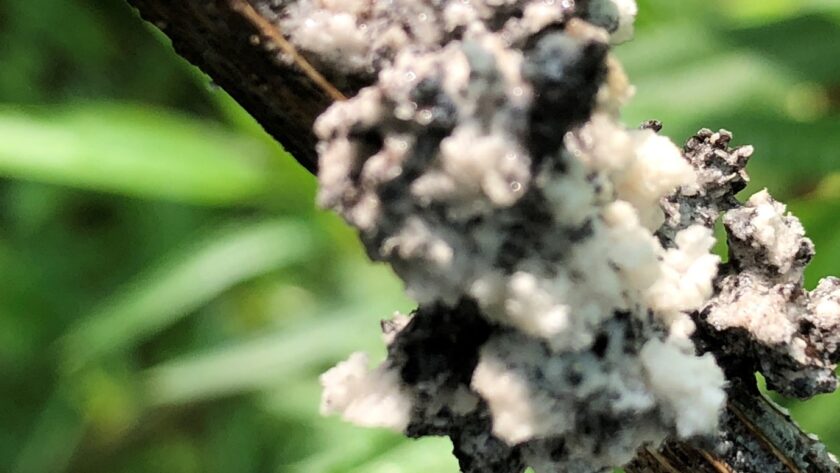
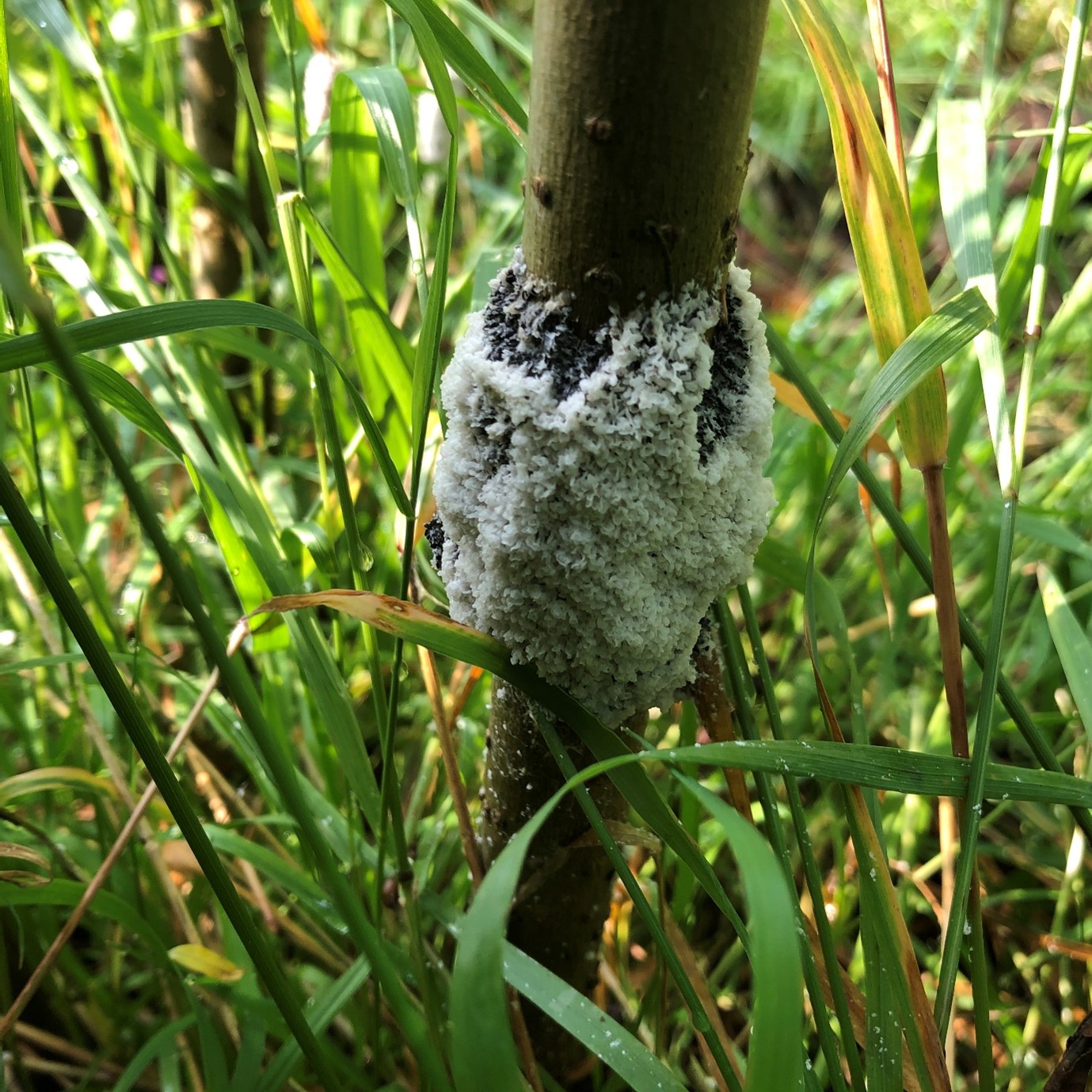
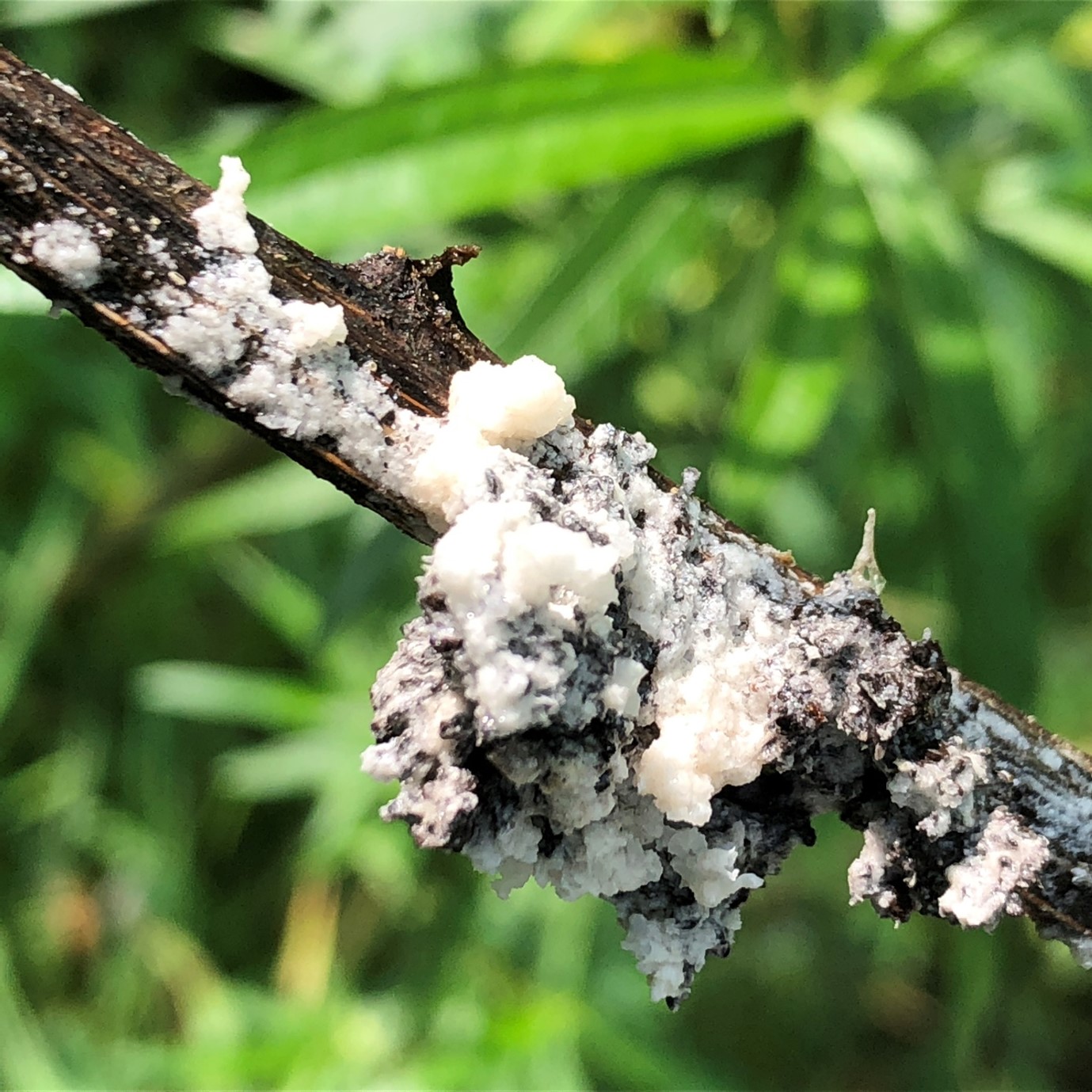
The Tapioca slime mould is said to be non-hazardous to plants, it is non-parasitic and thrives in decaying woodland floors. It will hopefully dry up and depart on the breeze though it is noted in the literature that it is sticky and adheres to beetles and other insects to be spread around an area.
Each growth is a single cell, some have been recorded as weighing 12kg. This makes them amongst the largest cells on earth.
The plasmodium emerges from soil and leaves as a pure white structure, often very large and exhibiting rhythmic cytoplasmic streaming which helps transport chemicals within the organism. The plasmodium may move some distance before forming the aethalium or sporangial phase of an equal size, 4–30 cm in its longest dimension, 5–15 mm thick, carried upon a widespread, silvery, shining hypothallus, purplish black. The cortex at first papillate, however this is a fugacious or transitory phase. The capillitium, the network of thread-like filaments in which the spores are embedded within sporangia is abundant, the threads dark, netted, the nodes bearing multicellular vesicles, the whole borne upon, but often breaking away from the flattened and irregular, columellate basal strands. The spore-mass is brownish black or a dusky colour. The spores are yellow-brown, distinctly warted, and 9-12 µm in diameter. Found living on decaying organic material, such as old tree stumps, logs, leaf mould, compost heaps, and other organic debris in fields, woods, and along the roadsides. (Wikipedia)

Slime moulds live off other bacteria available on sites such as ours where there is compost and leaf litter breaking down. The research site is run to ensure that the natural bacteria are healthy and can engage with the tar. In so doing the other elements of the site, compost, leaf litter, emulsions from algae and bacteria and other material breakdown are also a haven for other bacteria that also find it a desirable location.
‘Compared with most organisms, slime molds have been on the planet for a very long time—they first evolved at least 600 million years ago and perhaps as long as one billion years ago. At the time, no organisms had yet evolved brains or even simple nervous systems. Yet slime moulds do not blindly ooze from one place to another—they carefully explore their environments, seeking the most efficient routes between resources. They do not accept whatever circumstances they find themselves in, but rather choose conditions most amenable to their survival. They remember, anticipate and decide. By doing so much with so little, slime molds represent a successful and admirable alternative to convoluted brain-based intelligence. You might say that they break the mold.’
(Scientific American)
The above, published in 2012 demonstrates the base level of understanding of these organisms, their real location within the orders of plants, animals and insects is not yet fixed. Only a few years ago it was considered a fungal species but now it is of no formal taxonomic group.
References
https://www.scientificamerican.com/article/brainless-slime-molds/
https://pages.vassar.edu/viva/?p=987
https://www.projectnoah.org/spottings/7737631