Introduction.
Some 25 years ago we discussed with mining companies in the UK and the Coal Authority, the Department for Trade and Industry and the Department of Environment, several water companies including Severn Trent Water and Anglian Water, also the Ministry of Defence the concept of mining water. The development of supplies from unusual or miss regarded resources. All loved the concepts at the time, but no organisation saw the need. Since then, the Trust has brought up the schemes again regularly to remind people.
The opportunities to mine water are vast, from old mines millions of gallons of water are run to waste daily, it is often polluted but with management it can be brought up to standards that are better than what goes into our water supplies today. Much could be used initially as process water during its time in cleansing. Treated sewage of one form or another makes up drinking water supplies today in many areas of the UK.
Historically many mines supplied potable water from their drainage systems, ensuring the mines did not flood to mining communities across the country.
Coal Mine Drainage.

Clean Rivers Trust carried out research with the University of Nottingham, Severn Trent, and Anglian Water into the sustainability of water supplies from coal mining operations in the 1990s. We considered the volumes, pathways, and routes to move supplies from discrete locations to centres of population. We also considered long distance movements by waterway transfer. British Coal, later RJB Mining and Coal Investments; Later Midlands Mining worked alongside the schemes. The mining industry being supportive and aware of the wasted resource leaving their operating sites as well as from the more distant pumping stations that maintained the safe mining environment by taking water from long closed mined areas at the outcrops.
The research further looked at methods for removing the more pernicious pollutants from minewater. The main problem being chlorides. Several methods were trialled by both RJB Mining and Anglian Water’s Innovations Team alongside University of Nottingham.
Demonstration Projects
1.

The Trust was commissioned in 1995 to 1997 by a pharmacological and sports/health drinks company to research a minewater in the Forest of Dean in Gloucestershire. It was an abandoned iron mine, sunk in the early 1800s and closed in the 1950s. The water from the mine had been used by the company for process water at their factory close by (1.2 miles) for several years but was originally thought to be contaminated and had risks attached to it.
We worked on a set of risk assessments and engineering issues over several months, we then carried out water quality testing over an 18-month period in conjunction with the company’s chemists and the Environmental Health Department of the district council.
After that set of tests were completed, the company was able to produce products on an international scale. The water quality was superior to water supplied by water companies for product production and needed little work for use in products. The cost savings to the company were substantial.
2.
The Trust was invited to demonstrate the use of mined water from a mine system in Cumbria in 1997. The purpose of this scheme was to save money for process water for a factory that had negotiated a preferential water price with a local authority water undertaker in 1951. This agreement was about to end, and the water supplier had through the changes in local authority and water undertakers become United Utilities. The cost was about to rise from about 0.005pence per cubic metre to 70 pence. A rise that was disturbing for a major chemical company with a need for plentiful water supplies.
The research was initially to identify a suitable resource supply point. The factory site was underlain by worked coal measures at a number of horizons, and from several different shafts set along a near 1.5 mile stretch of land. The Trust also identified two other sets of mineral mines close to and allied to the chemical works site, one an anhydrite mine the other an alabaster mine.
All the possible options had to be analysed and accessed alongside gaining agreements with the regulators of any abstraction. That being the Environment Agency alongside the owners of any mine void utilised. Initially this was to be the Coal Authority, but as they claimed ownership of the water as well and their pricing of any abstracted volume was to be nearly as high as that of taking the water companies supply this was dropped. The second choice of supply and possibly the one that should have been the first option was that from an anhydrite mine that had been closed in the 1970s. Originally the mine had been the source of some of the chemical works raw materials.
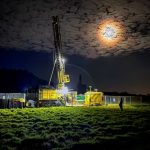
Prior to any test pumping a protracted study of wells and springs within the catchment of the mine had to be drawn up and agreed with the Environment Agency and other interested parties, he Friends of the Lake District, Wildlife Trust, RSPB, borough, and county councils, alongside others who felt they may have water rights as well as documented mineral rights. Once the study had been agreed and the data collected a borehole was placed through the cap of a ventilation shaft into the centre of the mine system. The shaft then was surveyed, and a pump was lowered on a steel rising main to an agreed depth. To avoid any risk of pollution a 4-inch coupled main was laid from the shaft top to the chemical works ¾ of a mile distant. The water proved to be of a good quality and an agreement was reached to supply the works, initially, to the power generation station as coolant, one of the largest water uses on site.
Further research continued and other parts of the chemical works came onto the minewater supply. At this time though the site was sold to two other chemical companies who rationalised the site and closed the complete operation. The mining of water was though proven to be an option that was both sustainable and cost effective.

Historic Mining of Water.
Coal measures have been mined for centuries and several were also the only or main source of potable supply.
In 1873 the town of Bedlington was supplied with water from collieries from about the area. The water was at the time noted as ‘clear and transparent, and containing very small proportions of organic elements (organic carbon and organic nitrogen.) It is too hard for washing; but it may be safe used for drinking and other domestic purposes.’
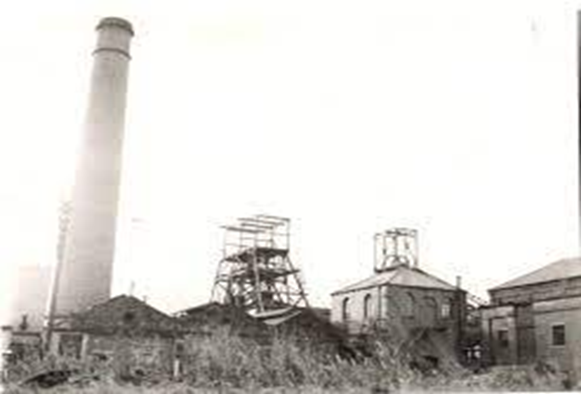
Similarly at the same period the town of Castleford supplied coal measure waters to its inhabitants. The water was noted to be slightly chalybeate and ‘becomes slightly turbid on exposure to the air’. It was also noted to contain ‘a remarkably large proportion of common salt.’ The iron was treated at the reservoir by adding 1lb lime to every t every 1,000 gallons of feed water. The town of Normanton in Yorkshire received water from the colliery in the town, as was Tynemouth. Whitewood, in Yorkshire took its water for more than 3000 people from its ‘coal pit’.
Metalliferous mines have also been seen as suitable sources of supply for populations across the country and some are still utilised for that purpose. Some drainage adits from lead mines in Derbyshire are important water resources.
Potable resources.
Water from mines of any type is usually seen as at best problematic and avoided for human use. The methodologies for treating water are though now more various and successful. As the UK and European water suppliers are now forecasting severe shortages of resource the use of water from mine workings are not just a dream. The large volumes of water that must be removed and or treated by the Coal Authority need not be treated and sent to waste.
Other Considerations.
The Coal Authority is now pursuing the value of minewater as a low-grade heat source that can be installed as a heat resource for both industry and domestic needs, and as such the mines are pumped for environmental management of pollution.
If the heat was extracted and then the water purified to a suitable standard for use within the communities that the mines are situated the benefits would be further increased and at the same time costs of reinjecting water back to mines would be avoided.
Coal and other mine water concentrates have not as yet been explored as resources in their own right. Some are known to carry loadings of lithium and other rare earths. One starts to break down an offending pollution stream into its salient parts the circular economy starts to play its role. The natural capital of minewater is yet to be established.
References.
The Commissioners Appointed to Enquire into the Best Means of Preventing the Pollution of Rivers. 1874. The Domestic Water Supply of Great Britain. HMSO, London.
Anglian Water, 1996. Membrane Treatment of Minewater. University of Nottingham.
CRT, 1992 to 1998 Reports: on Minewater Resources Across the UK. Severn Trent, Thames, Kelda, Hartlepool, Northumberland, and Anglia Water Companies.
CRT, 1995 – 1997. Reports on Easter Shaft. Royal Forest Factory.
CRT, 1997 – 2002 Minewater Research. Albright and Wilson, Rhodia and Huntsman.
https://www.gov.uk/government/organisations/the-coal-authority
https://www.sciencedirect.com/science/article/pii/S0883292720301852