The British Government is about to state that its professional enquiry into shale gas potential supplies outstrips………
The anticipated reports on the potential shale gas reserves that lie beneath Britain’s green and pleasant land outstrip many other European countries. The reserves are huge and easy to access in comparison to exploiting the natural gas resources around British coasts, though public disquiet as to the methods used to win the product and the major energy companies both do not see advantage at this present time. The reasons for such shared negativity are many fold and will ride hand in hand for some time into the future.
There are other, and as yet unquantified oil and gas resources allied but not directly analogous to shale derived gas; these being known as tight gas and its partner tight oil which can be found locked in sedimentary rock and would require similar methods to shale gas to liberate it from its host strata.
Shale Gas.
Shale gas is formed from plant matter that was laid down in the carboniferous and earlier geological periods though not directly in association with coal seams. The strata that it is predominantly, but not exclusively found in are shales and mudstones, closely interbedded clay based rock formations that underlie large areas of the UK. The first shale gas in the UK was found in Sussex in an academic investigation borehole of the geology beneath the Sussex Weald near Netherfield in 1875: gas seeps had long been known of in Britain, in Lancashire and Cheshire gas, due to spontaneous combustions formed willow the wisp or bright ghostly emissions. The gas at Netherfield was never considered as a resource, but the gypsum that was discovered at the same time went on to be exploited for over 150 years.
Natural gas has been a common find in borings across the nation during exploration for coal and during the sinking of water wells. In the case of coal prospecting gas was thought to be a significant encouragement to the investors as it was believed that it was derived from coal seams. Other strata also show signs of gas and oil deposition; amongst the best known being the Kimmeridge clays and the Sherwood sandstones.
The shale bands of strata are amongst the most widespread geological formations across the country; they generally outcrop in the west and dip down to the east being overlain by younger formations.
The potential of shale gas reserves; it’s fiscal, strategic and calorific values are now considered to overshadow coal, both in its preindustrial and present reserve potentials.
Thus such a large reserve is beyond government expectation and will impact greatly on their strategic energy supply planning. One area of the Bowland shale near Blackpool where the only exploration drilling and development is taking place in the UK below ground, carried out by Cuadrilla Resources has reported that it has found 200 trillion cubic feet (5,700 km3) of gas in the area; this is greater than all reserves in the UK off shore gas portfolio put together. Such claims are not uncommon whilst developing geological finds and if only half such a forecast is recoverable the long-term stability of gas supply to the UK is assured into the foreseeable future.
 Shale Gas Areas of the UK
The gas once extracted may need to be brought up to the required specifications that Transco; the management and infrastructure provider for the national gas supply network, might place upon the supplier. Such requirements may include set water content, limitation of other gaseous compounds, or any other requirement considered necessary for the protection of the infrastructure and public.
Several UK small scale gas producers utilise their own gas to run generating engines, the electricity derived from them is fed directly into the national electricity supply grid.
Conundrums.
The problems of shale gas are stratified into many layers, fears, factoidinal misinterpretation, economic, the unknown; there are many claims and stories that need to be honestly addressed.
The UK is reliant on imported fuel to supply the populace with much of this gas flowing from Norway; Algeria and Russia. There is a long term expansion of importation of LPG from the Middle East, particularly from Qatar and the Emirates. UK Government guarantees have led to binding agreements for these supplies for the next twenty and thirty years. It is questionable how difficult it might prove to let go of these contracts which may underpin other trade deals such as in the fields of defence and aviation. . Whitehall has further underwritten an expansion of the gas super tanker fleet to service the Middle East contracts: these are important in other ways including the protection of jobs, retaining a skills base in the country and protecting strategic marine industry infrastructures.
The development of shale gas in the United States has been rapid; the exploration and production of gas into the home market has surprised everyone including the major energy companies. The price of gas to households in the last five years has gone down markedly, with the side effect that some of the smaller shale gas development companies being unable to maintain production at the tariff prices gas is being reduced to. This is leading, in some areas, to gas company liquidation and closure.

Protesters outside Parliament 2012.
The Protesters Fears.
The environmental lobby have taken against shale gas as a duck to water. Concern is a natural reaction with regard to such major changes in energy availability allied to some remarkable stories coming from America with regard to shale gas drilling.
The possibility of danger to the aquifers and drinking water of the nation has come to the fore; easily the best known pictures and internet video footage being that of a tap dispensing flames and water simultaneously. It is an unnerving image and is an elegant illustration regarding the incipient dangers of the shale gas industry. It is also a quaint image; the water supply to that tap has not been degassed by the supplier or otherwise the water may be from a private borehole that has been contaminated with methane from coal measures that underlie many areas between the shales and the aquifer. Water pumping stations and wells are always at risk from methane or natural gas build-up; as was witnessed in the tragic accident at Abbeystead Water Pumping Station, UK in 1984 were 16 guests of the North West Water Authority were killed and 30 other people critically injured. The explosion was reported by the Official Enquiry to have been coursed by gas entering the subterranean chamber from coal measures 1000 feet below the building.
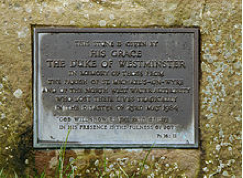
The Memorial Plaque at Abbeystead.
The threat of pollution to aquifers by fracture chemicals that are mixed with the water used to liberate the gas from the parent rock strata in Britain is much diminished due to the expertise of passing borehole drill heads, mineshafts and other devices through water bearing strata for over two hundred years. The UK mining and tunnelling engineering community is at the forefront of best practise and lead the world in these and allied methods of sinking shafts and tunnelling through any strata. The engineer who puts a borehole through an aquifer does not wish to have that water entering the borehole anymore than it is desirable that fracturing chemicals should enter the aquifer.
In engineering terms most aquifers in the UK that are exploited for public water supply are shallow; whilst the gas bearing shale strata are much deeper. There are issues of concern for the aquifer from the flooding of abandoned coalmines that lie below and often adjacent to such aquifers.
Coalmining leads on to the seismic issues of concern; earthquakes being experienced at times of fracturing the shales so as to release the gas from its parent rock. The reality of the ground beneath our feet is that it is never still. Reporting of earth tremors has increased but now these events have been renamed ‘earthquakes’; geology has been spun by tabloid journalise and the media benchmark of the Great San Francisco event of 1906. In January 2013, three seismic events took place in Loughborough within seven days of each other, and ranged from 1 to around 2.5 on the Richter scale, hardly anyone noticed the events but they were reported as earthquakes and not tremors in the newspapers. The scale of seismic activity that is anticipated from the fracturing of shales is below 1 and a worst case in the region of 2.
To illustrate the continual background earth movement theme; the M6 motorway running past Keele University is not noticeably moving while you pass along the road, but time lapse film shows the road moving side to side and waves passing along the carriageway surface. This activity is coursed by subsidence taking place continually in the coal workings beneath the road. Pile driving, acoustic surveys and many other benign ground shaking exploration and development activities are felt across the country on a daily basis with no harm or fear engendered.
With regard to the technologies used at present to fracture the shales other methods are being considered including acoustic, percussive force and freezing amongst them. The future of gas liberation from shale horizons has yet to learn from the water engineers of the past who when wells were sunk needed to stimulate the water bearing strata to part with its resources by fracturing. One such well sunk at Harrow on the Hill, North London used quantities of TNT to set the chalk water flowing from the strata above.
The costs of alternative methods of gas liberation are expected to be comparable though as not proven to the industry’s satisfaction as yet further research is needed.
The other aspect of deep terrestrial boreholes is their usefulness after all the gas is extracted from the strata. These onshore boreholes are what are usually put forward by the carbon capture business lobby as ideal sites of the disposal of CO2. The design of such facilities mirrors those of shale gas well facilities.
The use of chemical additions to the water that under extreme pressure is used to fracture the parent rock are cited by some as a concern, the use of a cocktail of the required additives to ease shale pore separation will be in extremely small quantities and in dilution of parts per million at strongest; only small volumes need be used. Lagooning of the used fracking water on the surface by the wellhead is an American model of working that is not an accepted method in the UK, bunded tank holding and recycling to other sites is considered feasible or treatment at specially prepared sewage treatment facilities is accepted to be a sustainable and satisfactory solution.

Corporate Considerations.
The corporate sectors are increasingly concerned about the shale gas issue, cheap and abundant energy for long periods of time: the fiscal stability of the UK’s energy needs could remove opportunities for developing increased profits. The energy companies are asking for government interventions to limit any future declines in energy prices in the short term so as to cushion a price plateau in the future.
The green energy generation companies, particularly wind farms will require enhanced government and consumer funded subsidy to maintain their place in the energy market alongside that of shale gas. Other alternative energy generation schemes would be called into question including the resurrected Severn Barrage Project.

Swaffham Wind Turbine.
The future of much alternative energy will need to have the capacity to be worked sympathetically together with shale gas: technologies. Those such as geothermal minewater can be run in tandem to the benefit of the environment and generation efficiency.
The present energy generating infrastructure demonstrates the decline in coal powered generation. The ‘dash for gas’ of the 1990s has proved sustainable due to the industry’s ability to import from abroad; Norway, Russia and Algeria particularly.
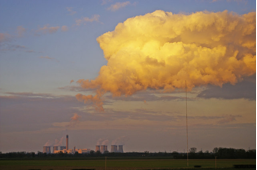
Drax; UK Coal Fuelled Generator
Shale Gas; legal issues.
All land in the UK is held freehold; this allowing the owner the right to enjoy the use of the soil layer, that land can be leased or sold on as the owner wishes. This right of freehold tenure does not allow the owner any right to the minerals beneath the surface soil; energy mineral rights are vested with the state: the rights to precious metals; gold and silver the ownership lies with the monarch directly. Sand and gravel, gypsum, earthen or metals; iron, copper, tin etc, are the property of the holders of mineral rights. These rights can be ancient families, universities or religious orders; seldom are the mineral rights vested with the surface freehold.
Shale gas is the property of the state; as administered in London, though the individual devolved parliaments are pressing for this to be devolved down to them as is the case of the Isle of Man. To explore for, develop and sell shale or other forms of gas you need a Petroleum Exploration and Development Licence for the area in which you wish to operate. The initial license areas are 296 km2. The license requires that prospecting and development capability and financial resources are proven before it is granted: it is then for six years which can be then extended by five more if it is deemed by the Authorities that work is ongoing and a satisfactory schedule of works is in hand. Beyond those eleven years a further grant of twenty may be made so as to allow full exploitation of the resource to be undertaken.
Each licensee is annually charged rent at certain sums per square kilometre on an annually increasing scale to allow companies to divest themselves of any areas that are not to be exploited. This allows for other companies to enter what would otherwise be closed areas and at the same time moving exploration along to the production stages to limit increasing costs of purely holding licensed land away from others who may wish to enter the market.
This difference in property law between the United States and the UK is most noticeable in that freehold in the States is of all that is of and below the surface of the land to the earth’s core. To extract oil or gas requires no license and is dependent on the market for its fiscal regulation; the environmental issues though are rigorously enforced by the local and federal agencies.
To bring a satisfactory conclusion to any development of shale gas as an energy resource once licensed, a formal agreement with the holder of the mineral rights will need to be negotiated. Along side these two issues, formal undertakings with the Coal Authority will need to be signed so as to indemnify the State if any damage is occasioned to coal or abandoned coal working that may be drilled through in investigation and development of any scheme.
PEDL Licence Holders.
PEDL licences are for not shale gas alone, they are for the exploration, development and exploitation of any gas or oil that might be encountered, there are a few oil and gas wells functioning at present on the UK mainland, the best known being Wytch Farm in Dorset. There are a developing number of other production sites in Lancashire, Yorkshire, Lincolnshire, the Midland Valley in Scotland and else where. During the Second World War the area known as Kelham Hills in Nottinghamshire produced vital oil supplies.
As an example of how an onshore oil and gas borehole operation functions can be seen at Wytch Farm where it takes in gas and oil via pipelines from two smaller operations in Dorset and then passes the gas into the national gas network via a linked pipeline to Sopley, north of Christchurch, the oil is pumped 53 miles to the far side of Southampton, from where it is loaded onto sea going tankers. The site also produces LPG which is transported by road tankers.

Wytch Farm Oil Well.
There are many license holding companies, some purely a name only and are consortia of sectoral specialist companies, others such as Alkane Energy who run several successful coal seam methane power generating units from abandoned coal measures in South West Yorkshire/ Nottinghamshire coalfields, also hold PEDL licences in Lancashire, the West Midlands and South Wales (eight in all). The only active shale gas company is Cuadrilla Resources who are extracting natural gas from the sandstone at Elswick, the fracturing of the strata took place in 1993 and the gas is used to produce 1 megawatt of electricity which is placed directly into the national grid. The company holds ten PEDL licenses from the North to Cowden in Kent.
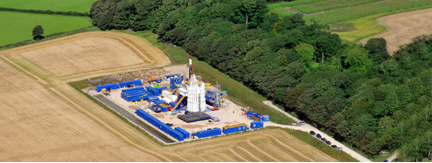
Cuadrilla Resources’ Operational Site.
Dart Energy own four PEDL licences for areas in Scotland and the Borders which are at present being developed for production of coal bed methane.
There are many other license holders though many less than there were ten years ago; there were many speculative investors at that time hoping to be able to benefit from a possible rapid development in coal measures derived gas.
Potential Shale Gas Markets.
Shale gas has the potential of being of a quality that will require little ‘polishing’ when brought to the surface so that it can be fed directly into the gas grid across the country. The reasons for this are several fold, but principally the required borehole environment after the fracturing of the shale is carried out: once the frack water is removed, a ‘dry’ atmosphere is maintained within the well to encourage the gas to flow from the target strata.
There are several other potential options that may be considered, such as the creation of generation hubs that supply both gas and electricity on smaller regional or local needs networks such as communities or major industrial energy users. Local supply sources would allow a company to be insulated from energy price increases, or energy starvation brought on by national or international events.
The likely available shale gas on the scale now envisaged has yet to be fully appreciated with only recent realisation of the potential volumes accessible: certainly all the present gas powered electricity generation facilities in the UK would function using shale gas as their fuel stock.
Harvey Wood Dip AD, FRSA, FRGS, FGS, FLS
February 2013.