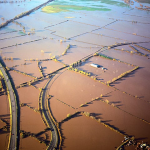
Since the last meeting of the Trustees on 13th June 2016 work has been carried out on a number of research areas, Red Media research into minewater remediation, salmon stocks levels in UK and Europe and their relationship to global warming and climate chaos, groundwater characterisation and movement including its relationship with stream and river flows in areas of metamorphic intrusion: including consequential issues relating to abstraction for both irrigation and bottling of table waters.
The Trust has had news of progress of both the wetland and stream reinstatement projects at Wainsgrove and has been invited by the Environment Agency to take an interest in the Derbyshire Derwent Partnership and Bottle Brook Projects.
Salmon.
As outlined by Dr Melody Stokes the prognosis of the North Atlantic salmon is not good: global warming and climate chaos being put at the top of the agenda as reasons for this calamitous decline in this remarkable fish. Since the meeting research in the field has been carried out in both the UK and France and with the latter location (please see web site article) it is surprising any salmon run at all due to the multifarious issues and problems that have impeded or poisoned their progress over the last 70 years. I feel personally that a creature that can struggle through the remarkable set of obstacles to survival warrants support.
Research carried out on the River Loire, can be seen on the Trust web site.
Red Media.
The Trust has been helping to reconfigure the structure of the pellets by which this compound may be utilised as well as their formulations over the last 18 months. The progress has been very satisfactory and some of the major shortfalls have now been satisfactorily resolved making the pellets not just suitable for minewater treatment but for the removal of phosphates from sewage treatment works waste waters and for the spent pellets to be used as a nutrient supply for agricultural use. The fact that they act as a slow release fertiliser without further modification is an added bonus.

Minewater, Rio Tinto, Spain © CRT 2014
The Trust has been looking at proposed areas for their use in a range of locations: Finland, New Zealand, US, Spain, Bangladesh and Chile are all possible locations for trials in the next year. The Coal Authority are now happy with the report of the Devon trial which led to CRT involvement. The Environment Agency have also sanctioned the product use and are more than a little surprised as to pellet reliability and lifespan as a treatment material. The costs of the product have become less that the ubiquitous lime dosing which has been the benchmark treatment method for most active treatment facilities.
Ground/Surface Water Interaction in a Metamorphic Zone.
The Trust has been looking at the two rivers that interact with the Mount Etna volcano in eastern Sicily. There are two rivers that rise close to the intrusion from limestone aquifers and then flow into the igneous zone. This zone feeding the rivers to a considerable degree. This being demonstrated by the summer draughts where the rivers dry out till the igneous inflow begins. These variable source rivers are similar in many aspects to those ‘bourne’ streams and rivers found along the South Downs of England.
The correlation is remarkable in that the flow lines of the English rivers corresponds to the overlay of marls as in Sicily this can be seen as the junction between the country rock and the intrusion. This is though where the similarities end (as far as can be at present judged) as these water are related to the folding of the African Plate sinking beneath that which makes up the European.
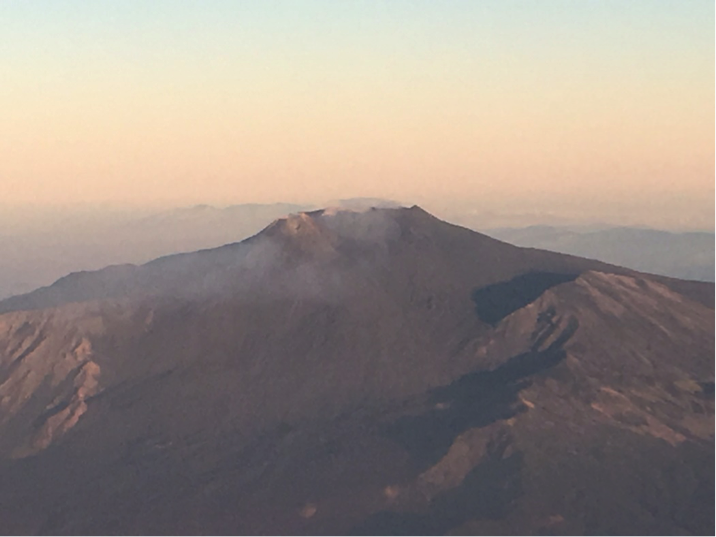
Mount Etna CRT 2016
Surprisingly the water being expelled into the river systems is not sea water or chloride rich but highly mineralised potable quality water not unlike many of the table waters available on the island and some sold in the UK (St Pellegrino). There are a number of pseudo-perched water tables that are exploited for irrigation on the mountain side which bear similar isotopic markers. (This is at present being written up for the web site.)
Wainsgrove.
The news from Wainsgrove is all positive with the wetland now stable with a developing natural fauna, dragon fly, frogs and their growing juveniles and newts. The group are planning to put in a proper sluice instead of the cobbled together plank structure in place at the present. CRT have recommended this work is carried out in the late autumn.
The stream that fills the Hall Lake and passes through the community woodlands is now running again. The quarry company has carried out the required works to regenerate the local aquifer so that the stands of ancient beech and holly are safe for the time being.
The Trust has put its stance as to Fracking online as was discussed at the last meeting. A short myths and factoids piece will be published before the next meeting.
Dear Trustees,
I hope you agree this has been a well spent summer.
To remind you the next Trustees meeting is on Monday 5th September 2016 at Pauls offices in Nottingham at 10.30.
Harvey Wood.
Director.