Introduction
The Clean Rivers Trust has a 25 year history of involvement with water courses and remediation of polluted water. This has brought the Trust into areas of mine-water research and consultancy, alongside academic and environmental organisations around the globe. As such, the Clean Rivers Trust has long held an interest in use of mine-water for district energy. To achieve the UK’s long-term goal of an 80% reduction in carbon emissions by 2050 (from 1990 levels), the Department for Energy and Climate Change (DECC) is encouraging use of renewable heating systems, notably heat pumps. There is a rising level of interest in use of low temperature sources of heat for district heating, not only in the UK but also across Europe. DECC is currently working on a map of resource for water-based supplies of energy to feed heat pump based systems (including surface and underground water, expected to be published in 2015). The development of district heat systems based on mine-water is therefore of significant and current interest.
The Clean Rivers Trust, in association with sustainable energy consultants, Down to Zero Ltd, has been investigating the potential for mine-water heating across the UK. The Trust’s Harvey Wood met with the Coal Authority who are supportive of efforts to develop suitable schemes. The focus is currently on sites with a reasonable heat demand but those with future potential are also of interest.
the Trust has met with land owners, property developers, local authorities and other stakeholders, all are interested and looking at the technologys and possible opportunities and ways forward so as to develop an initial full scale UK demonstration.
This document sets out a little more of the potential, briefly reviews the technology and the potential sites. Finally it provides a proposal for a Feasibility Study by the Trust and the next steps.
Use of mine-water for district energy
Heat pumps have been widely used on mainland Europe for decades, especially in Sweden, Austria and Switzerland (where, in 2006, 75% of new homes used them for space heating and hot water). The technology uses a basic refrigeration cycle, which uses heat from an external source (such as ground or surface water) to evaporate a refrigerant. The vapour is compressed and releases heat as it condenses back into a liquid. By using the latent heat arising from a change from a gas to a liquid, a heat pump is able to use relatively low temperature sources to provide higher temperature supplies – literally pumping heat from a lower temperature range to a higher, more usable temperature. By extracting energy from the ground, whether stored solar energy from the surface or deeper geothermal energy, the heat pump is typically able to provide three or four times the input energy in the form of useful heat (this ratio is the ‘seasonal coefficient of performance’ or CoP). The CoP is affected by the temperature of the supply from the ground loop; by using minewater, supply temperatures of over 15oC can yield very efficient heating systems.
Heat pumps can operate in reverse, providing cooling as well as heating. Heat energy extracted in summer months can be stored in the ground loop and further improve the CoPs in the heating season. Supply temperatures from a heat pump are typically around 45oC, which is very suitable for heating systems but require existing buildings to have reasonable levels of insulation and large surface heat emitters. Existing buildings can be effectively heated at these relatively low temperatures. Heat pumps can provide hot water at 50-60oC, although CoP values fall.
Heat pumps are being widely used for commercial buildings, especially in London. Here are a few examples of larger, water based systems already commissioned in the UK:
Kingston Heights: 2.3MW river water heat supply to houses + hotel
The Kingston Heights district heat scheme supplies heating and hot water to 140 new homes and a 150 room hotel and conference centre near Richmond Park. The scheme was officially launched in October, 2013 by Energy Secretary, Ed Davey, who used the occasion to announce a campaign to extend the use of heat pumps based on water sources. The system pumps water from the Thames at the rate of 150 litres/second through a heat exchanger. The water is collected 2m below the river surface, which provides heat at a minimum temperature of 7oC all year round. The system can provide up to 2.3MW of heat and uses heat extracted from the hotel rooms and conference centre to boost heat supplied to the housing.
“Kingston Heights is a great example of how sustainable solutions can help power entire
communities. I want to see a community energy revolution where projects like this are the norm, not the exception”
Ed Davey, Secretary of State for Energy and Climate Change, October ‘13
More details:
http://heating.mitsubishielectric.co.uk/KnowledgeBase/Public/kingston_case_study.pdf
Plas Newydd: 300kW marine water heat system for a 300 year old mansion

A 300kW marine based heat pump has just been commissioned to supply heat to the 300 year old National Trust property at Plas Newydd in Anglesey. The system pumps water from the Menai Straights through a shore-based heat exchanger. The extracted heat warms water, which is pumped up the 30m cliff-face to feed the heat pumps in the plant room in the old stables of the mansion house. The system cost £600K and is expected to save £40K in operating costs (the building used 1,500 litres of heating oil per day in winter). The old oil system has been completely removed.
http://www.nationaltrust.org.uk/article-1355838486323/ and several videos of the system: http://www.dailypost.co.uk/news/local-news/anglesey-mansions-new-pump-harnesses-7160047
Kingsmill Hospital: 5MW heating + cooling system using heat from a lake
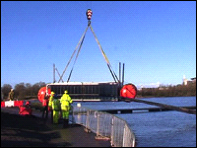
In 2009, a 5.4MW heat pump system was installed to provide cooling for the new Kings Mill Hospital near Mansfield. The hospital is sited across the road from the 65,000 m2 King’s Mill Reservoir, which is used for water supplies and for recreation. 140 stainless steel heat exchangers have been installed under the surface of the reservoir (hidden by floating reed beds). These take heat from the reservoir and the warmed ground loop passes through two 350mm diameter pipes, under the A38 dual carriageway to supply the 42 heat pump units. The heat pumps provide cooling for the hospital and can provide up to 5MW of heating, which is used to supplement the gas boiler system. The heat pumps operate at CoPs of 6.0 for cooling and 3.8 for heating. The temperature difference around the lake-based heat exchangers is no more than 1oC, a requirement of the Environment Agency. The system has not been without problems but is now running well and providing the 300,000 patients who visit the hospital annually with a comfortable environment.
Further information: http://www.gienergy.net/gi-energy-in-your-sector/case-study-kings-mill-hospital/
One New Change
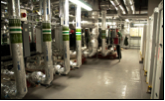

A combined retail and office building was completed close to St Paul’s Cathedral in 2010. The building includes a heat pump system which provides 2.3MW of cooling and 2.4MW of heating under peak output. The site for the building was excavated deep into the ground and the system is partly supplied from ground loops encased in the piling. This is supplied by a pair of open loop boreholes, which extract water from the aquifer beneath the building (London is served by a plentiful supply of water in a chalk aquifer) and return the water around 100m from the supply. There is no net abstraction and the heat is recovered in a heat exchanger. The system continues to successfully supply up to 10% of the overall energy demand of the building.
Further details: http://www.gienergy.net/gi-energy-in-your-sector/case-study-one-new-change/
In terms of mine-water use specifically:
Systems are used in North America, with the most significant at Springhill in Nova Scotia. Here, the flooded mines deliver water at temperatures of around 18oC at the surface and provide both heating and cooling to the surrounding community. There is some net heat extraction but ostensibly, the system could operate indefinitely. The system supplies 10 non-domestic buildings, including a community centre, commercial buildings and an ice rink. The system cost $600K but saves around $80K per year on energy costs.
Further details available here:
http://www.geothermal-energy.org/pdf/IGAstandard/WGC/1995/1-jessop.pdf
Video of the plant available here: http://www.youtube.com/watch?v=JDXkBGp0qPQ
In Europe, the most significant system using mine-water is at Heerlen in the Netherlands. Mine-water is pumped to the surface at temperatures reaching 35oC. The system is used to heat and cool 440 new homes, 57,000 sq m new commercial buildings and 84,500 sq m existing commercial buildings.
For more information, see: http://www.energy-cities.eu/Heerlen-the-Netherlands-New-energy
In the UK the Coal Authority Dawden trial scheme plus Alkane’s Markham Vale demonstration project are both successfully using 15kW systems to heat adjacent office space.
In Shettleston, Glasgow a system commissioned in 1999 supplies 16 newly built homes. A 100m deep borehole into the Glasgow Ell seam provides water at 12oC. Heat pumps are used to raise the supply temperature to 55oC. The system is linked to solar thermal and hot water storage and supplies both space heating and hot water to the houses at typical annual costs of £100.
At Lumphinnans, Fife, a mine-water system supplies a 1950s apartment block with 18 flats. Commissioned in 2001, the system uses a 172m borehole into the Jersey/Diamond seam, supplying at temperatures of between 12-14.5oC. A return feed at 3oC is passed to an aquifer above the mine-working.
These are both social housing projects (unsanctioned by the Coal Authority). A recent report by the British Geogological Survey provides further evidence that water sources can provide 40% of the thermal energy requirements in Glasgow.
Report details available here:
http://www.bgs.ac.uk/research/energy/geothermal/heatEnergyGlasgow.html
and visualisation of the resource available here:
https://www.youtube.com/watch?v=1KWgRs5nSt0
Potential UK mine-water sites
There are several options to be considered with mine-water schemes:
Pumping and recovering heat from the surfacing supply:
This may be from a pumping station such as at Williamthorpe or Hartington to protect a working mine or to address an environmental criteria by managing minewater in the abandoned mine systems, to allow for treatment of water at sites to suit the Coal Authority. One such being at Lynemouth in Northumberland where the Coal Authority are about to begin a trial pump and treatment operation adjacent to a suitable land holding.
Other sites that are worthy of consideration include Harworth, Thoresby and Kellingley; all three will have open access to water in shafts and adjacent boreholes
A similar opportunity exists at Carr House where the water levels within that shaft are at present highly variable – a good example of minewater not being a settled or stagnant, ponded, resource. With a flow pattern or patterns constantly moving the water about the abandoned workings ensures that the resource is not cooled due to residual heat extraction. The system may also allow cross-seasonal heat storage capacity, using heat energy from the summer months stored within the subterranean system.
Recovering heat using boreholes
Where pumping is not being carried out for environmental or operational purposes the alternative would be to use closed loops to that take heat from the water whilst at rest within the mineshaft or accessible using existing boreholes; thus avoiding any issues relating to the Environment Agency over mine-water abstraction. This may ease the process and reduce timescales.
Available heat energy
The thermal capacity depends on the geothermal gradient, heat exchange with the walls and circulation of water flow within the mine. There are two basic methods of calculating mine-water energy capacity as used in the Nova Scotia operations and since reused in the scheme in the Netherlands and being used in future EU projects which are;
1/ an estimate of the area mined in each seam, multiplied by the average thickness of the seams, which gives an approximate volume. This figure is adjusted for subsidence and angle of working allowing 25% as a conservative working volume.
2/ uses total coal production from a mine assuming a density of 1500kg/m3 which gives a volume that is then reduced by 25% for subsidence and methods of extraction.
(The two figures will not normally match as the latter does not register dirt or other material removed)
Such methods are not appropriate in the scheme of things where pumping is being undertaken to further other needs such as pollution control or operations of similar nature.
Many UK mines cannot be realistically surveyed in this manner due to numbers of mines being interconnected and linked underground. Also this is because of the nature of many mining areas where historic workings are unrecorded with void spaces in many instances unknown and unquantifiable.
Specific opportunities include:
Daw Mill, Warwickshire
Down to Zero and the Clean Rivers Trust currently have submitted a proposal to DECC via North Warwickshire Borough Council to identify resource need and sizes of load for low temperature/alternative energy in the Borough. This will include the old mine site at Daw Mill along with several others opportunities in the area (Galley Common, Arley, Kingsbury, etc). Proposed use of mine-water to supply future development at Daw Mill may provide benefit to Harworth Estates during future negotiations and discussions both with the Borough Council and with future developers and tenants.
Lynemouth/Ellington.
This site offers a suitable location for an initial evaluation of the concepts involved. The initial scheme will require consultation with all interested parties as swiftly as possible due to the time scales for development of the adjacent site. The main stakeholders include the Coal Authority, Northumbria County Council, DECC, and peripherally the Environment Agency as well as Harworth Estates.
It is important to identify the possible use of the rising main leading the pumped mine-water to the initial treatment module or lagoon. It is this pipe and the water temperature at the surface that can allow for a low cost heat pump scheme to be installed. Alongside this is the development of a proposal that involves the planning authority and their energy/sustainability departments to aid a possible feasibility study that could be prepared ready in advance of the next round of DECC’s Heat Network Delivery Unit funding. An application to this programme will need to come from the local authority rather than from the Coal Authority or Harworth Estates. Round 4 of the scheme will be announced in late summer 2014, with further rounds of the £6M programme to follow. The scheme looks specifically at heat demand rather than supply but this can be used to review the opportunities in the local area and adjacent site (previously used by Rio Tinto for the Alcan smelting plant and now owned by the Crown Estate).
Initial contact with the Planning Officers at Northumberland County Council suggest that there is already significant interest and support for the idea. Harvey Wood will meet with the local authority on the 1st July, 2014 and with the Coal Authority on the 16th August. Regeneration of the site has been delayed due to theft of copper cables.
Other Sites
The three collieries discussed previously (Harworth, Thoresby and Kellingley ) as options are all suitable locations and easily set up to be low temperature, high output operations. The required engineering could be carried out in the capping off of the shafts and developed specifically to the planned specifications of each site.
The Carr House shaft would be a low cost opportunity that could be considered for an evaluation exercise initially with a possible client close by if shown to be viable.
The Environment Agency, the Coal Authority, mining and property companies have access to over 1000 shafts and boreholes that give pathways that might be utilised to manage minewater and other related related resources.
Proposed Feasibility study
The Clean Rivers Trust proposes to continue exploration of sites across the UK.
Initial actions including developing a knowledge of the current aituation and establishing a rapport with estate management personnel/contractors on site working for both the client and the Coal Authority. Meetings together with all the stakeholders. The objective would be to bring together a resolution to develop a sustainable heating and cooling system to allow the economic value and social redevelopment potential of a site to be realised.
As time is usually of the essence, the Trust would propose to begin research and carry it through with a view to present findings within a short timeframe – ideally coinciding with a funding round of DECC’s heat network programme.
A suitable reporting mechanism would be agreed with interested parties, with the Trust proposing to support technical evaluation as well as the business case for commercial evaluation. Harvey Wood, drawing on an extensive network of contacts and prior knowledge of many of the mine-water possibilities, can lead negotiations with DECC, the Coal Authority and the local authority to explore the opportunity and potential funding mechanisms, on behalf of the commissioners.
The Trust, as a registered charity, acts for the benefit of all in relation to the water environment. In cases where it acts as a consultant to a commercial entity, it does request a contribution to the costs associated with the activity. Support to cover expenses and time spent would be appreciated.
Further details
For further information about the proposed study and mine-water, please do not hesitate to contact:
Dr Harvey Wood
Clean Rivers Trust
72 Appleton Gate, Newark, NG24 1LR
Tel: 07885 422428
Email: hwoop@aol.com
Website: http://www.cleanriverstrust.co.uk/