‘For the last 40y, substantial evidence has surfaced on the hormone-like effects of environmental chemicals such as pesticides and industrial chemicals in wildlife and humans. The endocrine and reproductive effects of these chemicals are believed to be due to their ability to: (1) mimic the effect of endogenous hormones, (2) antagonize the effect of endogenous hormones, (3) disrupt the synthesis and metabolism of endogenous hormones, and (4) disrupt the synthesis and metabolism of hormone receptors. The discovery of hormone-like activity of these chemicals occurred long after they were released into the environment. Aviation crop dusters handling DDT were found to have reduced sperm counts, and workers at a plant producing the insecticide kepone were reported to have lost their libido, became impotent and had low sperm counts. Subsequently, experiments conducted in lab animals demonstrated unambiguously the estrogenic activity of these pesticides. Man-made compounds used in the manufacture of plastics were accidentally found to be estrogenic because they fouled experiments conducted in laboratories studying natural estrogens. For example, polystyrene tubes released nonylphenol, and polycarbonate flasks released bisphenol-A. Alkylphenols are used in the synthesis of detergents (alkylphenol polyethoxylates) and as antioxidants. These detergents are not estrogenic; however, upon degradation during sewage treatment they may release estrogenic alkylphenols. The surfactant nonoxynol is used as intravaginal spermicide and condom lubricant. When administered to lab animals it is metabolized to free nonylphenol. Bisphenol-A was found to contaminate the contents of canned foods; these tin cans are lined with lacquers such as polycarbonate. Bisphenol-A is also used in dental sealants and composites. We found that this estrogen leaches from the treated teeth into saliva; up to 950 microg of bisphenol-A were retrieved from saliva collected during the first hour after polymerization. Other xenoestrogens recently identified among chemicals used in large volumes are the plasticizers’ benzylbutylphthalate, dibutylphthalate, the antioxidant butylhydroxyanisole, the rubber additive p-phenylphenol and the disinfectant o-phenylphenol. These compounds act cumulatively. In fact, feminized male fish were found near sewage outlets in several rivers in the U.K.; a mixture of chemicals including alkyl phenols resulting from degradation of detergents during sewage treatment seemed to be the causal agent. Estrogen mimics are just a class of endocrine disruptors. Recent studies identified antiandrogenic activity in environmental chemicals such as vinclozolin, a fungicide, and DDE, and insecticide. Moreover, a single chemical may produce neurotoxic, estrogenic and antiandrogenic effects. It has been hypothesized that endocrine disruptors may play a role in the decrease in the quantity and quality of human semen during the last 50 y, as well as in the increased incidence of testicular cancer and cryptorchidism in males and breast cancer incidence in both females and males in the industrialized word. To explore this hypothesis it is necessary to identify putative causal agents by the systematic screening of environmental chemicals and chemicals present in human foods to assess their ability to disrupt the endocrine system. In addition, it will be necessary to develop methods to measure cumulative exposure to (a) estrogen mimics, (b) antiandrogens, and (c) other disruptors.’
Sonnenschein C & Soto AM. J Steroid Biochem Mol Biol. 1998 Apr; 65(1-6):143-50.An updated review of environmental estrogen and androgen mimics and antagonists.
Such an abstract is hard to follow; 17 years on from this succinct synopsis of the situation in 1998 and much has been achieved, but with changes in government, national regulatory organisations: the changes from River Boards to the National Rivers Authority and River Purification Boards in Scotland to the Environment Agency and Scottish Environmental Protection Agency, plus their natural wastage of staff and retirement over more than half a century the subject is still vacillating between the comic and deadly serious.

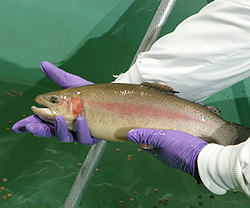
The comic is the world of tabloid journalism in ‘the pill and the mutant trout’ genre, the other is the natural hypothesis that eventually all natural fauna will become infertile except though the test-tube. Human, cow, sheep, duck or fish. All part of a multi layered food chain will fade out eventually.
Now much more is understood regarding the constituent causes of mutation and the major sources are better known. The realisation that so many essential parts of daily life contribute towards the small but significant volumes of materials that may course environmental damage at some particular point. This may be within the river into which the pollution is discharged downstream of a sewage treatment works or it may possibly not impact till it reaches the sea or ocean. It is not a one off exposure that is most damaging but the long term exposure and concentration of contaminants in the subjects’ metabolism: this can be passed on to progeny.
It is a problem recognised now as a developed world issue but as the rest of the world catches up; using pesticides and wrapping food in plastics or in countries like parts of China where much of the first World’s consumables are manufactured can be identified as suffering from oestrogenic or oestrogen mimicking contaminations. The list of materials and their product lists are remarkable; from natural food stuffs such as soy, sunflower seed products and coffee to phthalates, used in the manufacture of films and plastics, lead and arsenic to fire retardants and water purification chemicals and even water filters and the coatings on many tablets to ease their swallowing palatability. These few are illustrative and by no means the only or most important of the materials. These are the ‘stuff of modern life’ and a remarkable synthesis of human kinds’ ingenuity to make life better for the whole species; it could also be the ultimate recipe for extinction.

There are answers, some fanciful; such as changing the way the world’s population lives, but there are ways to limit the volumes that are reaching the environment. It should be said that the volumes are small to start with, at nanogramme per mega-litre and removal rates of between 95% and 98% are achievable. Methods as diverse as Nano filtration; the use of membranes to remove the compounds and there are active methods of adding flocculants to take much material out of suspension. These treatments also may require further residence time within a waste water treatment plant for methods to work satisfactorily. This increase in time from the present operational scale will lead to many such treatment facilities being too small to operate efficiently. It may be argued that some technologies will cut down on treatment costs and timescales elsewhere in the process biofiltration units are amongst the several methods of treating the effluent after conventional treatment and prior to tertiary treatment such as a reedbed or wetland. The costs and other environmental consequences are needing to be factored into the costs of these works as electricity and the consequential increase in carbon dioxide emissions across each water company’s estate.
The capital and running costs, the breaching of greenhouse gas quotas and increases in technical expertise alongside the possible increase in footprint of the sites across a water company’s area goes a long way to putting any organisation off voluntarily installing treatment facilities. This is the stumbling block in this area of concern as each treatment facility will need capital outlay to bring about vital but minimal alterations to treated sewage discharge quality. As has been pointed out already on this web site the decision as to when and how best to do this needs government input as does the mechanism that allocates the sources of funding or is such a major investment to be faced by the population as a whole with substantial increase in the household water bill?