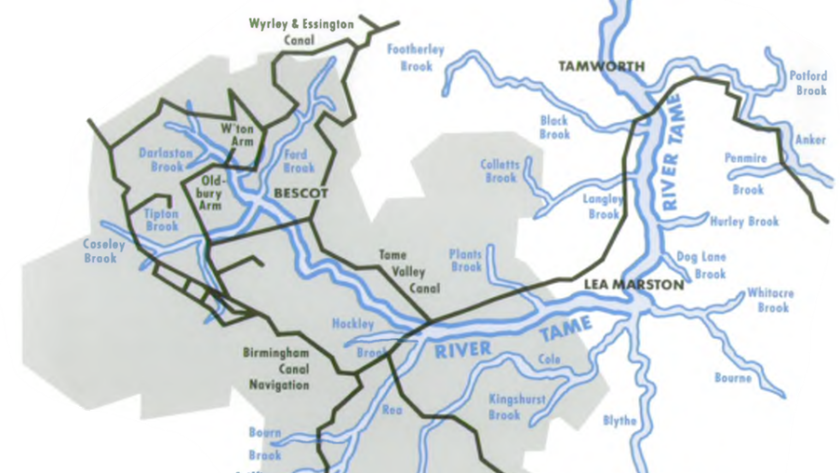
The River Tame flows out of the West Midlands and joins the River Trent north of Tamworth. Up to the 1980s/90s it was thought to be the most polluted river in the UK. There have been many contenders for this unenviable accolade but few have had such justification.

From the time of the Industrial Revolution to the 1980s little existed in the River Tame, no fish, only the occasional sewage worms were found. The lifeless stream was so noxious that when it entered the River Trent it destroyed all life in this great river. The remediation of the river is the sum of actions, time and events.
The pollutions entering the river include; metal working waters, mine water from active mining, and now closed mines; agriculture, transport, urban trash, drainage, sewage, litter, dumping, chemicals, metals, pharmaceuticals, heat from power generation (Hams Hall0, acid rain and much else. Today much of the pollution is similar but not as noxious, industries have closed, recessions work wonders for the natural environment, if not for the human species. Sewage treatment works are now almost fit for purpose, contaminated land leaches pollutants still into the waters of the Tame.
Fish though now live in the river; wildlife has followed the improving water quality as it improves deeper into the city of Birmingham and close by Wolverhampton. Otters are seen in the centre of Brum, herons fish in the Rea where it is not culverted, egrets are also seen regularly.
What Was Done.
In the 1970s it was decided to do something to clean up the river. 1974 being the vital date with reform in local government. Prior to this year sewage was the responsibility of local authorities and Birmingham was not spending much on doing much more than remove the larger fractions of sewage. The rest went straight to the river or its tributaries. Huge volumes of solid waste was dumped into the river along with contaminated soils, foundry sands and similar, rubbish from everyday life, beer kegs and dustbin waste.
The new water authorities that were formed in 1974 had the care of the environment as part of their new remit. Severn Trent Water Authority were minded to start the process of cleaning the Tame. Firstly the sewage system of the Black Country especially Birmingham City had to be rationalised. Many sewage works had literally been lost by local councils. It was not uncommon to find that even the most basic filter beds were broke, rotating arms brokem with trees growing in the bacteria beds. (STW) Minworth Sewage Treatment works was decided on to become one of the largest sewage treatment works in Europe. Many small works closed, their flows pumped, in some cases for miles to the Minworth site.
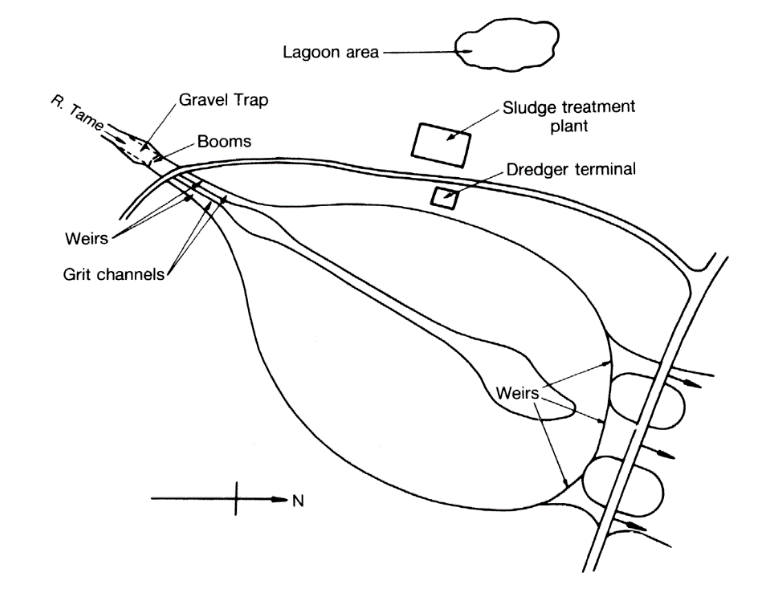
This major infrastructure project made a huge change in the Rivers water chemistry. Sill though huge volumes of waste in the form of litter and contaminated silts entered the Tame River system annually. The authority looked for an area of cheap land that could be used to manage the river as it flowed beyond the Hams Hall power plant. This scheme was modelled on a German innovation on the Ruhr. The authority purchased a series of worked out gravel pits at Lea Marston, a small village in the floodplain of the river which was remodelled and engineered to allow the river to pasb from its restricted channel into a series of broad lagoons. The waters sudden change in velocity allowed the majority of the silts to frop out of suspension.
The resulting silts were then dredged from the lagoons and remediated to a lesser or greater degree, depending on the pollutants. For more than ten years this decontaminated silt load (upto 18,000 tons per annum) was discharged back into the flow. Along side the silts hundred of tons of floating waste, debris of an urban society were removed on screans. This waste was either recycled or went to landfill.
By the end of 1990s the operations on the Purification Lakes was untenable. The Owners of the site had transferred twice since the inception of the scheme, the Environment Agency were unable to continue operating the cleansing operations, one volumes of silt had dropped, costs were escalating and the Environment Agency could not grant themselves the discharge consents needed to reintegrate the silts back into the river flow.
The New Regime.
In time the site has been passed onto the Wildlife Trust and specifically to the Tame Wetland Project which is transforming much of this part of the Tame floodplain. Clean Rivers Trust has supported and where possible advised on the Warwickshire Wildlife Trusts work on both the Tame and Anker Rivers. Similarly, the wetland developments on the Trent by the Trent Rivers Trust.
The old lakes are now being transformed from an engineered site to become a naturally developing, complex wetland system that will be integrated into the larger whole. These are exciting times.
References.
http://ea-lit.freshwaterlife.org/archive/ealit:2370/OBJ/20000935.pdf
https://environment.data.gov.uk/catchment-planning/v/c3-draft-plan/OperationalCatchment/3437
https://www.sciencedirect.com/science/article/abs/pii/S0273122399000566