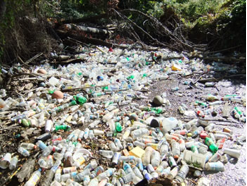
The Trust is regularly contacted by members of the public about drains, ditches and streams that are choked with rubbish. We are regularly asked what we can do about it or who is responsible.
I am not surprised that people are fed up with finding small streams, burns and rivers choked with rubbish; particularly plastic bottles, and carrier bags, usually located adjacent to or close by the edges of public areas; it is a sorry site that perplexes most people, everyone says the same thing ‘some one should do something about it’ and nobody does. It is reported that these sites are dirty and a breading ground and refuge for rats and other vermin.
Now to start, by ending the legend of the mythical rodent lair in the last statement about vermin; rats are not fools, this build-up of rubbish holds neither warmth nor food for them, they find such mess a totally alien environment and a near no go area, which is true for any form of wildlife you can think of. The only sure use rodents may make of such a place is as a convenient crossing point from one bank to the other.
The true concern is that for properties close by such sites: as the stream bed and its banks fill with bottles and bags; silts are held up from the flow and start forming a barrier to water, this can and does regularly block culverts so that roads flood; where water backs up the watercourse it can overtop and enter gardens, garages and homes. If a culvert is blocked and volumes of water are held back that blockage can clear and the whole flooded stream can decant again below the obstruction coursing a wash of water below, that can be damaging to built structures down stream.
Litter that holds water up can allow blue green algae to develop; this is potentially dangerous to both humans and animals including dogs and is to be avoided.
Events such as this are worst case events; on the whole waste filled streams are purely unpleasant, dirty, sordid; unnecessary? Naturally; it is unnecessary for these accumulations to develop, plastic bags, plastic bottles are all part of the supply cycle of modern human society; both are non deposit and when their use has been served they can be thrown away; in a bin at home or in the street litter bin. This though, as the clogged streams prove, is not the case. A breeze empties bins, bags float away for no apparent reason, bottles are seen throwing themselves from car windows, no one person is to blame; it is the bag and bottle that is trying to break free. I wish it were, but society continues to follow the dictum of once out of sight out of mind (for society read ‘we’). Few of us; as individuals, can say we have not thrown/dropped something in the street (missed the litter bin) or from a car.
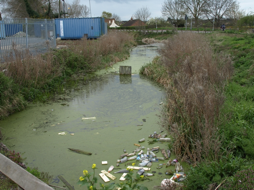
The answer to the question of what can be done rests with each of us in our communities; each area needs its group who is willing to act on society’s behalf. To get stuck in and clean out the stream, and then regularly manage the area; local councils love such groups, they save the council tax from being spent on council staff having to do the job. It is always faster to do it as a volunteer, there is unlikely to be a risk assessment, protocols or method statements put in place; provision of life jackets or other health and safety issues which a council staff member would need to carry out. The council will usually take all the rubbish away once bagged up in sacks that they should provide free of charge. The council might even supply rubber work gloves for a specified number of volunteers.
Once your group of volunteers are agreed to carry out a clean up of a stream and before the day of action reconnaissance is needed: how steep are the banks, how deep is the water, are waders needed, is the stream fenced with barbed wire, have we got permission to access the water from a landowner, can it be achieved from a road or path with nets and grappling hook without getting into the water? A lot of questions to answer but better beforehand than on the day; having to address problems then might hold your volunteers up as their time is precious; it is their free time and you do not want to waste it.
Before the day of cleanup action tell the local paper what you are doing and why; tell them in plenty of time so they might photograph it before mess disappears, they may come on the day and photograph your volunteers in action. This is good in two ways; it shows that people are engaged with their community and doing things to better it and it encourages others to think that it is not good to let rubbish go in the street and put it in bins.
Once the site is cleaned up, keep an eye on it and act again as needed; someone living nearby can walk by with a net to scoop out the odd piece of returning rubbish.
One basic piece of healthcare when coming into contact with river or burn waters; any cuts and scrapes need to be covered with plasters and rubber gloves should be worn. The water can carry disease and basic hygiene; washing your hands before eating food after the cleanup is strongly advised. Keep children away from the water during the cleanup as it is easy for them to drown.
Do not forget that now you are in control.