This is the first of several short outlines of remediation outlines from around the world that have been brought to our attention since we have conducted our initial Cinderhill Project in Derbyshire using phytoremediation methodologies.
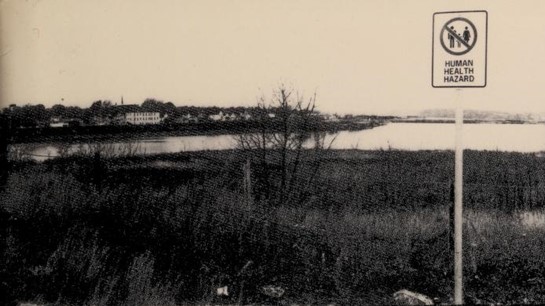
Sydney Pits, Cape Breton Municipality, Nova Scotia, Canada.

This site qualified as one of the most polluted sites in Nova Scotia, which takes some doing. For an area with such an industrial history as this. It was also slowly being cleaned in part by erosion of the estuary bank on which it is located.

The site is over 250 acres in size and was the site of a major steel furnace and manufacturing centre. Historically it started production in the 1880s and continued iron production for over one hundred years. The use of coal first to create the iron from ore and waste and later to produce huge volumes of gas to be used for the same purpose left over 700,000 tons of tar and even more heavy metal waste deposited across the site, much or most being stored in non-engineered or non-lined lagoons, or just spread across parts of the site. The wastes were tars, heavy metals, PAHs, PCBs, and much else.


It is a site that is now said to be safe, clean and no danger to the environment or human health. For many years, from the 1970s the local community numbering around 20,000 people began agitating for the site to be cleaned up. The site in summer was dry and air pollution was bad, metals, gas production compounds such as blue billy was whipped up from the site surface and entered homes and human lungs. In winter, the tar pits and cooling lagoons flooded polluting local streams and the estuary. It also contaminated groundwater and flowed with surface water. Groundwater flowed through the site collecting waste as it went with ground conditions and gradients even depositing arsenic in cellars of local homes.
Methodology.
The 7000,000 tons of tar wastes were mixed in situ with 70,000 million tons of cement supplied by Lafarge. The mixture was created with as little water as possible. The method used required long arm diggers to mix a few square yards of tar at a time with their buckets in cells to the base of the tar. The work was protected from slumping by sheet revetment driven through the tars. This method could be said to be bucket chemistry at its most basic. The cement/tar mixture took varying times to set across the site depending on ground conditions. Once the cells solidified enough, they were capped off by a further cement cap with any infrastructure channels cast into the surface. The whole was covered over with soils and dredgings (contaminated) to form a low-lying landscape including a nature reserve for birders, children’s playground, cycle route, and sports pitches.
The New Role for the Site.
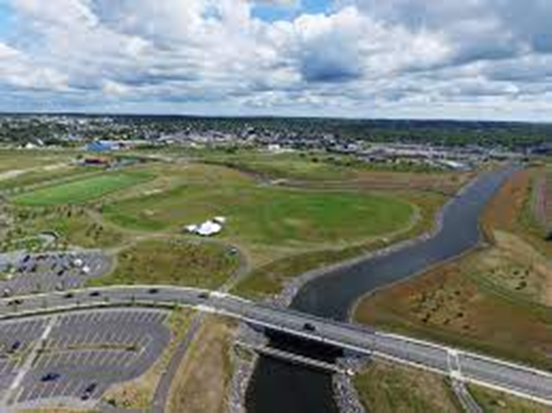
The site was transformed to a public open space, Open Hearth Park.
Responsible Organisations.
Sydney Tar Ponds Agency.
The agency was created as a single operation body tasked with the sole purpose of bringing about the remediation of the tar ponds. This was to improve water quality of the estuary and lock up pollutants within the site, alongside remove the atmospheric pollution that plagued the town.
Consultants.
This project involved a large number of consultancies with multi-disciplinary abilities, starting in the 1980s. As the project outline developed and the initial $40 million tar incineration project failed to deliver the results expected the increased budget was seen to be growing and as this became clear: this was the first remediation on a major scale to be carried out in Canada larger and larger companies vied for the pecuniary benefits of the project
Stantec.
The original concept designers for the landscaping of this project.
AMEC.
Looked at incineration and then junior partnered AECOM in the delivery of the final cement mixing and encapsulation of the tar.
AECOM
AECOM state they provided project management, design, remediation, regulatory compliance, and construction oversight services for the project, which is being managed by the Sydney Tar Ponds Agency, a special operating agency of the Nova Scotia State Government.
Failings.
Subsurface plumes of contamination exist beyond the treated areas.
Continued contamination of the estuary waters, effecting the fisheries due to erosion of the shoreline.
Urban forest planned for some areas of the reclaimed site have failed due to the trees being unable to grow in shallow soils on the concrete cap.
Tar oils are apparently penetrating the concrete mix and cover which has led to the introduction of bacteria sowing across the site, an additional cost to continue remedial works.
The closure of the Sydney Tar Pits Agency in 2013/14. The loss of this steering group has meant that there was a loss in continuity of long-term management of the remediation and the inevitable issues arising from such a project.
Future Actions to be Considered.
The plumes of contamination may best be treated by using trees to place bacteria (rather than costly bacteria irrigation as presently being undertaken). The method used at Cinderhill, Derbyshire has demonstrated its ability to remove all such pollutants.
Tree planting around the periphery of the site to ensure any contamination still mobile is treated within the area.
Comments.
The larger the consultancy is who take on major projects the less innovative the solutions can be, and the costs escalate.
Note.
AMEC and AECOM have over the last number of years worked closely on several projects. In the UK they ran the decommissioning of nuclear waste at Sellafield. The remediation project was a major project, worth approximately £1 billion pounds per annum and planned to last for 120 years. Their contract was removed from them after a report by the UK Public Accounts Committee showed that overspends at the site were felt to be unnecessary.
Harvey Wood. 2022.
Bibliography.
Barlow, Maude; May, Elizabeth (2000). Frederick Street: Life and Death on Canada’s Love Canal. Toronto: HarperCollins. ISBN 978-0-002-00036-9.
Web Sites.
https://en.wikipedia.org/wiki/Sydney_Tar_Ponds
https://www.cbc.ca/news/canada/toxic-timeline-1.888186
https://www.environmentandsociety.org/tools/keywords/sydney-tar-ponds
https://ejatlas.org/conflict/sydney-tar-ponds-contamination-nova-scotia-canada
https://www.youtube.com/watch?v=lg2iVw6KWLk
https://waves-vagues.dfo-mpo.gc.ca/Library/345123.pdf
https://slideplayer.com/slide/4617074/
https://www.worldatlas.com/articles/what-are-the-sydney-tar-ponds.html
https://www.theglobeandmail.com/news/national/ns-tar-ponds-to-be-buried/article17990276/
https://www.jstor.org/stable/26162184
https://www.cens.org/project-spotlight-tar-ponds
https://onlinelibrary.wiley.com/doi/abs/10.1002/rem.21397