Guardian image
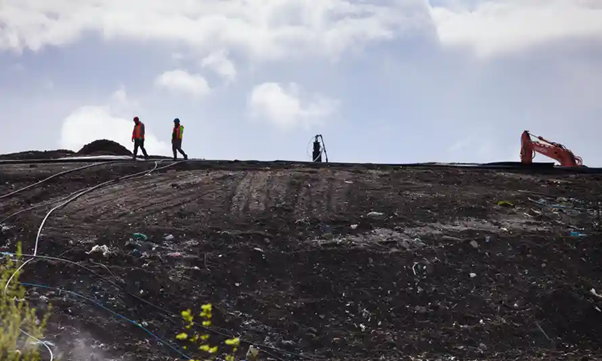
This site has been brought to our attention. The gas/odour venting from this site is causing misery for thousands. See the report in italics taken from the local authority website. Clean Rivers Trust have written to the council offering our help.
‘Multi-agency partners to hold Walleys Quarry community engagement session
Partner agencies are holding a community engagement event about the continued air pollution from Walleys Quarry Landfill site in Newcastle-under-Lyme.
Remedial works carried out by Walleys Quarry Limited to date, which were ordered by the regulator the Environment Agency, appear to have made a small difference to emissions from the site. The Environment Agency has instructed Walleys Quarry Limited to carry out further urgent works including a series of complex and costly engineering solutions.
While the assessment remains that the long-term risk to health is likely to be small, public health partners are increasingly concerned that if hydrogen sulphide emissions continue at the levels seen up until May, the risk to long-term health from pollutants in the area cannot be ruled out. People continue to report symptoms daily, with negative impacts on both physical and mental wellbeing.
It had been hoped that conditions would have significantly improved, after regulator the Environment Agency ordered remedial work and a substantial further plan of action. As part of this work around 50 per cent of the site has been capped and gas capture increased by 500 cubic metres per hour, which is a 20 per cent increase overall.
Hundreds of people across Newcastle-under-Lyme, and parts of Stoke-on-Trent, have reported suffering symptoms such as headaches, feeling sick, and irritation to the eyes and nose; with some people with pre-existing conditions such as asthma being more badly affected.
While partners have been working collaboratively since March to tackle the impact of the operations at Walleys Quarry, due to concerns about how long this situation might continue to impact negatively on residents, a Strategic Coordinating Group (SCG) of Staffordshire Resilience Forum agencies has now been established. This is being chaired by Assistant Chief Constable Simon Tweats from Staffordshire Police.
A report from Public Health England (PHE) Midlands, on air quality monitoring in the vicinity of the quarry from March to May, concluded that hydrogen sulphide levels were above the World Health Organization (WHO) annoyance guideline for between 7 per cent – 36 per cent of the time. ‘
Such air pollution is reminiscent of the acid tar pit at Cinderhill, near Belper in Derbyshire which apart from being carcinogenic, soft, and dangerous to all was venting high volumes of malodourous gases. This odour was both foul and dangerous to anyone coming close to the site, it contained not just hydrogen sulphide but methane and other hydrocarbon derivatives.
The answer we proposed for remediation of that site used a form of phytoremediation that had been and is still being developed by the Trust over thirty years. The use of compost, lime and tree planting stabilises a site, filters the gases and remediates the hydrocarbon acid tars.
Proposal.
Clean Rivers Trust’s methodology may be demonstrated on this site, the costs being low as little engineering needs to be carried out and there would be no intrusive works carried out on site.
The cover could be developed, mixed on site, green waste compost and spent mushroom compost, small amounts of lime and this spread across the site to a depth of 1 foot to 18 inches. The site would then be planted with trees. The most suitable being a selection of willows and possibly other species, for diversity. There would need to be an irrigation system installed to ensure that the planting was watered over the first few years of establishment.
The willows would allow gases to pass through their systems but removing the odour in so doing. The compost working in a similar manner.
The smell issue would be noticeable lessened within a fortnight to four weeks of installation on the site. The odour would be removed within six months of the willows and other plants establishing on the site. A total time scale of nine months from start to finish.