Clean Rivers Trust charity no. 1037414
Edgbaston
Birmingham
B15 2UX
www.cleanriverstrust.co.uk
July 2021.
A Potential Strategy for Developing a Brownfield Site Whilst Actively Remediating Areas of Contamination During and After Development.
Produced by Professor Harvey Wood FRSA, FRGS, FGS, FLS. Director; Clean Rivers Trust.
Introduction.
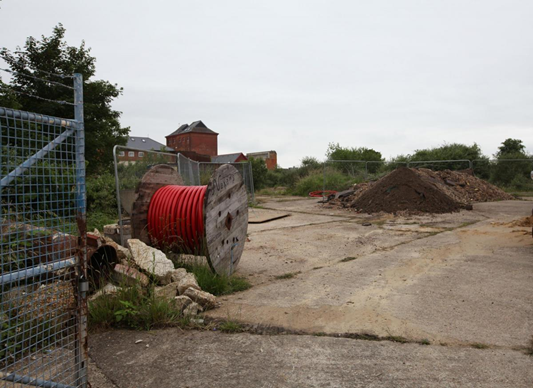
Much brownfield land lies dormant due to the problem of contamination of some part of the site. Contaminate land is an expensive add on to most redevelopment. The local authorities and the Environment Agency both need to see contamination issues addressed prior to development start up because they know that the contamination is only going to be covered over with concrete to stop surface water moving the pollution elsewhere or spreading from its core.
Regulators prefer the standard approaches of either treating the pollutant on site or it being excavated from off the site for treatment. Both these options are costly and if one has invested in land there is going to be no return until the site is able to be developed. Contamination within the confines of a site is costly both in time and interest payments. The removal of many contaminations from development land are exceedingly costly and time consuming. The cost being often prohibitive.
This short paper is put forward to outline alternative strategies that would allow both the development of land and the treatment of contaminants to be carried out in tandem with development and to continue after completion as a design gain for the redeveloped sites.
Outline.
The development of a site requires the maximum available space, floor area, factory space to be generated into any design that might be realised as swiftly as possible. The development needs to generate income from that space and needs be as large as the site allows.
Contamination on part of the site stops this and as already stated brings development to a halt. Careful design though that engages with the limitations of contamination, which in each case is unique can lead to more adventurous design of new structures that need not be less profitable.
Clean Rivers Trust Expertise.
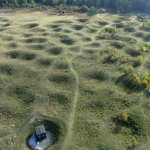
Cinderhill, Derbyshire.
The site needed to be stabilised, the acidity (pH0 to pH1) needed to be ameliorated, tars broken down, public access denied, odour from hydrocarbon lessened. These were achieved in months, other benefits included site gases vented safely through plant systems and PAH carcinogens were broken down and neutralised. The site is now a small woodland with a diverse flora a d fauna.
His Majesty’s Chemical Works, Forest of Dean.
The wood chemical products site we identified to the Deputy Gaveller of the Forest of Dean. Sheep were dying; poisoned from eating contaminated vegetation, this was exacerbated by carrion animals and birds consuming fatalities also dying. Trees were weeping acid from bark lesions. Remediation of the site being carried out with the support of the local Forestry Commission to remove the problems using natural methods of decontamination.
Minewater Pollution.
The Trust has worked on research into natural methods of minewater pollutions (both coal and metalliferous) since its foundation 31 years ago. The use of aeration, wetlands, reed beds and plants such as willows in carr systems have all been found to work satisfactorily. The Trust has been involved in more than 50 minewater projects in the UK and several in Europe, Germany and Romania being the most notable.
Arsenic Stabilisation, Cornwall.
The Trust has worked on arsenic remediation methodologies for 27 years using natural by-products of mining and refining methods. The use of grasses to bind toxic metals and reverse their natural water solubility have been pioneered.
Armament Factory Drainage, Yemen.
The use of wetlands to remove both historic contamination alongside new pollution carried out of an arms factory which was having severe effects on local peoples’ health.
Aba Samuel Reservoir,
Time Scales.
Time scales are variable and erratic as plant-based methods rely on the elements of weather and the nature of the land that planting is taking place in. a moist rich soil in warm conditions is apt to grow and work faster than a site where it is arid, with poor soil and the winters are cold and long.
The use of phytoremediation even in the later scenario should not be precluded as an option.
Cost Benefits.
There are costs to contaminated land remediation, but with the options available using these methodologies require less engineering and can be carried out during and after the site’s development these are negligible. More fundamental or traditional clean up options are often needing time to finance and carry through prior to the building of any development. The long-term care will add little to site maintenance costs or the most part: ground keeping and plant health being the major factors. The green space created by the remedial works can be developed as an oasis space in which workers can relax at break times.
Ethiopia.
The lake was a defunct hydroelectric dam reservoir used for fishing and irrigation but filled up with sewage from the capital Addis Ababa. The site is again supplying power, there are fish stocks, water for agriculture as well as a new eco tourist industry developing. The use of reedbeds and carr systems to remove/treat the sewage problem being found the most cost-effective solution going forward. This scheme was put in place by Chines officials over the last years.
Phosphorus, Europe.
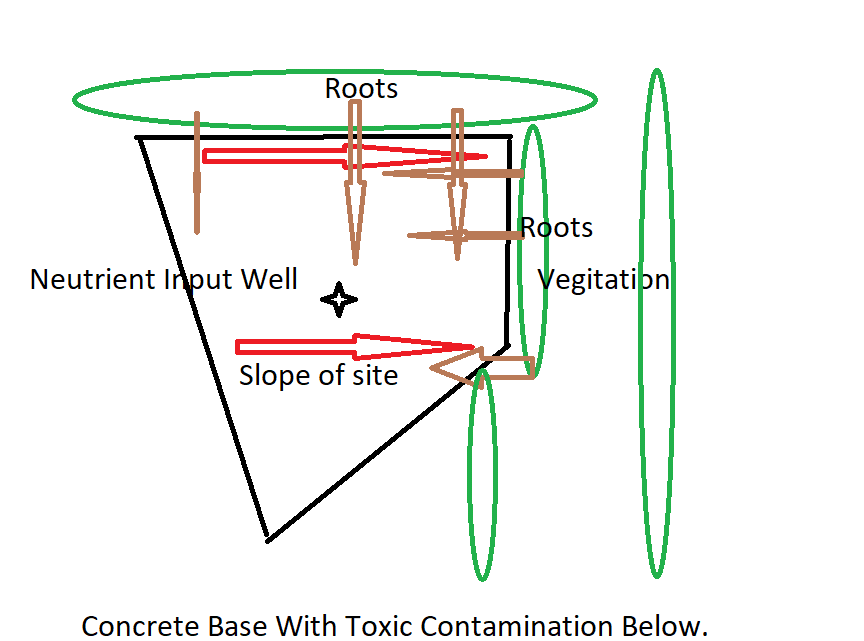
A multinational company that uses elemental phosphorus and has done for more than 100 years has several sites in Europe that are highly contaminated. Their main problem was the stopping of polluted liquids escaping through their sites as well as treating the contamination on site. One area of serious pollution is beneath a major concrete plinth that is unable to be moved. Willow and other carr system plants now surround the concrete treating the contamination, accessing the material with their roots.
Design Parameters.
The owner of a brownfield contaminated site recognises that there will be substantial costs involved regarding the development of the land has at present to accept that income generation is held up and the site it is in limbo.
If one can pinpoint where the contamination is, the design for the whole site might be developed to mirror it and its remediation. If it is intended that natural methods are to be employed on a site to remove contaminants the whole could be factored into the design. This might include flyovers of road systems on the site or second or third story bridging of industrial units. Options are various and would allow the remedial works to be carried out around and beneath the new infrastructure.

Time Scales.
Time scales are variable and erratic as plant-based methods rely on the elements of weather and the nature of the land that planting is taking place in. a moist rich soil in warm conditions is apt to grow and work faster than a site where it is arid, with poor soil and the winters are cold and long.
The use of phytoremediation even in the later scenario should not be precluded as an option.
Cost Benefits.
There are costs to contaminated land remediation, but with the options available using these methodologies require less engineering and can be carried out during and after the site’s development these are negligible. More fundamental or traditional clean up options are often needing time to finance and carry through prior to the building of any development. The long-term care will add little to site maintenance costs or the most part: ground keeping and plant health being the major factors. The green space created by the remedial works can be developed as an oasis space in which workers can relax at break times.