Introduction and the Regulators Actions (to May 2023).
Clean Rivers Trust has been contacted by a concerned user of Whitehaven Harbour. Since the end of November 2022, the harbour has been polluted by red or orange water and no one is telling interested parties what it is.
It is minewater that has risen to the surface somewhere within the Bransty Beck catchment which is culverted into the harbour.
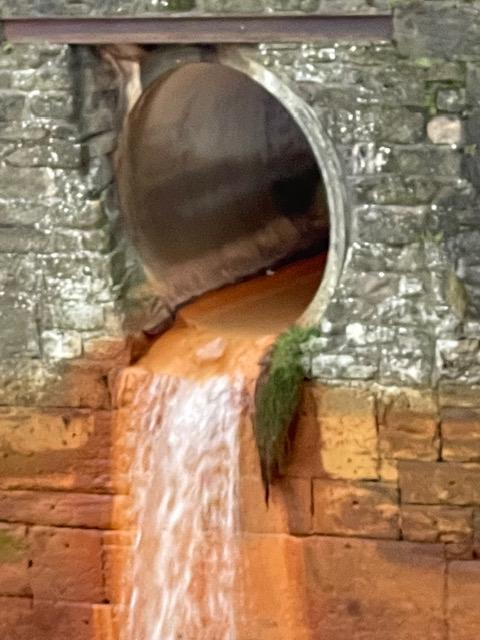
Minewater entering the harbour
The Environment Agency said that there are some elevated levels of metals in the water and that they are taking further samples. They do state it is not sewage. The Coal Authority has said that it may be minewater and are now in the process of finding its source which may take some time. They state that the water will need to be rerouted from the harbour and sent somewhere else. At this point they do not speak of treating the pollution. The Coal Authority and Network Rail are looking at possible linkages between the railway tunnel beneath Whitehaven and old mine workings and drains to the beck. This will, Network Rail say, see who might have to conduct remedial works. This statement alone is interesting in that the tunnel has been in existence for 150 years and no previous pollution to the harbour of this nature has occurred.
The colour of the water entering the harbour and the mining history of the area ensure the that the source of water is from an abandoned coal mine. The Coal Authority is the body vested with the responsibility to mitigate the environmental damage or threat to the environment. The involvement of Rail Track suggests that there is a concern for the railway infrastructure of the Cumbrian coastal line, the loss of the Whitehaven section would likely have serious implications for the Sellafield Nuclear Establishment a few miles away and an important rail customer.
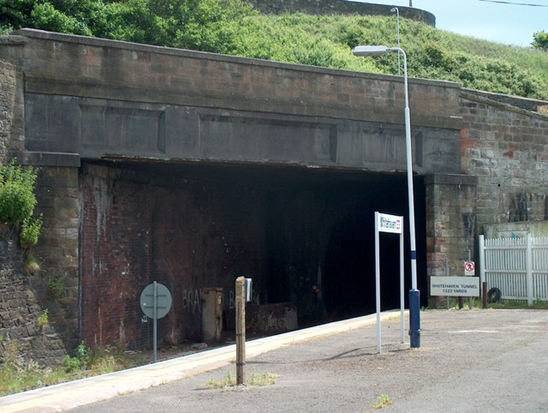
Bransty to Corkickle Railway Tunnel – Harold Potts
Minewater Pollution.
Minewater is the drainage of rainfall or and sea water that percolates into mines when they are created and from their first sinking has to be managed to allow material to be mined. Prior to the invention of steam driven pumps minerals and metals below the local water tables could not be won without some other draining like adits taking water away from an area to somewhere lower. These methods were expensive and time consuming.
Today there are no major deep mines operating in the Uk (though still a handful of hobby or man and dog operations do exist). Once mines close the pumps are no longer operated unless to protect linked mines down dip of the closed operations. Once coalfields close entirely no pumping persists, and mines fill with water and in many instances spill out into the natural environment. The waters that emerge carry the markers of the geological makeup of the mines. The most obvious indicator being iron which as in the Whitehaven Harbour incident stains the water and the sediments ochre or orange.

Whitehaven Harbour
This iron often only shows its presence as oxygen mixes with the water and forms scum and deposits of Iron hydroxide. Apart from iron one might encounter a number of other metals present in the water discharge: aluminium, copper, manganese, zinc and much else. The water acidity may be acid, neutral or alkaline. All depends on the bacteria and geology within the old mine workings. No two mines are the same and neither are their waters.
Across the United Kingdom there are thousands of kilometres of rivers and streams impacted by such pollutions. The Coal Authority manage more than 70 minewater treatment works with more than 300 planned going forward into the future. No two treatment schemes are the same due to the individuality of the waters surfacing but many are known as passive, wetland operations whilst others, either due to space constrains or water chemistry are active treatment sites. These may require chemical, or lime dosing, filters, or other engineered solutions.
Depending on mine depth and complexity and number of seams or lodes worked beneath the ground water can take years to come to the surface, some never do, and others have to be pumped to protect aquifers. The maintenance of minewater management once it begins is in reality an open-ended commitment that may continue in perpetuity.

The Marina section of Whitehaven Harbour
Whitehaven Mining.
Whitehaven was the centre of Cumbrian coal mining from the at least Medieval period through to the late 20th Century, with a new coal mining enterprise granted planning permission recently for winning coal from beneath the floor of the Irish Sea beyond St Bee’s Head.
There are many mines situated to the north and south of the harbour that are recorded. Several of the mines noted in the following plan would have been developed in the 17th and eighteenth centuries to follow the coal seams dipping down towards the south and west, towards the harbour and out under the sea.
Many of the pits marked upon the following plan follow on and into older workings that followed coal seams that were worked from the outcrops of the seams to the east of the Town. Many of the mine workings both link workings from many pits and through drifts to many different levels of mining activity. Mine inspectors reports document that it was possible to travel underground from one side of the town to the other. The mines produced much gas and there are reports of many explosions beneath the surface. There was also a risk of inundation whilst mining out to sea. One colliery, further north at Workington never reopened after one such accident. The link to the sea in that mining area being still open and the Coal Authority mines gas monitoring site in the town is affected by the state of the tides, either expelling out methane or drawing in air. (Records of the Workington Gas and Light Co. 2003)
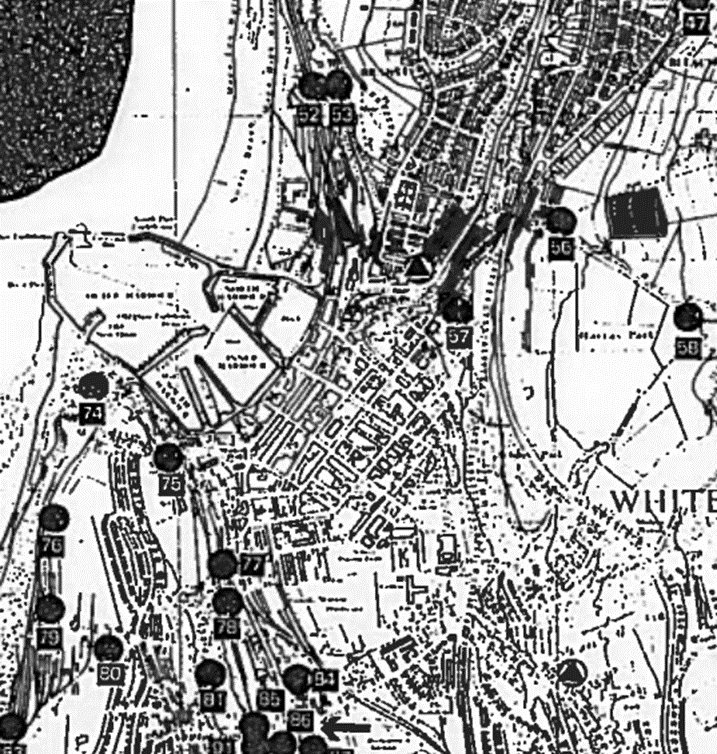
Whitehaven harbour and mines as recognised by the local museum. The circles are mine tops known by name these unnamed are shown by a triangle
Clean Rivers Trust and Whitehaven Mining.
The Trust was commissioned by the chemical company Albright and Wilson to find a new source of water for use of their large factory site to the south of Whitehaven in 1998. The project was successful and delivered water to their site from the company’s own abandoned and flooded anhydrite mine.
The Trust and the company though worked on several other projects over the following 4-5 years. Some of the research investigated coal mine methane and the understanding of water within several interlinked mines across the town. Other research was to identify any sites of possible pollution that might arise in the local area from abandoned mines.
The research required research at several locations including the Coal Authority, Cumbrian Records Office, National Archive at Kew, as well as the Lowther Estate, and the private collection of the retired ex-Manager of the Sandwith Anhydrite Mine (The site of the possible new coal mine that would use the long closed anhydrite mine drifts to access new drifts to reach the coal measures beneath the Irish Sea.)
Over 1 year in hours worked was expended on this research.
Pollution Concerns.
The pollution of Whitehaven Harbour is a major problem for all. News of the event is surprising in that it has not gained the media’s attention apart from the local Cumbrian press and BBC North. To gain action in the UK even photogenic pollution has to be in the south to offend the ‘chattering classes. It appears to still be true that the government thinks it is ‘grim up North’ so not worth worrying about.
The minewater in the harbour is red, ochre in colour and as the weather warms up the surface of the water will develop an oil sheen, as if someone had dumped engine oil into the harbour: this is a bacterial growth of the family that includes Thiobacillus ferroxidans. This will benefit the water quality in that it will help metals in the water drop out into the silts of the harbour but will draw adverse attention to the users of the marina.
The life within the harbour’s water, microbial, crustacea and fish will die off and the water will become, if not already lifeless.
The effect of pollution on tourism is likely to impact the economy of the town that has suffered more than most in the North of England from economic decline.
Yacht owners and there are 400 in the marina are even made of fibreglass are susceptible to damage if kept in acid water for a prolonged period. Owners need to know if the water is acidic.
The Trust’s View of Where the Pollution Emanates From.
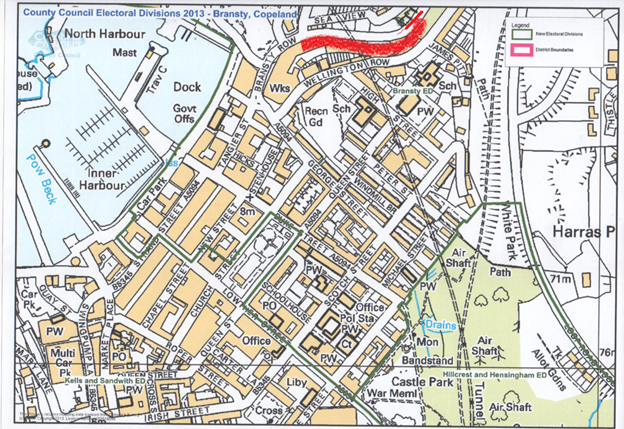
Local Authority plan of the centre of Whitehaven. The red highlight shows New Road, the route o the Bransty Beck prior to culverting beneath the road when it was made in the 18th Century. ‘Whitehaven’s Loop Road avoids the town centre by cutting across Sunny Hill, so to enter the town you turn off at the Pelican Garage and follow the course of a glacial overflow channel which cuts deeper into bedrock as it approaches the harbour. This channel, once just a rocky defile, occupied by Bransty Beck, which did not become a roadway until the beck was culverted and the New Road constructed over it.’ (John Irving ,1990. Whitehaven Streets Tour. Whitehaven.org.uk)
The beck follows the red line of the New Road marked in red on the above plan and is a distance from the drains marked coming away from the railway tunnel by the bandstand in the Castle Park. It is believed this drain takes the shortest route to the harbour via Duke Street and enters the water by the marina at the northeast corner of the ‘Harbour’. The Bransty Beck enters the ‘Dock’ at its northeast extremity.
The lowest level mine entries in the whole of the West Cumbria Coalfield are based around the Bransty Beck and Wellington Road area. Initial research in this area needs to be consider as a more credible site of minewater discharge from the mine system and not from above the railway tunnel.
A brief survey via video deployed into the culverted Bransty Beck would allow this to be achieved quickly and at a minimal cost. Once the source has been identified a scheme to divert the pollution and a treatment plan may be agreed and easily put in place.
Shareholders.
The pollution is being managed by a confederation of regulators, Cumberland Council, The Environment Agency, Whitehaven Harbour Commissioners, The Coal Authority, and Rail Track. News is managed so that no one knows any real detail of the situation outside this group. The users of the harbour are kept very much in the dark regarding research being conducted. Times for research and would be expected to be elastic at this stage and the agencies are not worried that any entity can hold them to any time frame at present.

The Harbour
The harbour was built by the Lowther family, starting in 1634 to enable coal to be exported from the local mines to Ireland. By 1704 around 80% of coal used in Ireland came from Whitehaven. During the 18th Century the harbour was formed in its present form. A nearly complete Georgian port. Apart from coal it was a major importation hub for rum and sugar from the Caribbean and tobacco from North America. Ship building, and repair was a major industry.
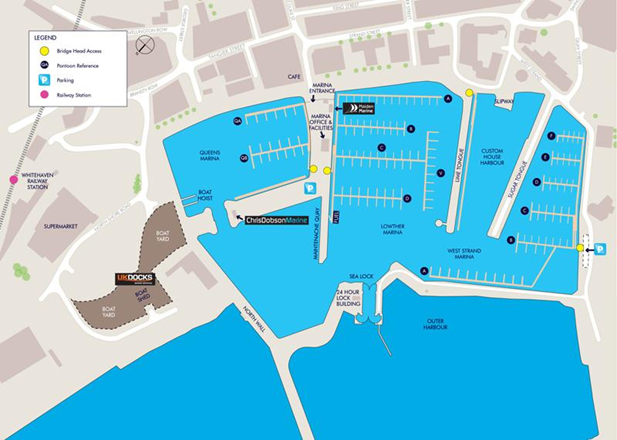
The harbour declined in the mid-20th Century but in the 1960s the importation of phosphate and phosphoric acid from Morocco used at the Marchon / Albright and Wilson Factory.gave it a fresh lease of life. By the 1990s that trade had ceased and the harbour declined until with the sea lock installed in 1998 yachts and private boating allowed for the harbour to reinvent itself. Today 400 yachts and other boats are moored in the harbour.