Mike Wood and I visited the minewater treatment scheme at Dawdon, on the edge of Seaham in County Durham to see the heat exchange system that takes its energy from the thermal temperature of the water pumped from one of the shafts from the abandoned mine overlooking the North Sea an is utilised to heat the Coal Authority offices, laboratory and other facilities at the site. The mine workings are pumped to protect the regionally important aquifer from intrusion or rebound from the chloride and metal rich waters that have flooded the abandoned mine workings that underlie it. There is a second pumping and treatment scheme a few miles to the south, along the coast at Horden. This operation, which was of a similar configuration to Dawdon originally and was put in place earlier, has now been replaced by a passive wetland/reedbed scheme (2012).
The Minewater Treatment Plant.
The water is pumped from the Theresa shaft via rising main 850 metres long to the treatment installation. The treatment that the water receives is very similar to that of Wheal Jane in Cornwall though on a smaller scale. The plant treats 1000 gallons per second of highly ochreous (160 mg l) and with high salinity; the plant does not effect the chloride loading, but the iron is removed to <1 mg l for discharge to the North Sea via a directionally drilled pipeline.
The waters treatment at the plant requires initial dosing by the additions of lime and a polymer flocculent that aid the iron to drop out of suspension in the ‘classic’
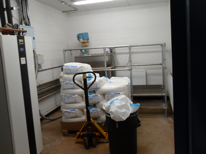
Polymer Flocculent Store
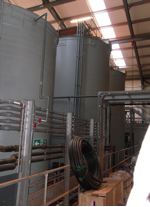
The Active Treatment Plant
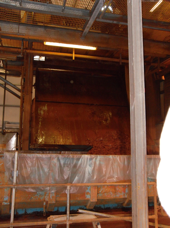
The Ochre Coming Away From the Press
High Density Sludge’ active treatment process: oxygenation, clarification and separation. The liquid fraction going to sea and the ochreous sludge going to filter press for concentration and then going on to become part of a brickworks feedstock. This route for the waste by-product is still an ongoing cost to the Coal Authority, though not as costly as if it were to go to landfill, which is the more accepted route for ochre from other minewater treatment plants. Sustainable ochre uses are hard to find.
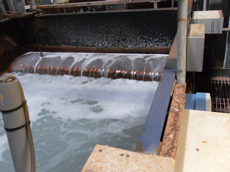
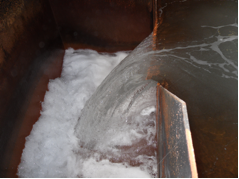
The ‘Clean’ Water on its way to discharge to the North Sea
[It is notable that the water still contains iron that is still precipitating out of suspension when aerated and passing over friction points such as the steel weirs in these two photographs. The milkiness of the discharge water would indicate that not all the flocculent or lime has been flocked out in the process. The same indicator suggests that aluminium is at this stage may be hydrolysing. Other minewaters are known to demonstrate their aluminium content after the iron fraction has been removed (Woolley in West Yorkshire being one example).]
The Harvesting of Minewater Heat.
The treatment works at Dawdon was considered a suitable location to trial the use of minewater as an energy source to heat the various parts of the Coal Authority building housing offices, laboratory and minewater treatment plant.
The plant initially passed a small proportion of the treated minewater discharge water through a heat exchanger to garner heat but due to the incomplete nature of the water treatment the mechanism rapidly became fouled with residual iron ochre and ceased to function.
The reason for this clogging of the heat exchanger will have been because the water during the treatment process has been oxygenated and willing to continue precipitating out. This has led to the reconfiguration of the scheme so that the water is abstracted from the raw minewater as it enters the treatment works.
The water is allowed to increase in temperature, using a heat storage medium so as to exceed the temperature of legionella development in the feed supply. The water then passes out through a heat exchanger and returns to the minewater treatment stream.
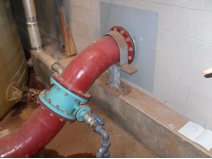
The Abstraction Point from the Rising Main
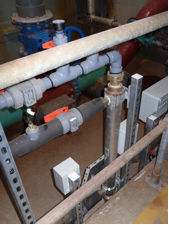
Monitoring Temperature Probe on Insulated Pipe Holding
Heated Medium to Increase Minewater Temperature.
The day before the visit the whole plant had failed, and though the treatment works was operational again the water takeoff from the rising main was not functioning correctly only drawing off a fraction of the minewater that it should have been abstracting. The possibility of an airlock was acknowledged with the fundamental concern that the pipe work in such an instance could become clogged with ochre. The iron in solution meeting oxygen in an airlock would instantly precipitate in bulk. The actual cause was not at this point ascertained.
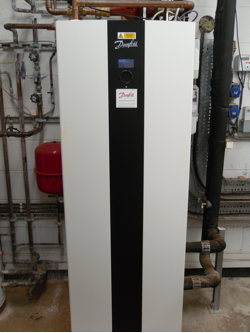
The Heat Exchanger
The scheme though has proved, in the UK, that the use of minewater treatment schemes could be successfully used as a source of heating and cooling. The next stage is to see this technology be developed as it has in Nova Scotia, Canada and Heerlen in the Netherlands.
Thanks are due to Matt Bailey of the Coal Authority for showing off the plant so well and explaining things so clearly.
Harvey Wood.
October 2012.